


IoT SIM cards work by connecting smart devices to cellular networks so they can send and receive data automatically without human help. Unlike regular phone SIMs, they are built to survive harsh environments, connect to multiple networks for reliable coverage, and allow businesses to manage thousands of devices remotely. This steady connection makes them perfect for smart cities, tracking shipments, and automated factories.
Imagine a world where everything around you is awake. Your smart watch tracks your run. A rental scooter on the street corner waits for its next rider. A water meter in a dark basement sends a leak warning to the city. All of these machines talk to each other. They share vital data every single second. But have you ever wondered how they stay connected?
They do not use your home Wi-Fi. They do not have a human operator to type in a password. Instead, they rely on a tiny piece of technology. They use an IoT SIM card. We will dive deep into this technology today. We will look at how they connect, why they are so tough, and how they power our modern world.
Key Takeaways
- Automated Connectivity: IoT SIMs let devices talk to each other and the cloud without needing a person to run them.
- Multi-Network Roaming: They automatically switch to the strongest cellular signal, even across different network brands.
- Industrial Durability: These SIMs can survive extreme heat, cold, and heavy vibrations that would break a normal phone SIM.
- Central Management: Businesses can track, lock, and update thousands of SIM cards using a single online dashboard.
- Enhanced Security: They use private network connections (APNs) and fixed IP addresses to keep data safe from hackers.
- Flexible Form Factors: They come in standard plastic cards or can be soldered directly onto a device circuit board as eSIMs.
📑 Table of Contents
What is an IoT SIM Card?
An IoT (Internet of Things) SIM card is a smart chip. It looks very similar to the SIM card in your phone. But it does a very different job. Your phone SIM is made for calls, texts, and browsing. It is built for one person. An IoT SIM is made for machines. It helps machines talk to other machines over cellular networks.
These cards are built for hard work. They go into devices that sit in remote places. They might go into weather stations, tracking devices, or deep underground pipes. Unlike normal SIMs, they can survive harsh environments. They do not mind extreme heat or freezing cold. They also do not mind heavy vibrations.
The Different Types of IoT SIMs
IoT SIMs come in many shapes and sizes. You can get them in standard sizes. These are Mini, Micro, and Nano SIMs. They look like the plastic cards you slide into your smartphone.
But there is another popular type. It is called an eSIM or MFF2. This is a tiny chip. Workers solder it directly onto the device’s circuit board during assembly. This means it cannot fall out. It is safe from dust, water, and vibration. It makes the device much more durable and waterproof.
How Do IoT SIM Cards Work?
To understand how these chips function, we must look at how they talk to cellular towers. How do IoT SIM cards work when a device turns on? The process is simple but clever.
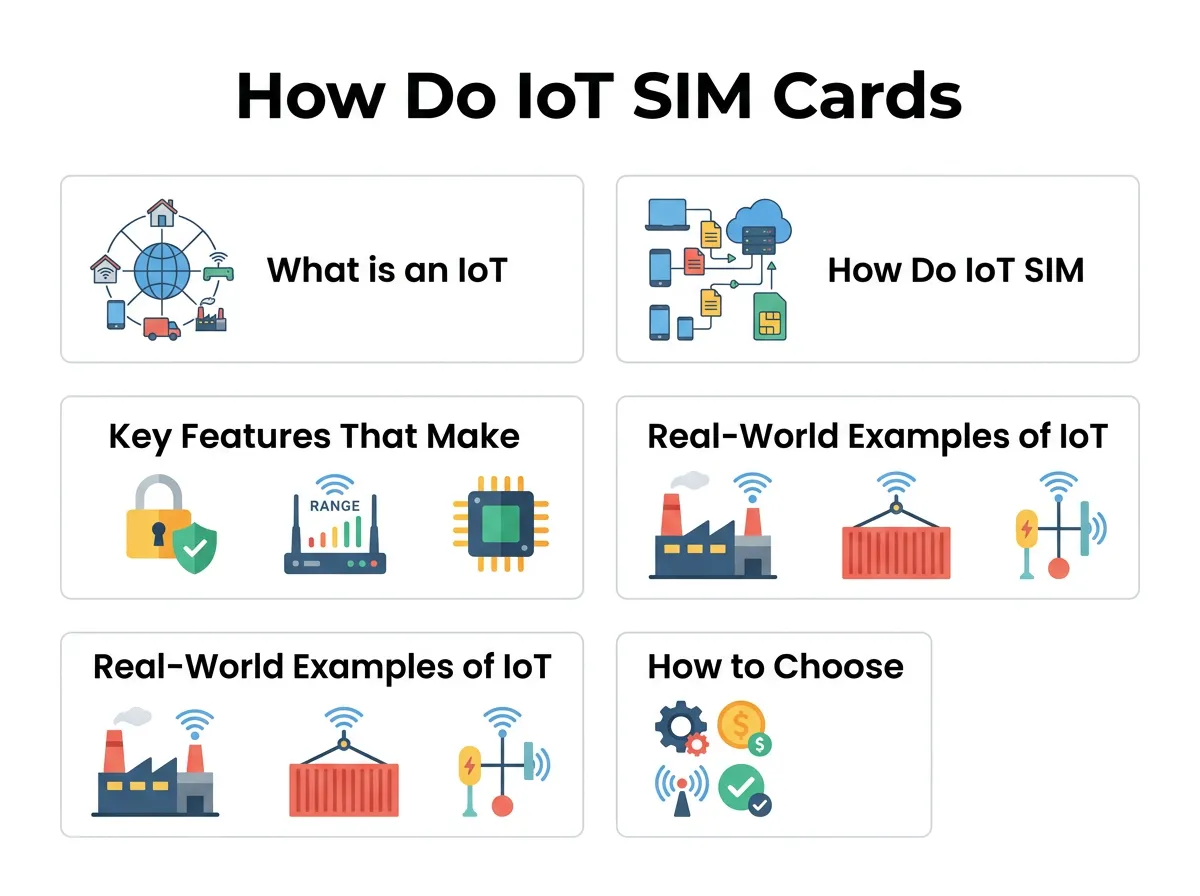
How Do IoT SIM Cards Work? — key points at a glance
First, the device turns on. The IoT SIM card searches for a signal. It does not just look for one network. It looks for any network it is allowed to use. This is called roaming. But it is not like the expensive roaming on your personal phone. IoT SIMs have special agreements. They can jump from one network provider to another. If Network A has a weak signal, the SIM switches to Network B. This keeps the device online all the time.
Second, the SIM authenticates the device. It proves to the network that the device is safe. Once the network approves, the device can send data. It might send a temperature reading or a GPS location. The data travels through the air to the nearest cell tower. From there, it goes straight to the cloud.
This system is very useful when crossing boundaries with SIM cards in IoT devices because they never lose their connection when moving from country to country.
Sending Small Packages of Data
Most smart devices do not stream movies. They do not need to download big files. They only send small bits of data. A smart water meter might send a single number once a day. Because of this, IoT SIMs use special data plans. These plans are designed for low data use. This keeps costs very low for businesses that run thousands of devices.
Key Features That Make IoT SIMs Unique
You might wonder why we cannot just use normal phone SIMs. There are key features that set IoT SIMs apart from consumer cards.
Centralized Management Platforms
Imagine you run a rental bike company. You have ten thousand bikes in ten different cities. Each bike has a GPS tracker. If a bike stops working, how do you fix its connection? You cannot walk to every bike to change the SIM card.
With IoT SIMs, you do not have to. They connect to a central management platform. This is an online dashboard. You can log in from your computer. You can see every SIM card in your fleet. You can turn them on or off. You can see how much data they use. You can even update their software over the air. This saves time, travel, and money.
Advanced Security Protocols
Security is a big deal for smart devices. Hackers love to target unsecured smart tech. IoT SIMs have built-in safety features. They are a safer alternative to mobile SIMs for business security.
They use private Access Point Names (APNs). This means the data travels on a private road. It does not mix with general public internet traffic. Many IoT SIMs also use fixed IP addresses. This makes it easy for your company server to recognize your devices. It blocks bad traffic from getting in.
Real-World Examples of IoT SIMs in Action
IoT SIMs are everywhere around us. We often do not see them, but they keep our world running smoothly. Here are some everyday examples.
Smart Agriculture
Farmers use sensors in their fields. These sensors measure soil moisture. They also track weather conditions. The sensors use IoT SIMs to send this data to the farmer’s tablet. The farmer knows exactly when to water the crops. This saves water and grows better food.
Logistics and Shipping
Trucks and cargo ships travel across the globe. They carry valuable goods. Companies place GPS trackers inside shipping containers. These trackers use IoT SIMs. They help companies track their cargo in real time. This is a key part of logistics and supply chain tracking. It prevents theft and keeps deliveries on schedule.
Smart Medical Devices
Some patients wear heart monitors at home. These monitors track their heartbeats. If the device detects a problem, it sends an alert. It uses an IoT SIM to tell the doctor immediately. This quick action can save lives.
How to Choose the Right IoT SIM
If you are planning an IoT project, you need the right SIM card. Here are a few tips to help you choose.
First, look at the coverage. Does the SIM support multi-network roaming? You want a card that can connect to multiple carriers. This is vital if your devices move around.
Second, think about the environment. Will your devices be outdoors? Will they face hot summers or snowy winters? If yes, choose industrial-grade SIMs or eSIMs. They last much longer than cheap plastic ones.
Third, check the management tool. Make sure the provider offers a good dashboard. You need to be able to monitor your SIMs easily. Without a good platform, managing your devices will be very hard.
Conclusion
IoT SIM cards are the quiet heroes of our connected world. They work behind the scenes to keep our machines talking. They are tough, smart, and secure. They allow businesses to track assets, save resources, and keep people safe. As the Internet of Things grows, these tiny cards will become even more important. Understanding how they work is the first step to building a smarter, connected future.
Frequently Asked Questions
Can I use a normal SIM card for IoT devices?
You can use a normal SIM card for a single IoT device in a pinch. However, they lack the remote management tools, security features, and rugged build needed for business applications. They also do not support multi-network roaming, which can lead to lost connections.
What is the difference between an eSIM and an IoT SIM?
An IoT SIM refers to the service type, while an eSIM is a specific physical form factor. An eSIM is a tiny chip soldered directly onto a device’s board, whereas older IoT SIMs are removable plastic cards. Many modern IoT SIMs are designed as eSIMs to save space and increase durability.
Do IoT SIM cards work globally?
Yes, many IoT SIM cards are designed to work globally. They use special agreements with carriers worldwide to roam across different countries without extra fees. This allows devices to stay connected as they cross international borders.
How much data do IoT SIM cards use?
Most IoT SIM cards use very little data, often just a few megabytes or kilobytes per month. They are built to send small packets of text, like sensor readings or location coordinates. However, devices like security cameras can use much more data.
What is an IoT SIM management platform?
An IoT SIM management platform is an online dashboard used to control all your connected devices. It allows you to activate or deactivate SIM cards, monitor data usage, and set security rules remotely. This tool is essential for managing large fleets of devices.
Are IoT SIM cards secure?
Yes, IoT SIM cards are highly secure. They protect data by using private APNs and VPNs to keep traffic off the public internet. They also use fixed IP addresses to ensure only trusted servers can communicate with the devices.
