


The best IoT GPS SIM card is a multi-network, roaming-enabled M2M SIM that offers flexible data plans, global coverage, and robust remote management. Rather than relying on standard consumer cards, tracking setups benefit most from specialized providers like 1NCE, Things Mobile, or Simplex Wireless because they support low-power networks like LTE-M and NB-IoT.
Imagine you run a fast-growing delivery business. Your trucks are out on the road, carrying thousands of dollars in valuable customer cargo. Suddenly, your main tracking system goes dark on the map. You refresh the screen, but nothing changes. Is the driver offline, or did the tracking device simply lose its cellular connection? This is a nightmare scenario for any fleet manager.
In the world of logistics, continuous connectivity is everything. A minor drop in cellular coverage can cause massive delays, lost assets, and unhappy clients. That is why business owners and fleet managers constantly ask: what is the best IoT GPS SIM card for reliable, uninterrupted tracking? Getting the right card ensures your devices stay online no matter where they travel.
In this guide, we will break down what makes an IoT SIM card perfect for GPS tracking. We will compare them to standard consumer SIMs, look at the key technical features you need, and review some of the top cellular providers on the market today. By the end of this article, you will know exactly how to choose the best connectivity partner for your business.
Key Takeaways
- Multi-Network Roaming is Crucial: Choose an IoT SIM that automatically connects to multiple carriers to avoid signal dead zones during transit.
- M2M Over Consumer SIMs: Avoid using standard phone SIM cards, as they lack the durability, security features, and centralized management portals needed for business tracking.
- Prioritize Low-Power Technologies: Opt for SIMs that support LTE-M (Cat-M1) or NB-IoT, which improve battery life and offer better signal penetration.
- Extremely Low Data Consumption: Most GPS trackers use less than 10 MB of data per month, making specialized low-cost IoT data plans highly economical.
- Centralized SIM Management: Always pick a provider that offers an intuitive online dashboard to monitor, activate, and suspend all your devices in one place.
📑 Table of Contents
- Understanding IoT GPS SIM Cards vs. Standard SIM Cards
- Top Features to Look For in an IoT GPS SIM Card
- Leading IoT GPS SIM Card Providers in the Market
- How Much Data Does an IoT GPS Tracker Actually Need?
- Step-by-Step Guide to Deploying Your GPS SIM Cards
- Finding the Perfect Balance: What Is the Best IoT GPS SIM Card?
Understanding IoT GPS SIM Cards vs. Standard SIM Cards
If you have ever tried to put a standard smartphone SIM card into a GPS tracker, you probably ran into some immediate issues. Maybe it worked for a few days, and then the carrier blocked it. Or perhaps the tracker lost its signal the minute it crossed a state line or a national border. These frustrations are incredibly common.
There is a fundamental design difference between standard consumer SIMs and IoT (Internet of Things) SIM cards. Consumer SIMs are built for high-speed data, voice calls, and video streaming on a single primary network. They are not built for constant, low-bandwidth background communication across diverse geographic areas.
When comparing an iot m2m sim vs normal sim for gps tracking, you will quickly see that M2M (Machine-to-Machine) cards are built specifically for industrial use. They offer global roaming, rugged physical materials, and specialized data pricing designed for small, consistent data transmissions. They also give you deep control over your network preferences.
Network Steering and Roaming Differences
Standard SIM cards are loyal to one carrier. If that carrier has a weak signal in a rural area, your tracker goes completely offline. IoT SIM cards use non-steered roaming. This means they will automatically switch to the strongest available network in the area, regardless of the carrier, without charging you high roaming fees.
Physical Durability and Lifespan
GPS trackers often sit in incredibly harsh environments. They can face extreme heat under a vehicle hood, heavy vibrations on a truck chassis, or freezing temperatures on an ocean shipping container. Standard plastic SIM cards can warp or crack. Industrial-grade IoT SIMs are designed to withstand vibration, high moisture, and extreme temperature ranges.
Top Features to Look For in an IoT GPS SIM Card
When you start shopping for cellular connectivity, you need to look beyond just the monthly price tag. If you choose a cheap provider with poor coverage, you will spend more money fixing offline trackers than you save on subscription fees. Here are the core features you must look for.
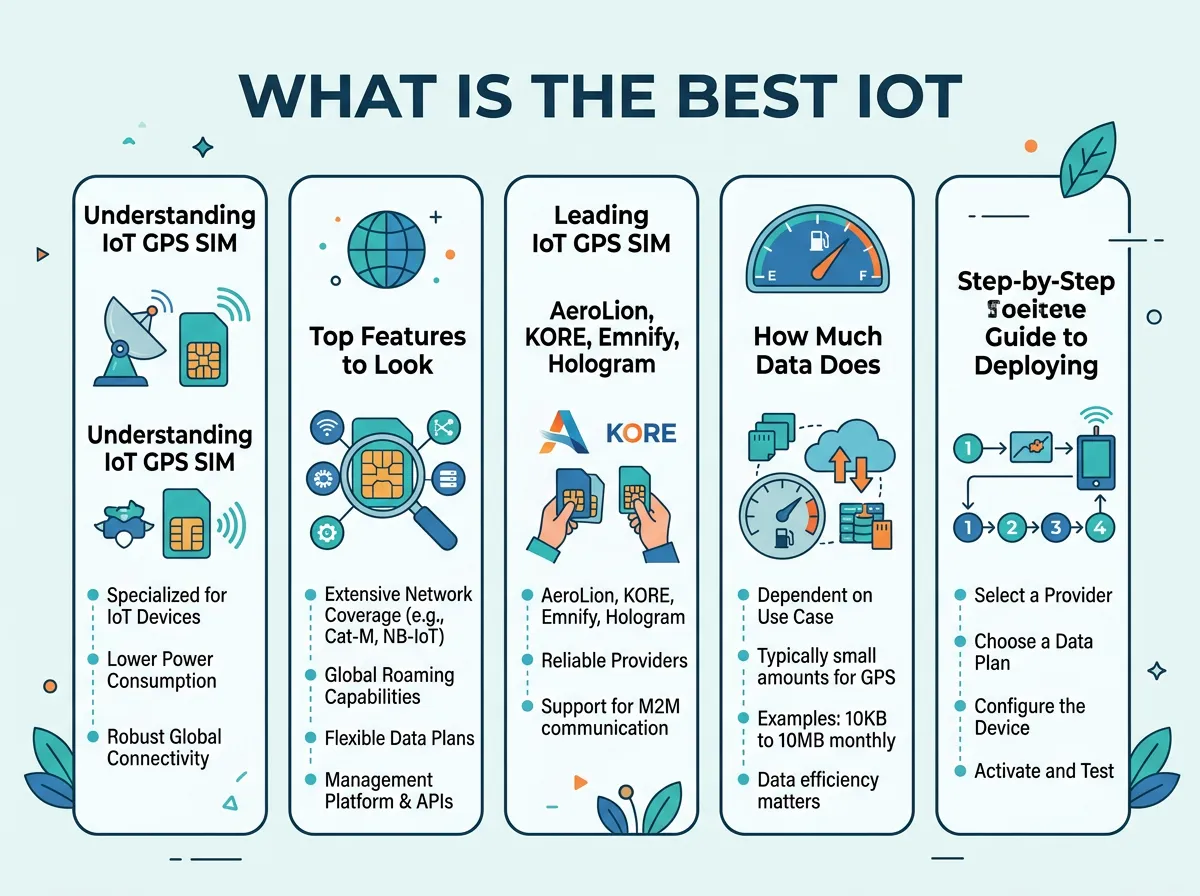
What Is the Best IoT GPS SIM Card? — key points at a glance
Multi-Network Connectivity
A great GPS tracker needs to work everywhere. Your SIM card should have access to multiple networks within each country. If your vehicle crosses a border, the SIM should switch networks seamlessly. This guarantees that your dispatch team never loses visibility of the asset.
Low-Power Technologies
For battery-powered tracking devices, power efficiency is critical. Standard 4G LTE networks drain batteries very quickly. Look for cards that support specialized low-power wide-area networks (LPWAN). For instance, Cat-M1 IoT SIM cards are ideal for battery life in remote tracking setups. They allow your devices to sleep when they are not sending data, extending battery life from days to years.
Centralized SIM Management Platform
If you manage a fleet of 50 vehicles, you cannot handle 50 separate phone bills. You need a central dashboard. A quality IoT SIM provider gives you a cloud portal. Inside this portal, you can see all your active cards, monitor their real-time data usage, and pause or activate them with a single click.
Leading IoT GPS SIM Card Providers in the Market
When searching for the right solution, you will find several key players that specialize in IoT connectivity. Let us look at some of the top providers and what makes them stand out for tracking applications.
1NCE
If you want simple, highly predictable pricing, 1NCE is an exceptional option. They offer a unique flat-rate model that makes long-term budgeting incredibly easy. With 1NCE flat-rate GPS SIM cards, you pay a low, one-time fee for ten years of connectivity. This is perfect for long-term fleet tracking where you want to avoid monthly billing cycles and hidden administrative costs.
Things Mobile
Things Mobile is another major player in the global IoT space. They offer incredible coverage across hundreds of international networks. Their platform is highly user-friendly, making it a great choice for small businesses that do not have a dedicated IT department to manage complex cellular configurations.
Simplex Wireless
If you are deploying battery-powered tracking solutions, Simplex Wireless offers excellent tailored plans. They focus heavily on global LTE-M and NB-IoT coverage, helping you keep your device operating costs low while maintaining maximum connection reliability in remote areas.
How Much Data Does an IoT GPS Tracker Actually Need?
A common worry for business owners is the monthly cost of data. People assume that because a GPS tracker is constantly online, it must use gigabytes of data. This is a common misconception that often prevents businesses from adopting smart tracking.
A typical GPS tracking ping contains very little information. It usually sends just a few text characters containing latitude, longitude, speed, timestamp, and battery status. It does not require high-bandwidth cellular channels.
Calculating Your Real-World Data Needs
Let us look at a simple math example to illustrate this point:
- Imagine your tracker pings the server once every five minutes.
- Each ping is about 100 bytes of data.
- That equals 12 pings per hour, or 288 pings per day.
- Over a 30-day month, that is 8,640 pings.
- At 100 bytes per ping, your total monthly data usage is less than 1 Megabyte (MB)!
Even if you track in real-time with pings every 30 seconds, you will rarely exceed 10 to 15 MB of data per month. This is why specialized IoT data plans are so incredibly affordable compared to standard consumer smartphone plans.
Step-by-Step Guide to Deploying Your GPS SIM Cards
Now that you know what to look for, how do you actually get your tracking system up and running? Follow these simple steps to ensure a smooth, pain-free deployment for your fleet.
Step 1: Calculate Your Fleet Size
Determine how many trackers you need today, and how many you might add next year. Choose a provider that can easily scale with you without charging high activation fees for new cards.
Step 2: Order Test SIMs First
Never buy hundreds of SIM cards without testing them in the field first. Order two or three test cards from your chosen provider. Place them in your GPS devices and run them in your local area to test signal strength, latency, and data transmission stability.
Step 3: Configure the APN Settings
Every IoT SIM card requires you to set the Access Point Name (APN) on your GPS tracker. This tells your tracker which network path to use. Your provider will give you this simple code, which you can usually set by sending a quick SMS command to the tracking device.
Step 4: Monitor on the Central Dashboard
Once your trackers are live on the road, log into your management portal regularly. Keep an eye on data consumption to ensure no devices are malfunctioning and sending excessive, repetitive data packets.
Finding the Perfect Balance: What Is the Best IoT GPS SIM Card?
So, when it comes down to making a final decision, what is the best IoT GPS SIM card for your specific tracking needs? The answer depends on your scale, budget, and power requirements.
If you want a set-it-and-forget-it solution with zero monthly bills, a flat-rate card like those from 1NCE is incredibly hard to beat. If you are building high-end, battery-powered tracking solutions that need to last for years in the field, look for a provider that specializes in LTE-M connectivity like Simplex Wireless. For smaller, highly flexible deployments, Things Mobile offers excellent pay-as-you-go flexibility.
Ultimately, the best card is one that keeps your assets visible, your data secure, and your monthly costs predictable. Take the time to analyze your tracking frequency, test a few options in the real world, and choose a partner with a robust, transparent management platform.
Frequently Asked Questions
Can I use a standard phone SIM card in my GPS tracker?
While a standard phone SIM card might work temporarily, cellular carriers often block them because they violate terms of service for machine-to-machine use. Additionally, consumer SIMs lack the multi-network roaming and specialized low-power features required for reliable tracking.
How much data does a GPS tracker use every month?
Most GPS trackers use very little data, typically between 1 MB and 10 MB per month. This is because tracking pings only contain small text strings of location coordinates and timestamps rather than heavy multimedia files.
What is the difference between LTE-M and standard 4G for GPS tracking?
LTE-M is a specialized low-power network designed specifically for IoT devices like trackers. It offers much better signal penetration inside buildings or under vehicles and drains far less battery power than standard high-speed 4G networks.
What is an APN and why do I need to configure it?
An APN, or Access Point Name, is the gateway address that your GPS tracker uses to connect to the cellular network. You must configure the correct APN in your tracker’s settings so it knows how to route its location data to your software platform.
Do IoT GPS SIM cards work internationally?
Yes, most high-quality IoT SIM cards are designed with global roaming agreements. They can automatically switch between different cellular networks and across international borders without incurring massive roaming fees.
What is a non-steered roaming SIM card?
A non-steered roaming SIM card does not favor any specific network provider when searching for a signal. Instead, it automatically connects to whichever local network has the strongest cellular signal, ensuring your tracker stays online in rural or remote areas.
