


The best multi-network SIM for IoT connectivity is one that offers unsteered roaming to automatically connect to the strongest available cellular signal. By combining eSIM technology, robust security protocols, and a centralized management dashboard, these SIM cards eliminate single-carrier coverage dead zones. This ensures your global fleet of smart devices stays online with maximum uptime and zero manual card swaps.
Imagine you deploy one thousand smart sensors across the country. Some go to busy cities. Others go to quiet farms. Suddenly, fifty of your sensors stop sending data. They sit in a coverage dead zone. Your team now has to drive out to swap their plastic cards. This costs a lot of time and money.
How do you stop this headache? The answer lies in finding the right cellular technology. Many businesses ask: What Is the Best Multi-Network SIM for IoT Connectivity? To answer this, we must look beyond standard phone cards. We need to look at how smart devices talk to the cloud.
In this guide, we will explore the world of smart roaming. We will look at how these smart cards work. You will learn the difference between steered and unsteered roaming. Finally, we will share tips to help you pick the perfect provider for your business. Let us dive in.
Key Takeaways
- Unsteered Roaming is Key: It allows your device to connect to the strongest network signal rather than a carrier’s preferred partner.
- eSIM Prevents Truck Rolls: Modern eUICC technology lets you update carrier profiles over the air without changing physical cards.
- Centralized Dashboards Save Time: A single management portal lets you monitor data, manage bills, and control all global SIMs.
- Data Pooling Prevents Bill Shock: Sharing data across your entire fleet helps balance out high-use devices with low-use ones.
- Industrial SIMs Outlast Standard Ones: Ruggedized SIM cards are essential for outdoor, high-vibration, or extreme-temperature environments.
📑 Table of Contents
Why Single-Network SIMs Fail Your IoT Fleet
Traditional cellular cards connect to just one network provider. If you use a standard card in your personal phone, it works well in your home city. But your smart devices move around. They travel on trucks. They sit in remote utility stations. They live in shipping containers on the open sea. They do not stay in one safe spot.
A single-network card relies on one carrier. If that carrier has a weak signal in a rural area, your device goes offline. Even worse, if that carrier suffers a major network outage, your entire fleet stops working. This can cause lost tracking data, missed safety alerts, and unhappy customers.
Swapping these cards manually is a logistics nightmare. Imagine sending technicians to change cards in thousands of devices scattered across the country. It is slow, expensive, and hurts your business growth. Your business needs a card that adapts to its environment automatically.
What Makes a Multi-Network SIM Different?
A multi-network SIM does not tie you to one cellular brand. Instead, it can connect to many different networks. It acts like a passport that lets your device visit different countries and use their local roads without changing cards.
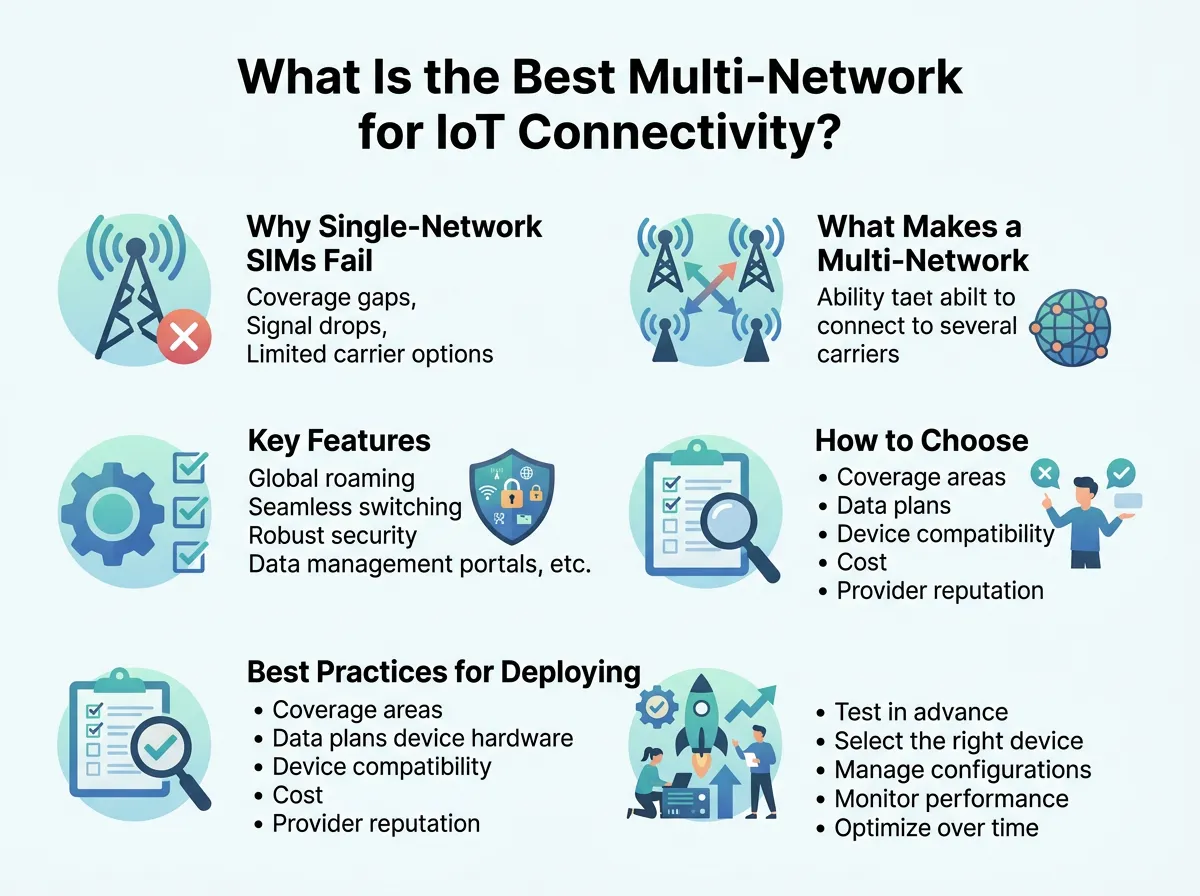
What Is the Best Multi-Network SIM for IoT Connectivity? — key points at a glance
When your device boots up, the card scans the local area. It looks for all available signals. It then picks a network to use. To truly understand how multi-network SIMs operate, you must look at how they handle roaming. If the first network drops, the card quickly switches to a second one. This keeps your device online almost all the time.
There are two main types of roaming: steered and unsteered. Steered roaming forces your card to use a specific partner network. It does this because that partner is cheaper for the carrier. But that partner might have a weak signal in your area. Unsteered roaming is much better. It lets the card pick the strongest signal, no matter what. Always look for unsteered options for your smart projects.
Key Features of the Best Multi-Network SIM for IoT Connectivity
Not all smart cards are the same. To find the best option, you must look for specific features. These tools make management easy and keep your long-term costs low.
eSIM and eUICC Technology
Standard cards are fixed. But modern eSIMs use eUICC technology. This stands for Embedded Universal Integrated Circuit Card. It allows you to change carrier profiles over the air. You do not need to pull the card out of the device. You can send a new network profile through the cloud. Learning the advantages of eSIM for IoT deployment will help you plan for long-term success. It saves you from physical updates in the future.
True Unsteered Roaming
As we mentioned, unsteered roaming is key. Your devices should always connect to the best signal. If Carrier A has a weak signal but Carrier B has a strong one, the SIM should pick Carrier B. This keeps your data flowing smoothly without manual intervention.
A Single, Clean Management Platform
Managing ten devices is easy. Managing ten thousand is hard. You need a single dashboard to view all your cards. This dashboard should let you check data use, turn cards on or off, and set alerts for high usage. It saves your team from logging into five different carrier sites.
How to Choose the Best Multi-Network SIM Provider
Finding the right provider can feel hard. There are many options on the market. Here are the main things to check before you sign a contract.
First, look at the coverage map. Make sure the provider has partners in all the countries where you operate. If your devices travel from the USA to Europe, your SIMs must work in both places without high extra fees.
Second, check the pricing plans. Some vendors charge you per megabyte. Others offer pooled data. Pooled data is great. It lets all your devices share a big bucket of data. If one device uses too much, another device’s low use balances it out. This keeps your bills stable.
Third, ask about security. Your smart devices send sensitive data. The best providers offer private APNs and VPN connections. This keeps your data off the public internet where hackers can see it. When you are choosing the best multi-network SIM for IoT, always put security at the top of your list.
Best Practices for Deploying Multi-Network IoT SIMs
Once you choose your cards, you need to deploy them. Follow these simple steps to ensure a smooth launch.
Test Before You Buy in Bulk
Never buy thousands of cards without testing them first. Get a few sample SIMs. Put them in your devices. Test them in the exact places they will live. Test them in metal boxes, deep basements, and rural areas. This helps you catch issues early.
Monitor Your Data Use Daily
Set up automatic alerts on your management platform. If a device goes rogue and sends too much data, you want to know fast. An alert can save you from a huge bill at the end of the month.
Use Ruggedized Cards for Harsh Places
Standard plastic cards can melt or crack. If your devices live outdoors, use ruggedized SIMs. These are built to survive extreme heat, cold, and shaking vibrations.
The Future of Smart Device Connectivity
The success of your project depends on staying online. A single network failure can hurt your business reputation and your wallet. Investing in a smart roaming solution is the best way to protect your business.
By using unsteered cards, eSIM tools, and a great management platform, you ensure your devices stay connected. No matter where they travel, they will find a path home. Take your time to test different options, study coverage maps, and choose a partner that grows with you.
Frequently Asked Questions
What is a multi-network SIM card?
A multi-network SIM card is a cellular card that can connect to multiple carrier networks instead of just one. It automatically switches networks to keep your device online when signals change.
What is the difference between steered and unsteered roaming?
Steered roaming forces a device to connect to a specific partner network because it is cheaper for the carrier. Unsteered roaming allows the device to connect to the strongest available signal, regardless of the carrier.
Can I update a multi-network SIM card remotely?
Yes, if the card uses eSIM or eUICC technology, you can update network profiles over the air. This means you do not need to physically swap the card to change carriers.
What is a pooled data plan for IoT?
A pooled data plan combines the data allowances of all your active SIM cards into one large pool. Devices that use very little data balance out the devices that use more, preventing high overage fees.
Do multi-network SIM cards work internationally?
Yes, most multi-network SIMs are designed for global use and can connect to hundreds of networks across different countries. Always check your provider’s specific coverage map before deploying.
What is a ruggedized SIM card?
A ruggedized SIM is a specialized card made from tough materials that resist extreme heat, cold, and physical vibrations. They are perfect for outdoor sensors, industrial machinery, and vehicles.
