


The best multi-network SIM for IoT depends on your specific coverage needs, data usage, and geographic reach. For most global deployments, an eUICC-enabled SIM that supports dynamic network switching and local profile provisioning offers the most reliable, future-proof connectivity. Choosing a provider with robust management software ensures your smart devices never lose signal.
Imagine you deploy hundreds of smart sensors. They measure things like temperature or location. Everything works great in your office. But when your devices hit the road, they go offline. They hit a dead zone. Suddenly, you lose your connection. This is a common nightmare for businesses that use smart hardware.
To stop this, companies use multi-network solutions. This brings us to a big question: Which Multi-Network SIM Is Best for IoT? There are many options out there. You have massive telecom brands, smaller brokers, and niche IoT providers. To find the right fit, you need to know how these cards connect. You must understand how they switch between cellular towers.
In this guide, we will break down everything you need to know. We will look at how these SIMs work. We will also compare steering options, discuss the power of eSIM technology, and share tips to help you pick the right provider. Let us dive in and get your devices online.
Key Takeaways
- Coverage over cost: Always prioritize network coverage and signal reliability over the cheapest data plans to avoid costly downtime.
- Steered vs. Non-steered SIMs: Non-steered SIMs connect to the strongest available network, while steered SIMs prefer a partner network even if the signal is weaker.
- eUICC is future-proof: Choosing eUICC (eSIM) technology allows you to change carrier profiles over the air without physically replacing SIM cards.
- Latency matters: Local breakout configurations prevent data from traveling halfway around the world, reducing latency for time-sensitive IoT applications.
- Platform control: A robust connectivity management platform (CMP) is vital for tracking data usage and troubleshooting devices in real time.
- Security first: Look for providers offering private APNs, VPN support, and fixed IPs to protect your IoT data from malicious threats.
📑 Table of Contents
Understanding Multi-Network SIM Technology
Before we can answer which multi-network SIM is best for IoT, we must look under the hood. A standard SIM card in your phone connects to one network. If that network goes down, your phone loses service. Multi-network SIM cards work differently. They can connect to multiple carriers in one country or across the globe. You can learn more about how multi-network SIM cards work to see how they keep devices online.
How Multi-Network SIMs Work
These cards hold agreements with many network operators. When a device turns on, the SIM looks for a signal. It selects a network and connects. If that signal drops, the SIM quickly searches for another carrier. This roaming ability is vital for moving assets like delivery trucks, cargo boxes, or security systems.
The Difference Between Steered and Non-Steered SIMs
Not all multi-network SIMs switch networks the same way. This is a vital point when deciding which multi-network SIM is best for IoT. A “steered” SIM is set up to prefer a specific partner network. Even if that partner has a weak signal, the SIM will try to stay on it. This saves money for the provider, but it can hurt your connection. On the other hand, a “non-steered” SIM does not have a favorite. It simply connects to the strongest signal available. For business tools, non-steered SIMs are almost always the best choice because they prevent drops.
Key Factors to Consider for Your IoT Deployments
When asking yourself which multi-network SIM is best for IoT, you must evaluate your project. A smart water meter has very different needs than a self-driving delivery cart. You must look at where your devices will go and how much data they will use.
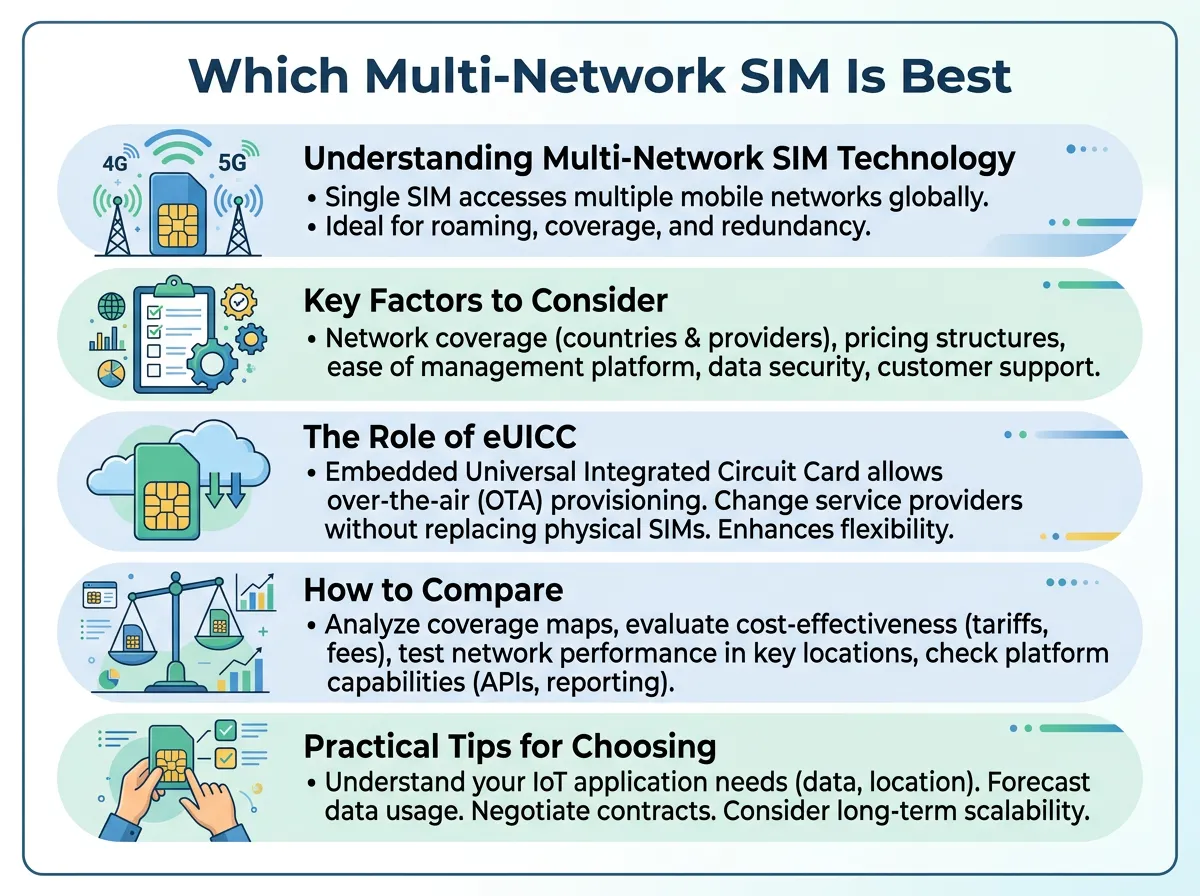
Which Multi-Network SIM Is Best for IoT? — key points at a glance
Geographic Coverage and Roaming
Does your device stay in one city? Or does it cross borders? Some multi-network SIMs are built for local use. Others are truly global. If you send devices to other countries, look for smart global IoT SIM solutions. These help you cross borders without losing your connection. This helps us see which multi-network SIM is best for IoT when moving assets across borders. It prevents your devices from getting stuck with zero signal.
Data Speeds and Bandwidth Needs
Smart devices do not all use data the same way. High-bandwidth devices like security cameras need fast 4G or 5G speeds. Low-power devices like soil sensors only send tiny text files. They can use slower, cheaper networks like LTE-M or NB-IoT. Make sure your provider supports the exact network your hardware needs. There is no point in paying for 5G speed if your device only sends one short alert a day.
The Role of eUICC and eSIM in IoT
If you want to know which multi-network SIM is best for IoT over the long term, you must learn about eUICC. This technology is changing how we manage connected hardware. It removes the stress of being locked into a single network provider.
What is eUICC?
eUICC stands for Embedded Universal Integrated Circuit Card. It is often called eSIM. It allows you to change network profiles over the air. You do not have to pull a physical card out of a machine to change your cellular plan. Instead, you send a digital command to download a new profile. This makes managing thousands of devices very simple.
Why eUICC Saves You Money
Imagine having ten thousand smart meters in the field. If your carrier raises prices, swapping those cards by hand would cost a fortune. With eUICC, you can switch providers with a few clicks on your computer. This flexibility is a game-changer for long projects. It ensures you are never stuck with high rates or bad service.
How to Compare the Best IoT SIM Providers
To find out which multi-network SIM is best for IoT for your business, you need to look beyond the hardware. You must look at the services that come with it. A great SIM is useless if the management software is hard to use.
Evaluating the Management Platform
You need a simple dashboard to manage your devices. This dashboard should show how much data each SIM is using. It should let you pause SIMs that are not in use. It should also alert you if a device uses too much data. A poor platform will lead to high bills and wasted hours. A great platform gives you total control.
Looking at Security Features
Security features also play a massive role in deciding which multi-network SIM is best for IoT deployments. Security is a major concern for smart devices. Look for providers that offer private APNs. A private APN keeps your traffic off the public internet. You should also check for VPN support and fixed IP addresses. These tools protect your data from hackers and keep your network safe.
Practical Tips for Choosing Your IoT SIM
Selecting the perfect setup can feel hard. Here are some simple tips to help you make your final choice without any regrets.
Start with a Pilot Test
Never buy thousands of SIMs without testing them first. Order a small batch of test SIMs. Place them in your actual devices. Test them in the real world. Check how fast they connect and how they handle weak signal areas. This test will show you which multi-network SIM is best for IoT in your specific locations. It is the best way to avoid expensive mistakes.
Read the Small Print on Data Pooling
Many providers offer data pooling. This means all your devices share a single bucket of data. If one device uses too much, another device can use less. This is highly useful. However, you must check for hidden fees. Some providers charge extra for roaming or network switching. Always ask for a clear pricing structure before signing a contract.
Look for Local Profiles
Sometimes, standard roaming is not allowed. Certain countries have strict laws against permanent roaming. To avoid this issue, look for local multi-network options. These options use local carrier profiles to bypass roaming restrictions. This keeps your connection safe and legal. This is crucial if you plan to scale your business globally.
Summary: Which Multi-Network SIM Is Best for IoT?
To sum up, there is no single answer to which multi-network SIM is best for IoT. The best choice is the one that fits your deployment. For global projects, a non-steered, eUICC-enabled SIM is usually the top choice. It gives you the best coverage and the freedom to switch networks in the future without physical hassle. For local projects, focus on finding a provider with an easy platform and strong security features.
Take your time to test different options. Compare platforms, security, and coverage maps. With the right multi-network SIM, your smart devices will stay online, secure, and ready to perform. Your business will run smoothly, and you will save money in the long run.
Frequently Asked Questions
What is a multi-network SIM?
A multi-network SIM is a special cellular card that can connect to more than one network carrier. This allows your device to switch to another network if the primary signal becomes weak or drops entirely. It helps keep your smart devices connected in different areas.
What is the difference between steered and non-steered SIMs?
A steered SIM is programmed to prefer a specific partner network, even if its signal is weak. A non-steered SIM does not have a favorite and always connects to the strongest available network. Non-steered SIMs are generally much better for critical business applications.
How do I know which multi-network SIM is best for IoT in my region?
To find out which multi-network SIM is best for IoT in your region, you should look at local coverage maps. You must also perform a real-world pilot test with a few SIM cards in your devices. This ensures the carriers in your area offer a strong and stable connection.
Can I change carriers without swapping physical SIM cards?
Yes, you can do this if you use eUICC-enabled SIMs, also known as eSIMs. This technology allows you to download new carrier profiles over the air with a few clicks on your management platform. It eliminates the need to physically replace cards in your devices.
What is a private APN in IoT?
A private Access Point Name (APN) is a secure gateway that connects your IoT devices directly to your private network. It keeps your data traffic off the public mobile internet, protecting it from hackers and security threats. Most top IoT SIM providers offer this feature.
Is permanent roaming allowed for IoT devices?
Some countries do not allow permanent roaming and may block devices that stay on a roaming network for too long. If you deploy devices in these areas, you should look for local multi-network options. These options use local carrier profiles to bypass roaming restrictions legally.
