

Choosing the right code for smart devices is crucial for performance and scalability. In 2023, the top programming languages for IoT projects include C, C++, Python, Java, and JavaScript, which lead the pack due to their versatility and efficiency. Understanding how these languages fit different layers of IoT architecture helps developers build more reliable systems.
Imagine waking up to a house that already knows your morning routine. The thermostat adjusts itself to the perfect temperature, the coffee maker starts brewing your favorite roast, and your smart blinds slowly open. This magic is powered by the Internet of Things (IoT). But behind every smart light bulb, fitness tracker, and industrial sensor lies millions of lines of code.
Building these smart networks is a complex task. Hardware is tiny, battery life is limited, and security is a constant challenge. This leaves developers with a vital decision. Which language should you choose to bring your smart hardware to life? Many developers ask: What Are the Top 10 Programming Languages Used in IoT Projects in 2023?
Today, we will dive deep into the ultimate tools of the trade. We will explore the strengths, weaknesses, and real-world uses of the leading coding tools for smart devices. Whether you are building a simple home hobby project or a massive industrial sensor network, this guide will help you choose the perfect fit.
Key Takeaways
- C and C++ remain dominant: These low-level languages offer unmatched control over hardware and minimal resource consumption.
- Python is ideal for data-heavy applications: Its simplicity and rich library ecosystem make it perfect for IoT data analysis and machine learning.
- Java provides cross-platform portability: The “write once, run anywhere” capability makes Java highly effective for edge devices and gateways.
- JavaScript and Node.js rule the web-connected IoT: These options allow developers to manage asynchronous event-driven tasks seamlessly.
- Rust is rising as a secure alternative: Its strict memory safety makes it an excellent choice for modern, secure embedded systems.
📑 Table of Contents
1. The Heavyweights of Hardware: C and C++
C: The King of Microcontrollers
If you are working with bare-metal hardware, C is your best friend. It has been the industry standard for decades. This language sits very close to the physical hardware, which means it has incredibly low overhead. It does not need a lot of RAM or processing power to run. This makes it ideal for tiny microcontrollers with very limited battery life.
Most of the firmware in your household smart devices is written in C. It gives you direct access to memory and system resources. However, this power comes with a cost. C does not have a safety net. A single memory leak or pointer error can crash your entire device. If you want to see how these low-level options stack up against others, you can check out this detailed breakdown of IoT programming languages.
C++: Objects and Complexity
C++ takes everything that makes C great and adds object-oriented programming (OOP) on top. This makes it much easier to organize large, complex projects. If you are writing software for a smart car or an advanced robot, C++ is usually the language of choice. It allows you to write reusable code while still maintaining almost the same speed and efficiency as C. It is a staple in the IoT community for a reason.
2. The Modern Favorites: Python and JavaScript
Python: Data Analysis and Fast Prototyping
Python has exploded in popularity over the last few years. It is famous for its clean, easy-to-read syntax. Writing Python feels almost like writing plain English. This makes it fantastic for beginners and rapid prototyping. You can build a working prototype in Python in a fraction of the time it would take in C.
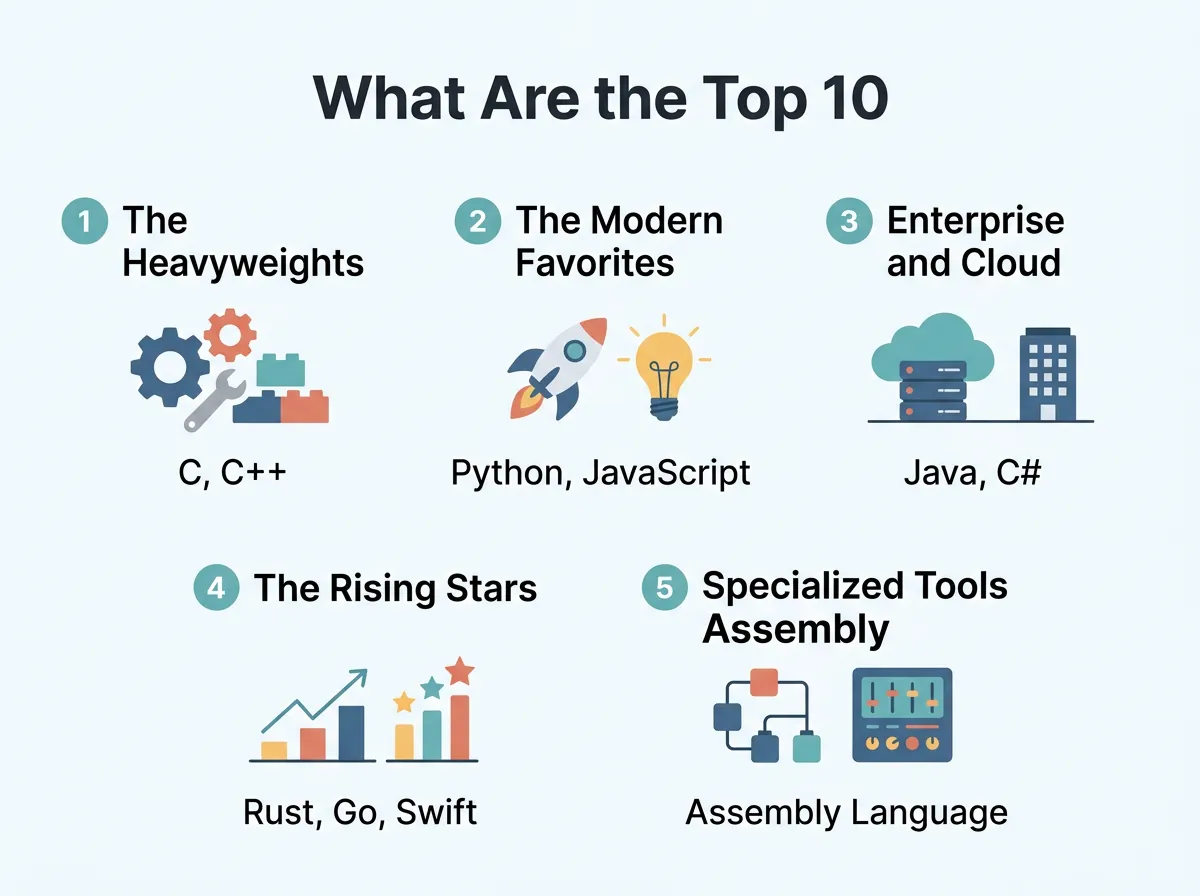
What Are the Top 10 Programming Languages Used in IoT Projects in 2023? — key points at a glance
In the world of IoT, Python is heavily used in edge gateways and data analysis. Since smart devices collect massive amounts of data, Python’s rich libraries like NumPy and Pandas are perfect for processing that information. Plus, with MicroPython, developers can now run Python directly on small microcontrollers.
JavaScript: Connected Devices and Web Integration
JavaScript is no longer just for web browsers. Thanks to Node.js, it has become a powerful server-side language and a top contender for IoT. JavaScript is built around an event-driven architecture. This is a perfect match for IoT, where devices are constantly waiting for inputs, signals, or network packets.
With JavaScript, you can easily manage thousands of simultaneous connections. It also makes integrating your devices with web APIs and cloud services incredibly smooth. Many smart home hubs use JavaScript to manage communications between different household devices.
3. Enterprise and Cloud Powerhouses: Java and Go
Java: Edge Gateways and Portability
Java is famous for its “write once, run anywhere” philosophy. This is made possible by the Java Virtual Machine (JVM). Because the JVM can run on almost any hardware, Java is highly portable. This makes it a popular choice for IoT gateways, which act as translators between tiny sensors and the cloud.
According to WebbyLab’s expert research, Java remains a staple for heavy-duty edge computing because of its rock-solid stability. It handles multi-threading easily, which is crucial when a gateway needs to talk to hundreds of sensors at the exact same time.
Go: High-Performance Concurrency
Go, also known as Golang, was created by Google. It was designed from the ground up for modern network applications. Go is incredibly fast and compiled directly to machine code. Its secret weapon is “goroutines,” which are lightweight threads that allow the language to run thousands of tasks at the same time without breaking a sweat.
For IoT, Go is mostly used on the cloud side of the network. It excels at managing massive data streams from millions of active devices. If your IoT project involves a massive network of sensors sending data to a central cloud, Go is the engine you want under the hood.
4. The Rising Stars: Rust and Swift
Rust: Safety and Performance
Rust is the darling of the modern programming world. It was designed to offer the raw speed of C and C++ but with built-in memory safety. Rust stops common bugs and security vulnerabilities at compile time. This means if your code compiles, it is highly unlikely to crash due to a memory error.
As IoT security becomes a major global concern, Rust is rapidly gaining ground. Developers are using it to build highly secure medical devices, automotive systems, and industrial machinery where a software crash could be dangerous.
Swift: Smart Homes and Apple Ecosystems
Swift is Apple’s primary language. While you won’t find Swift running on a tiny industrial water sensor, it is extremely common in the consumer IoT space. If you are building an app to control smart home devices from an iPhone, iPad, or Apple Watch, you will likely use Swift.
Swift integrates perfectly with Apple’s HomeKit framework. This makes it the go-to choice for developers focusing on consumer-facing iOS accessories and smart home automation.
5. Specialized Tools: Assembly and PHP
Assembly: Extreme Resource Constraints
Assembly is as low-level as it gets. It is direct machine code instructions. While it is rarely used to write entire applications today, it is still used for highly optimized micro-tasks. When a device has only a few kilobytes of memory, every single byte matters. Assembly allows developers to squeeze every ounce of performance out of minimal hardware.
PHP: Backend Web Integration
PHP might seem like an odd choice for IoT, but it plays a vital role in backend web integration. Many web servers that receive IoT data are built on PHP frameworks. It is easy to use PHP to receive data from a device, store it in a database, and display it on a web dashboard. To explore how these different technologies fit into a cohesive development strategy, review the TechAhead guide on IoT languages.
How to Choose the Right Language for Your Project
Understand Your Hardware Constraints
Before writing a single line of code, look at your hardware. If you are working with a tiny chip with minimal RAM and battery, you should stick to C or Rust. If you are working with a powerful single-board computer like a Raspberry Pi, you have the freedom to use Python, JavaScript, or Java.
Map Your Languages to the Architecture Layers
A typical IoT project has three main layers: the device layer, the gateway layer, and the cloud layer. You do not have to use the same language for all three. In fact, most successful projects use a mix. You might use C on the sensors, Python on the gateway, and Go on the cloud servers. Match the language to the specific job it needs to do.
Conclusion
There is no single “best” language for the Internet of Things. The beauty of IoT lies in its diversity. By understanding the unique strengths of each language, you can build smarter, faster, and more secure devices. We hope this look at what are the top 10 programming languages used in IoT projects in 2023 helps you kickstart your next innovative build!
Frequently Asked Questions
Which language is best for beginners in IoT?
Python is the best language for beginners in IoT. Its simple, readable syntax allows you to prototype projects quickly without getting bogged down by complex memory management. Devices like the Raspberry Pi also have massive community support for Python starters.
Why are C and C++ still so popular in IoT?
C and C++ remain popular because they offer direct control over system hardware with minimal overhead. They do not require a heavy runtime environment, making them perfect for resource-constrained microcontrollers. Their efficiency helps maximize battery life in remote smart sensors.
Can I use JavaScript for hardware programming?
Yes, you can use JavaScript for hardware programming, especially with frameworks like Johnny-Five or Node.js. It is excellent for handling event-driven tasks and asynchronous communication. This makes it a great choice for smart gateways and web-connected devices.
Is Rust going to replace C in IoT projects?
While Rust is growing rapidly due to its superior memory safety features, it is unlikely to replace C entirely anytime soon. C has decades of legacy code and hardware support that keeps it dominant. However, Rust is increasingly preferred for new, security-critical IoT projects.
What language is used for smart home apps?
Smart home apps are typically built using Swift for Apple iOS devices or Kotlin for Android devices. On the backend, these apps often communicate with servers running JavaScript (Node.js) or Python. The choice depends entirely on the mobile platform you are targeting.
Do IoT projects use more than one programming language?
Yes, most professional IoT projects use a combination of different programming languages. For example, a project might use C for low-level sensor code, Java for the local gateway software, and Go for the cloud-side data processing server. This multi-layered approach ensures each part of the system runs on the most efficient tool possible.
