


The top IoT companies in the USA include industry titans like Amazon Web Services (AWS), Microsoft Azure, and Cisco Systems, alongside specialized operators like Samsara and PTC. These market leaders provide the essential cloud infrastructure, smart sensors, and networking hardware that power today’s connected devices. Selecting the ideal partner depends on whether your organization requires consumer smart home systems, robust edge computing, or industrial fleet management tools.
Imagine waking up to a world where your alarm clock tells your coffee maker to start brewing. At the exact same time, your car preheats itself because your weather app reports a sudden frost. Meanwhile, in a factory across town, a robotic assembly line schedules its own maintenance before a single part can break. This is not science fiction. It is the power of the Internet of Things (IoT) in action.
Today, millions of devices talk to each other every single second. They share data, automate tasks, and make our daily lives much easier. If you are a business owner, a developer, or just a tech fan, you might wonder who is building this connected future. What Are the Top IoT Companies in the USA? In this article, we will take a deep dive into the industry leaders. We will look at tech giants, hardware pioneers, and specialized software brands that make the magic happen.
Key Takeaways
- Cloud Dominance: AWS and Microsoft Azure remain the undisputed leaders in hosting and managing large-scale IoT networks.
- Industrial Innovation: Companies like PTC and Samsara lead the market in connecting factories, heavy machinery, and shipping fleets.
- Hardware Excellence: Cisco and Intel provide the chips and rugged routers necessary for edge computing and secure data transfers.
- Security Focus: Leading US companies place data protection and automatic software updates at the forefront of their services.
- Future Readiness: The integration of 5G and artificial intelligence is accelerating the capabilities of American IoT systems.
📑 Table of Contents
The Tech Giants Leading the IoT Revolution
The foundation of the IoT world relies heavily on massive cloud computing platforms. Without cloud storage and raw processing power, smart devices are just isolated gadgets. The biggest players in the tech world have built incredible systems to handle billions of messages every day.
Amazon Web Services (AWS) IoT
Amazon is a household name for shopping, but it is also a giant in cloud technology. AWS IoT provides tools that connect devices to the cloud and to other devices. This helps businesses secure their data and manage millions of endpoints at once. For example, AWS helps car makers track vehicle performance in real time. Their systems are highly scalable, which is why many of the most influential IoT companies choose AWS as their digital backbone.
Microsoft Azure IoT
Microsoft is another titan in this space. Azure IoT offers a massive suite of tools for businesses of all sizes. They focus heavily on security and ease of use. With Azure, a company can easily build a “digital twin.” This is a virtual model of a physical object, like a wind turbine. It allows engineers to test updates on a computer screen before applying them to real machines. This process saves time, reduces risk, and keeps factories running smoothly.
Industrial and Enterprise IoT Pioneers
While consumer gadgets get a lot of attention, the real heavy lifting happens in industries like manufacturing, shipping, and energy. This is often called the Industrial Internet of Things, or IIoT.
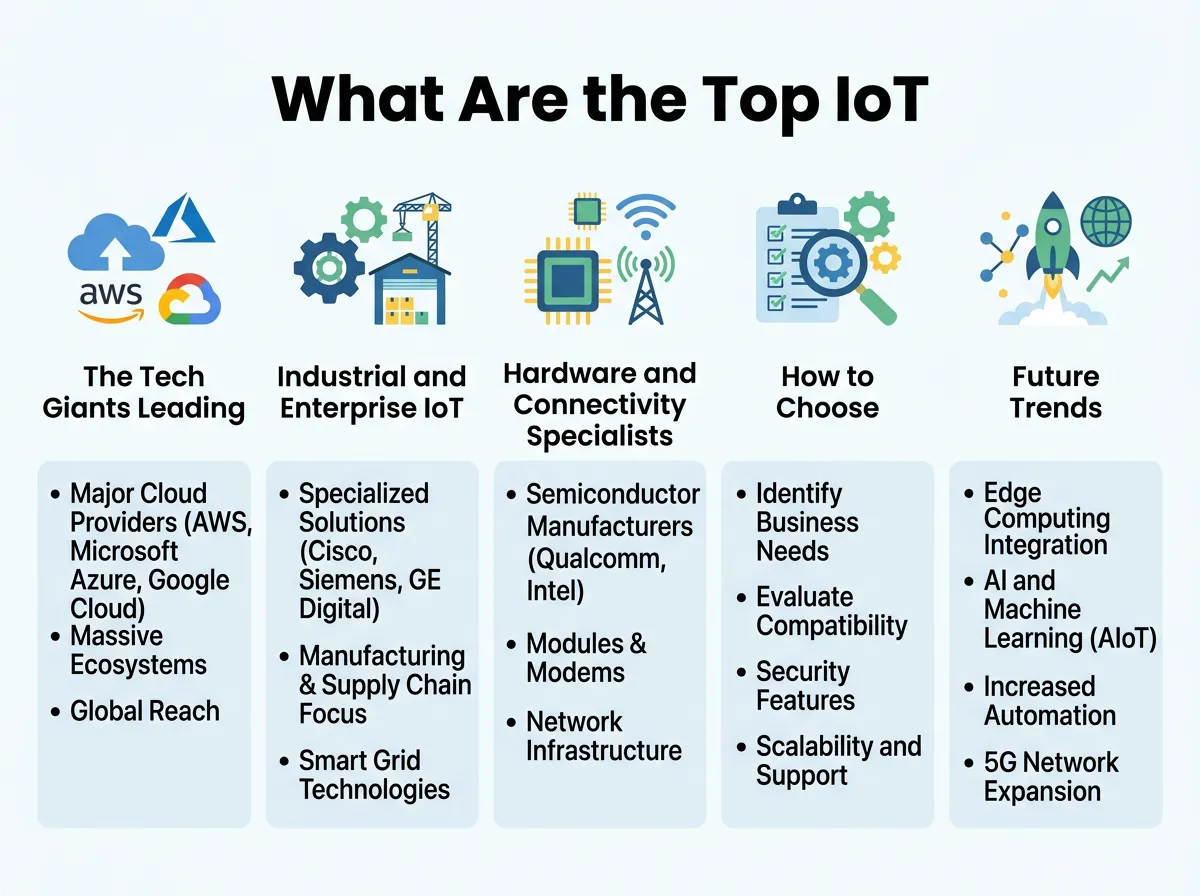
What Are the Top IoT Companies in the USA? — key points at a glance
PTC: The Industrial IoT Master
PTC is a leader in helping industrial companies go digital. Their famous platform, ThingWorx, makes it easy to connect different types of factory equipment. Imagine a factory with machines from ten different decades. ThingWorx connects them all so they can talk to each other. PTC also uses augmented reality (AR) to help workers fix machines faster by showing digital instructions right over physical parts.
Samsara: Connected Operations
Samsara is a fast-growing company that focuses on physical operations. They serve fleets of trucks, construction sites, and waste management systems. Samsara uses smart sensors to track GPS locations, driver safety, and fuel usage. If a refrigerated truck starts to warm up, the driver gets an instant alert. This keeps food safe and saves businesses millions of dollars every year.
Hardware and Connectivity Specialists
Software is great, but devices need physical parts and strong networks to function. These companies build the chips, routers, and gateways that keep us connected.
Cisco Systems: Networking the Edge
Cisco is the king of networking hardware. In the IoT world, sending all data to a distant cloud can take too much time. Cisco excels at “edge computing,” which means processing data closer to where it is collected. Their heavy-duty routers are built to survive extreme weather on oil rigs and wind farms, keeping vital data flowing no matter what.
Intel: Smart Silicon
Every smart device needs a brain, and Intel makes those brains. Intel designs high-performance microprocessors and chips specifically for IoT devices. These chips are small, energy-efficient, and capable of running complex AI programs right on the device. This allows smart cameras to recognize objects instantly without relying on a slow internet connection.
How to Choose the Right IoT Partner for Your Business
Finding the perfect partner can feel overwhelming because there are so many options. To help you navigate, here are a few simple tips to keep in mind.
Define Your Goals and Scale
Do you need to connect ten smart cameras, or do you need to track ten thousand cargo containers? If you need large-scale enterprise solutions, sticking with AWS or Microsoft is a safe bet. If you need custom software, you can look into dedicated development shops. You can explore lists of the top IoT development companies in the United States to find teams that specialize in building custom apps for smart devices.
Prioritize End-to-End Security
Every connected device is a potential doorway for hackers. When searching for partners, always ask about their security protocols. Ensure they offer automatic software updates, strong data encryption, and secure user login options. Never sacrifice security for a cheaper price tag.
Search Specialized Directories
If you want a highly customized local partner, directories can save you hours of research. Reading reviews and comparing portfolios on trusted platforms like directories of USA IoT service providers is a great way to find the perfect fit for your specific niche.
Future Trends in the US IoT Market
The IoT landscape is changing rapidly. What works today will be even smarter tomorrow. Here are two massive trends to watch closely.
The Rise of 5G Networks
Older cellular networks could sometimes be slow or drop connections. The rollout of 5G changes everything. With lightning-fast speeds and almost zero lag, 5G allows devices to talk to each other instantly. This is crucial for things like self-driving cars, where a delay of even a millisecond can cause an accident.
AI-Driven IoT (AIoT)
When you combine artificial intelligence with IoT, you get AIoT. Instead of just collecting data, smart devices can now make decisions on their own. For example, a smart thermostat can learn your daily routine and adjust the temperature before you even realize you are cold. In factories, AI can predict exactly when a machine part will wear out, preventing costly shutdowns.
Conclusion
The Internet of Things is no longer a concept for the future. It is here, and it is reshaping how we live and work. From giant cloud platforms like AWS and Microsoft to hardware kings like Cisco and Intel, the top IoT companies in the USA are driving this change. Whether you are looking to upgrade your home, automate a factory, or build a brand-new smart product, these industry leaders provide the tools and tech to make it happen. The connected world is growing every day, and there has never been a better time to get involved.
Frequently Asked Questions
What is the difference between IoT and Industrial IoT (IIoT)?
IoT refers to everyday connected devices like smart watches, smart home thermostats, and voice assistants. Industrial IoT (IIoT) focuses on high-stakes applications in factories, shipping, and energy grids. IIoT relies on highly durable sensors and advanced analytics to improve safety and operational efficiency.
Who is the largest IoT cloud provider in the US?
Amazon Web Services (AWS) and Microsoft Azure are the two largest IoT cloud providers in the United States. Both companies offer highly secure, scalable platforms that manage millions of connected devices. Their robust infrastructure makes them the top choices for large-scale enterprise deployments.
Why is security so important for IoT companies?
Every connected device acts as an entry point to a network, which makes them prime targets for hackers. If a single smart device is compromised, it can expose sensitive customer data or disrupt business operations. This is why top IoT firms invest heavily in automatic updates, end-to-end data encryption, and secure logins.
How does 5G affect the growth of IoT?
The rollout of 5G networks provides faster speeds and lower latency for connected devices. This allows smart devices to send and receive massive amounts of data in real time without lagging. It is essential for advanced technologies like self-driving cars, remote healthcare, and real-time factory automation.
Can small businesses benefit from IoT?
Yes, small businesses can use IoT to automate tasks, track inventory, and save energy. Simple tools like smart thermostats, connected security cameras, and asset trackers are affordable and easy to install. These devices help small businesses run more efficiently and reduce monthly operating costs.
What is edge computing in IoT?
Edge computing processes data directly on the device or a local router instead of sending it to a distant cloud. This reduces lag times and saves internet bandwidth, making systems respond much faster. It is incredibly useful for critical devices like medical monitors and autonomous vehicles that need instant data processing.
