


Choosing the right network is vital for your smart devices to work well. The best options include Wi-Fi for homes, Bluetooth for close-range gear, cellular for moving assets, and LPWAN for long-range sensors. Your ideal choice depends on your project’s range, power, and data needs.
Have you ever wondered how your smart devices talk to each other? Think about a smart watch. It tracks your steps. It knows your heart rate. Then, it sends that info to your phone. It feels like magic. But it is not magic. It is all about how devices connect.
If you are building a new smart tool, you have to make a choice. You must pick how it will share data. This is a big choice. The wrong link can ruin a great product. If your device runs out of power too fast, users will get mad. If it loses its connection, it becomes useless.
So, how do you pick? We will guide you through the maze of choices. We will look at short-range links, cellular networks, and long-range options. You will learn the pros and cons of each one. Let us dive in and find the perfect match for your smart gear.
Key Takeaways
- Match by Range: Choose your technology based on how far your data must travel.
- Power Source Matters: Use low-power networks like LoRaWAN for battery devices and Wi-Fi for plugged-in gear.
- Short-Range Strengths: Use Wi-Fi and Bluetooth for smart homes and indoor setups.
- Cellular Coverage: Use 4G, 5G, or LTE-M for assets that move across the country.
- LPWAN Benefits: Pick NB-IoT or LoRaWAN to get years of battery life on small sensors.
- Future Trends: Keep an eye on new standards like LTE Cat 1 bis as old networks shut down.
📑 Table of Contents
Short-Range Wireless Networks
Short-range tools are great for close work. They operate inside a small space. This could be a room, a home, or an office. They are cheap to set up and easy to run.
Wi-Fi: The High-Speed Home Standard
Wi-Fi is everywhere. You use it on your phone, laptop, and TV. It is super fast. It can handle large files with ease. This makes it perfect for smart home hubs. It is also great for security cameras that stream live video.
But Wi-Fi has a major flaw. It eats up a lot of power. If your device runs on a small battery, Wi-Fi is a bad choice. The battery will die in just a few days. Wi-Fi also has a short range. It cannot go through thick concrete walls very well. It works best when your device is close to a plug and a router.
Bluetooth: The King of Close Range
Bluetooth is the king of close connections. It links your phone to your headphones. It uses very little power. This means batteries can last for months or even years.
Today, Bluetooth is not just for music. It is huge in the business world. For instance, there are many wireless connectivity options for IoT applications like commercial lighting. You can link hundreds of lights in a big office. They talk to each other to save energy. Bluetooth is cheap, safe, and works with almost every phone.
Long-Range, Low-Power Networks (LPWAN)
What if your device lives far away from any router? What if it is in a water tank, a farm field, or a coal mine? You cannot use Wi-Fi there. You need a system that can reach far without using much power. This is where LPWAN comes in.
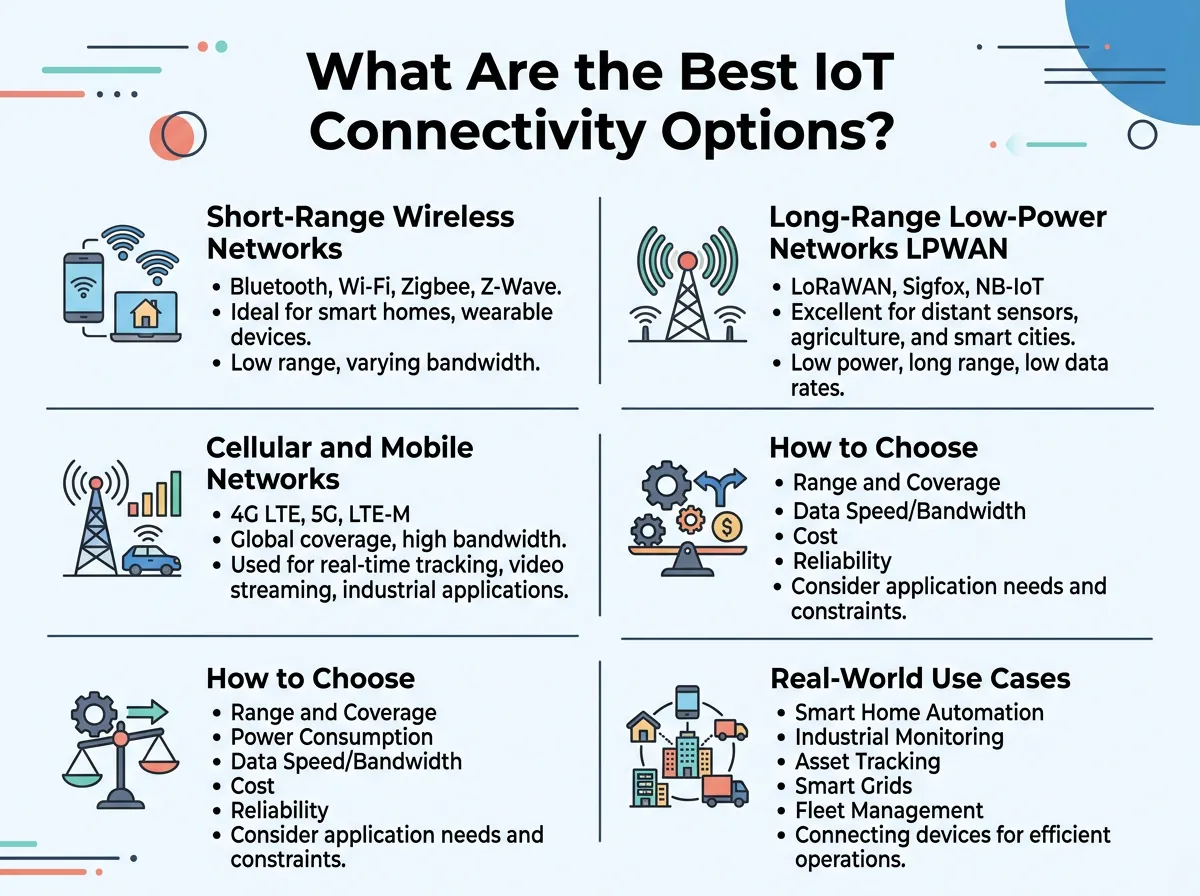
What Are the Best IoT Connectivity Options? — key points at a glance
LoRaWAN: Long Range on a Budget
LoRaWAN stands for Long Range Wide Area Network. It is a fantastic tool for open spaces. It can send data over miles. It uses very little power. A sensor using LoRaWAN can run on a single battery for ten years.
How does it do this? It only sends tiny packets of data. It might just send a temperature reading once an hour. It does not stream video or music. The best part is that you can build your own network. You do not need to pay a cellular company for a data plan. It is ideal for smart farms and outdoor sensors.
NB-IoT: Cellular for Small Sensors
NB-IoT is another great option. It stands for Narrowband IoT. Unlike LoRaWAN, it uses existing cell towers. This means it has great coverage in cities.
NB-IoT is built for machines, not people. It sends small updates at set times. It can even reach deep underground. This makes it perfect for smart water meters or gas line sensors. You do have to pay for a SIM card, but the monthly cost is very low. It is a safe and steady choice for big projects.
Cellular and Mobile Networks
Sometimes, your assets do not stay in one place. They might be on a truck driving across the country. They might be on a shipping container on a train. For these moving targets, you need a mobile network.
LTE-M and LTE Cat 1 bis
LTE-M is a sister to NB-IoT. It is faster and can handle moving objects better. It can even carry voice data. If you need to track a fleet of trucks, LTE-M is a top choice.
There is also a new star in the cellular world called LTE Cat 1 bis. This technology is gaining ground fast. It allows devices to connect using only one antenna. This lowers the cost of the chip. It also makes the device smaller. It is a smart choice as old 2G and 3G networks close down.
5G and Private Networks
5G is the newest and fastest cellular network. It has super low lag. This means devices can talk to each other in real-time.
But 5G is not for every project. The chips are costly, and they use a lot of power. However, for some jobs, 5G is a must. Think of self-driving cars or robotic arms in a factory. These machines need instant data to stay safe. When choosing the right IoT connectivity, you must balance cost and performance. 5G is expensive, but it offers unmatched speed.
How to Choose Your Perfect Connection
With so many choices, how do you pick? If you are trying to figure out what are the best IoT connectivity options for your business, you must ask yourself three simple questions.
What is Your Range?
First, think about distance. How far does your data need to go? If it is just a few feet, use Bluetooth. If it is within a building, Wi-Fi is great. If it spans a whole city or country, look at cellular or LPWAN. Do not pay for a big network if your device stays in one room.
What is Your Power Source?
Next, look at the power. Does your device plug into a wall? If so, power is not an issue. You can use fast, power-heavy tech like Wi-Fi or 5G. But if your device runs on a small battery, you must go low-power. Choose LoRaWAN, NB-IoT, or Bluetooth to keep it alive.
How Much Data Do You Send?
Finally, measure your data. Are you sending live video or large files? You need a high-speed link like Wi-Fi or 5G. Are you just sending simple numbers like temperature or GPS coordinates? A low-speed link like LoRaWAN or NB-IoT will save you money and power.
Real-World Use Cases
Let us look at some daily examples. This will help you see how these connections work in real life.
Smart Homes
In a smart home, you want everything to connect easily. Smart bulbs and plugs usually use Zigbee or Bluetooth. They do not need to send much data. Home security cameras, however, need Wi-Fi. They must send video to your phone in real-time.
Smart Farms
Imagine a farm with thousands of acres. The farmer wants to track soil moisture. There are no power plugs in the fields. The farmer uses LoRaWAN. The sensors send a small update every few hours. The batteries last for years, and the farmer does not have to pay monthly fees.
Fleet Tracking
A delivery company wants to track its trucks. The trucks travel through many cities and states. They need constant tracking and temperature monitoring for cold cargo. The company uses cellular LTE-M. It provides wide coverage and handles moving targets with ease.
The Future of Smart Connections
The world of tech is always moving. Old networks like 2G and 3G are shutting down. New technologies are taking their place. One exciting area is satellite IoT. Soon, we will connect devices in the most remote spots on Earth. This includes the middle of the ocean or deep deserts.
When you design a device today, think about tomorrow. Pick a connection that is future-proof. This will save you from having to replace your devices in a few years.
Conclusion
There is no single best option for every project. The best choice is the one that fits your unique needs. Map out your range, power, and data. Once you do that, the right path will be clear. Now, go out and build something amazing!
Frequently Asked Questions
What is the most common IoT connection?
Wi-Fi is the most common connection for home-based IoT devices. It is fast and easy to set up, though it uses a lot of power. For personal devices, Bluetooth is the most common choice.
Which IoT connection is best for long battery life?
LPWAN technologies like LoRaWAN and NB-IoT are best for long battery life. They send tiny amounts of data and can run on a single battery for up to ten years. This makes them ideal for remote sensors.
Can I use Bluetooth for long-range IoT?
No, standard Bluetooth is designed only for short-range connections up to a few meters. For long-range needs, you should use cellular networks or LPWAN technologies. However, Bluetooth Mesh can extend range slightly by linking multiple nearby devices.
What is the difference between LTE-M and NB-IoT?
LTE-M is faster, supports voice data, and works well with moving assets like trucks. NB-IoT is slower and cheaper, but it has better signal penetration underground. Both are excellent low-power cellular options.
Why is 5G important for IoT?
5G offers super-fast speeds and ultra-low lag for critical tasks. It is essential for real-time machines like self-driving cars and factory robots. However, it is too expensive and power-hungry for simple smart sensors.
Do all IoT devices need a SIM card?
No, only devices that use cellular networks like LTE-M or NB-IoT need a SIM card. Devices using Wi-Fi, Bluetooth, or LoRaWAN connect without a SIM card. This helps keep local setup costs much lower.
