


The European Union’s NIS2 Directive demands strict security measures across critical infrastructure and supply chains, heavily impacting connected devices. Leading cellular IoT SIM providers like EMnify, Soracom, FloLIVE, and Velos IoT support compliance by offering built-in private APNs, IPsec VPNs, IMEI locking, and real-time threat detection. Partnering with a compliant connectivity provider is essential to protect your business from cyber threats and avoid severe regulatory fines.
Imagine managing a fleet of thousands of smart devices across Europe. These devices monitor everything from city water grids to hospital equipment and logistics chains. Suddenly, a rogue actor hacks one device, gains access to your core network, and shuts down operations. This scary scenario is why the European Union introduced the Network and Information Security 2 (NIS2) Directive. This directive forces companies to take cybersecurity seriously, starting at the physical device level.
But when you rely on cellular connectivity, you cannot secure your devices alone. You must ask a critical question: Which IoT SIM Providers Support NIS2 Compliance? Your SIM provider is a key part of your digital supply chain. If they do not meet the strict security standards of NIS2, your entire business could face massive legal and operational risks. Let us dive into the details of NIS2, why your SIM cards matter, and which providers are ready to help you comply.
Key Takeaways
- NIS2 Mandates Supply Chain Security: Your IoT connectivity providers are part of your supply chain and must meet strict security standards.
- Top Compliant Providers: EMnify, Soracom, FloLIVE, and Velos IoT offer robust features designed to help you meet NIS2 requirements.
- SIM-Level Protection is Vital: Features like IMEI locking, private APNs, and virtual private networks (VPNs) protect your data at the cellular level.
- Avoid Huge Penalties: Non-compliance with NIS2 can lead to fines up to 10 million EUR or 2% of global annual turnover.
- Choose Zero-Trust Architectures: Modern compliant providers utilize zero-trust network access to verify every device connection continuously.
📑 Table of Contents
What is the NIS2 Directive and Why Does It Matter for IoT?
The NIS2 Directive is the EU’s latest cybersecurity legislation. It replaces the older NIS law to make Europe more resilient to cyberattacks. This updated law expands the list of sectors that must comply. It now covers energy, transport, banking, health, water, digital infrastructure, and manufacturing.
If your business falls under these categories, you must prove that your digital infrastructure is secure. This includes your Internet of Things (IoT) devices. Crucially, NIS2 focuses heavily on supply chain security. This means you must audit every vendor you work with, including your cellular connectivity partners.
The Consequences of Non-Compliance
Ignoring NIS2 is not an option. The law has real teeth. Organizations that fail to comply can face fines of up to 10 million EUR or 2% of their global annual turnover, whichever is higher. Company directors can also be held personally liable for security failures. Therefore, finding out which IoT SIM providers support NIS2 compliance is a top priority for procurement and IT teams today.
Why the SIM Card is the First Line of Defense
A SIM card is not just a plastic chip that connects your device to a network. In the world of industrial IoT, the SIM card is a secure vault. It holds cryptographic keys that verify the device’s identity. If a hacker steals a SIM card or intercepts its data, your entire network could be compromised.
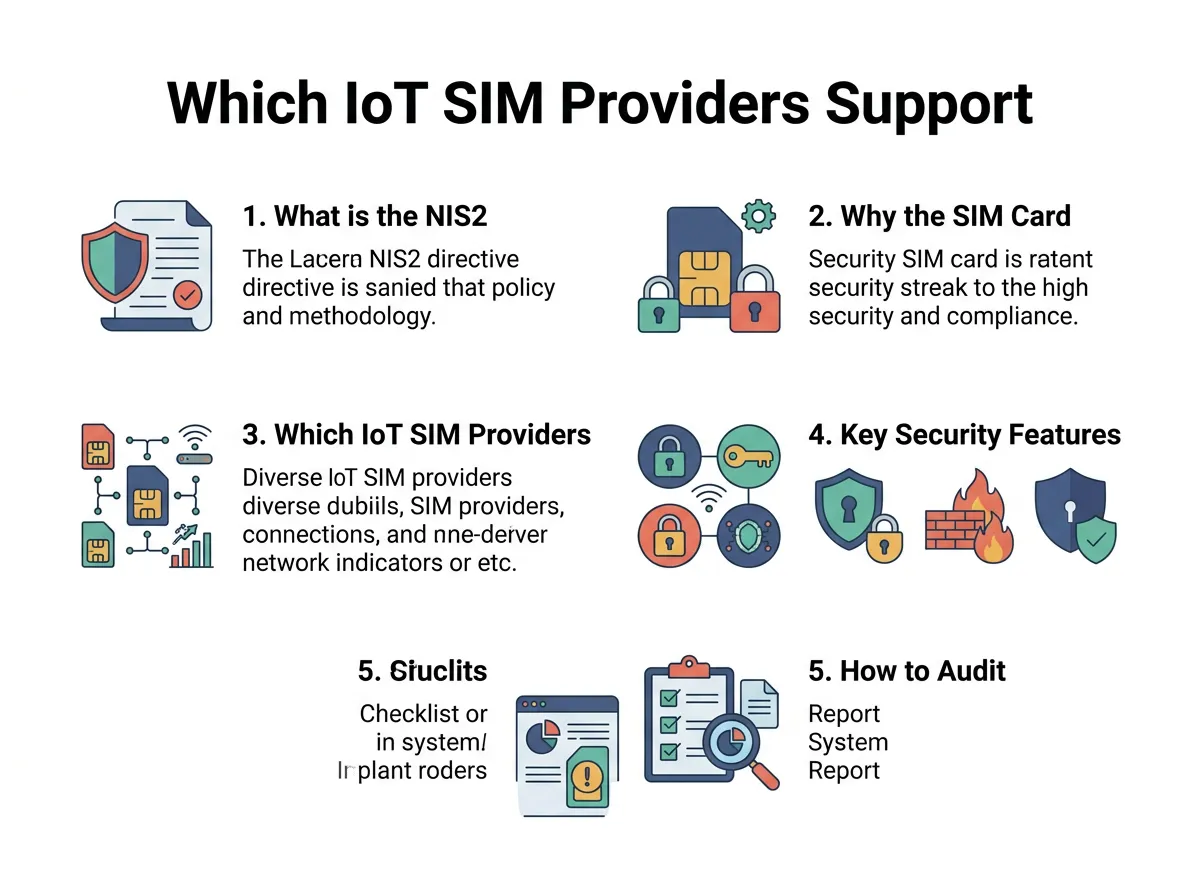
Which IoT SIM Providers Support NIS2 Compliance? — key points at a glance
To support your NIS2 journey, an IoT SIM provider must secure the data from the device all the way to your cloud server. They do this by eliminating public internet exposure. Instead of sending data over the open web, compliant providers use secure, private pathways.
Which IoT SIM Providers Support NIS2 Compliance?
Several global IoT connectivity leaders have built their platforms with strict security frameworks. These frameworks directly align with NIS2 requirements. Below are the top providers that can help you maintain compliance.
1. EMnify
EMnify is a leader in cloud-native IoT connectivity. Their platform is built directly inside AWS, which provides high-level physical and digital security. EMnify helps you achieve NIS2 compliance by offering several native security features:
- EMnify Cloud Connect: This feature allows you to bypass the public internet entirely. It routes your data directly into your cloud provider using secure VPNs or transit gateways.
- Intra-Cloud Firewalls: You can block your devices from talking to each other. This stops a hacker from moving laterally through your network if they compromise a single device.
- Real-Time Auditing: The platform logs all network events. This is highly useful for the strict incident reporting timelines required by NIS2.
2. Soracom
Soracom provides highly flexible cellular connectivity with a strong focus on developer-friendly security. They offer a suite of services designed to secure the entire data pathway, making them an excellent choice for NIS2 compliance.
- Soracom Canal and Door: These services establish private, secure connections between your devices and your servers using VPC peering and IPsec VPNs.
- Soracom Krypton: This tool allows secure provisioning of device credentials. You can authenticate devices without storing hardcoded passwords on the SIM or the device itself.
- SIM-Based Encryption: Soracom can offload encryption tasks from the device processor to the SIM card, ensuring data is encrypted from the moment it leaves the hardware.
3. FloLIVE
FloLIVE operates the world’s first hyper-local global cellular network. They specialize in high-security, localized compliance. This local approach is perfect for meeting the strict data residency requirements often linked to EU regulations.
- Local IMSI Switching: FloLIVE can switch carrier profiles over-the-air (OTA) to keep connections local. This keeps your data within European borders, satisfying local regulators.
- Private Core Network: Because they own their cellular core network, they can monitor and control all data traffic. This provides deep visibility and rapid threat detection.
- Centralized Security Management: Manage security policies globally from a single pane of glass, ensuring consistent compliance across all countries.
4. Velos IoT (Formerly JT IoT)
Velos IoT has decades of experience in global telecommunications. They have built their systems to meet the rigid demands of critical infrastructure providers.
- Custom Private APNs: Velos IoT offers fully managed private Access Point Names (APNs). This ensures your devices operate on an isolated network slice.
- IMEI Lock: This feature binds a SIM card to a specific device. If someone removes the SIM to use it in a laptop or another unauthorized device, the SIM immediately deactivates.
- Robust SLAs: Their service level agreements (SLAs) are designed for mission-critical applications, aligning perfectly with the high-availability demands of NIS2.
Key Security Features to Demand From Your Provider
If you are evaluating other providers, you must look past their marketing claims. Ask them if they support the following technical features. These are essential for meeting the security standards of NIS2:
Private APNs and VPNs
Your devices should never have public IP addresses. A compliant provider must offer private APNs. This acts as a private tunnel for your data. Combine this with IPsec VPNs to encrypt the data as it travels from the cellular tower to your server.
IMEI Locking and Anti-Tampering
Physical security is a major pillar of NIS2. Hackers often try to steal SIM cards from remote devices like smart streetlights or water meters. An IMEI lock ensures that the SIM card will only work when plugged into its designated device.
Over-the-Air (OTA) Updates
Security threats evolve quickly. If a vulnerability is found in your SIM profile, you cannot afford to manually replace thousands of physical cards. Your provider must support eUICC (eSIM) technology. This allows you to update security patches and carrier profiles remotely and securely.
Anomalous Traffic Detection
NIS2 requires quick detection of security breaches. Your SIM provider should offer tools that monitor traffic patterns. If a temperature sensor suddenly starts uploading gigabytes of data to an unknown IP address, the network should automatically flag and isolate that device.
How to Audit Your IoT SIM Provider for NIS2
Do not just take your provider’s word for it. You must conduct a formal audit to satisfy EU regulators. Use this simple checklist when speaking with your connectivity partner:
- Request ISO 27001 Certification: This certificate proves the provider follows global best practices for information security management.
- Check for GSMA SAS-UP Certification: This certifies that their SIM provisioning centers are physically secure.
- Ask About Data Residency: Where is your data stored and routed? For NIS2 compliance, keeping data transit within the EU is highly recommended.
- Review Incident Response Times: NIS2 requires you to report significant incidents within 24 hours. Your provider must have a system to notify you of network-level breaches immediately.
Conclusion: Choose Wisely to Protect Your Business
Securing your IoT deployment is no longer just a technical best practice. Under the new NIS2 rules, it is a legal requirement. When deciding which IoT SIM providers support NIS2 compliance, look for partners that offer end-to-end encryption, private routing, physical device locks, and detailed traffic visibility.
By partnering with forward-thinking providers like EMnify, Soracom, FloLIVE, or Velos IoT, you protect your critical infrastructure. More importantly, you shield your business from devastating fines and build a secure foundation for long-term growth. Do not wait for a regulatory audit or a security breach. Take control of your cellular IoT security today.
Frequently Asked Questions
What is the NIS2 Directive in simple terms?
The NIS2 Directive is an EU law designed to improve cybersecurity across critical infrastructure. It requires companies in essential sectors to protect their systems, secure their supply chains, and report cyber incidents quickly.
Do all IoT SIM providers support NIS2?
No, not all providers offer the advanced security features needed for NIS2. You must choose a provider that offers private APNs, encrypted data routing, and real-time security monitoring to meet the directive’s strict standards.
How does an IMEI lock help with NIS2 compliance?
An IMEI lock bonds your SIM card to a specific device, preventing physical theft. If a hacker removes the SIM and tries to use it in another device to access your network, the SIM automatically disables, protecting your data.
Can I use standard consumer SIM cards for industrial IoT under NIS2?
Using standard consumer SIM cards is highly risky and unlikely to meet NIS2 standards. Consumer SIMs lack essential features like private APNs, IMEI locking, custom firewalls, and deep traffic monitoring that secure industrial systems.
What happens if my IoT SIM provider suffers a data breach?
Under NIS2, you are responsible for the security of your supply chain. If your provider suffers a breach that compromises your devices, you must report it within 24 hours and could face severe fines if you failed to audit their security practices beforehand.
Does NIS2 apply to companies based outside of the European Union?
Yes, if your business provides essential services within the EU or operates devices that connect to EU infrastructure, you must comply with NIS2. This makes choosing a globally compliant SIM partner crucial for international businesses.
