


IoT device manufacturing for small businesses involves a clear path from concept design to prototyping, testing, and final production. By partnering with specialized contract manufacturers, small firms can produce high-quality smart tech without owning massive factories. This collaborative process allows startups to scale efficiently, manage costs, and launch innovative products in competitive markets.
Imagine you have a great idea for a smart device. It could be a smart pet feeder. It could be a simple water leak sensor. You can see the product clearly in your mind. But then, you stop and think. How do you actually get it made? If you do not own a giant factory, the path forward can feel like a mystery. You might find yourself asking, How Does IoT Device Manufacturing Work for Small Businesses?
The good news is that you do not need to be a tech giant to build hardware. The manufacturing world has changed a lot. Today, small businesses have access to the exact same supply chains as the big players. You can design, test, and build a physical product even with a small team.
This guide will walk you through the entire journey. We will cover everything from your first sketch to the final shipping box. By the end, you will understand the steps, the costs, and the best practices for success. Let us dive in.
Key Takeaways
- Start with a clear plan: Design your hardware and software together from the very beginning.
- Use standard parts: Save money and time by choosing off-the-shelf components.
- Build prototypes: Create a simple proof of concept before you make a final product.
- Find the right partner: Work with contract manufacturers who specialize in small batch runs.
- Plan for certifications: Set aside time and budget for legal tests like FCC and CE.
- Manage your budget: Simplify your design to lower your upfront costs and save cash.
📑 Table of Contents
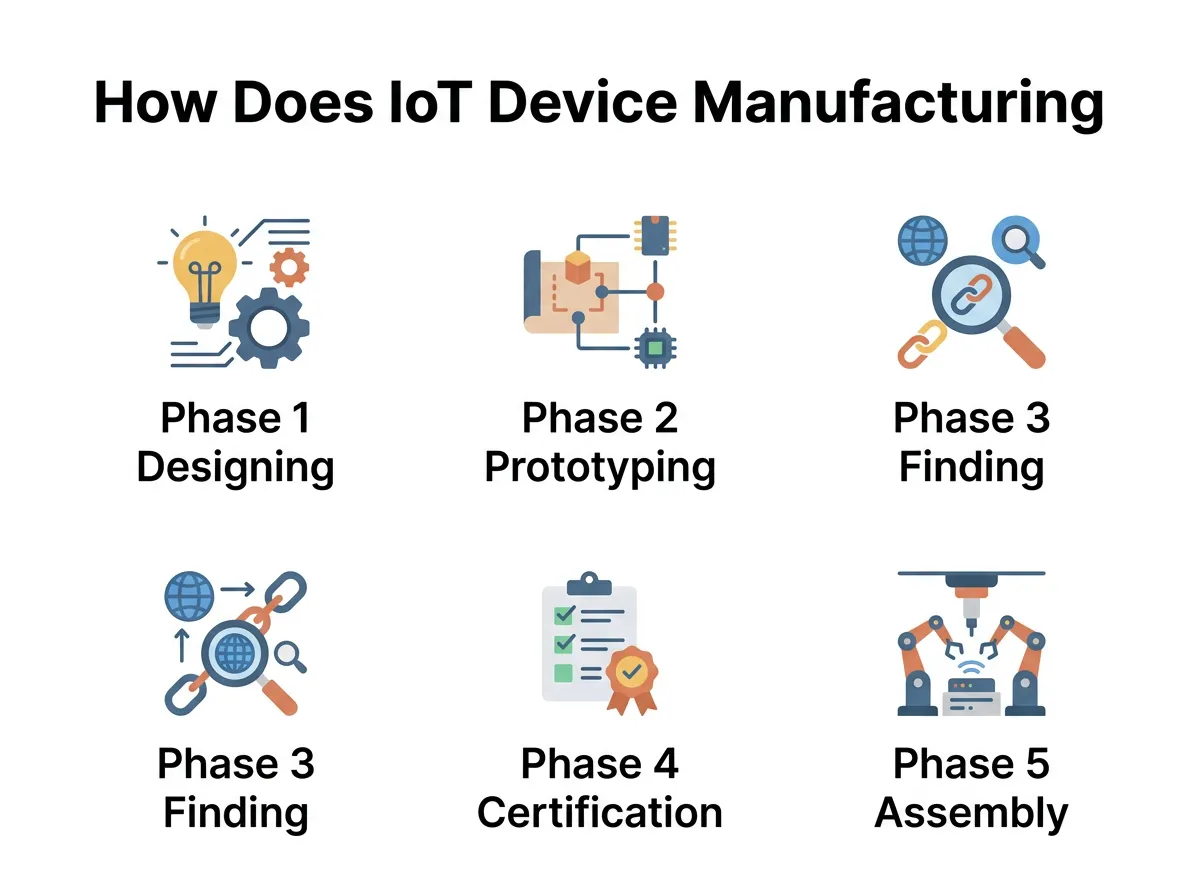
Phase 1: Designing Your IoT Concept
Every smart device starts as an idea. But to make it real, you need to turn that idea into a detailed technical plan. This is the design phase. It is the foundation of your entire project.
Hardware vs. Software
An IoT device is unique because it lives in two worlds. It has a physical body, which is the hardware. It also has a digital brain, which is the software. You must design both at the same time. The hardware includes the outer plastic shell, the circuit board, and the battery. The software includes the code on the device and the mobile app that users download. These two halves must talk to each other perfectly.
Selecting the Right Components
You need to choose your parts wisely. This includes microchips, sensors, and antennas. For a small business, using off-the-shelf parts is usually best. Do not try to build custom microchips. If a standard chip works for your device, use it. This keeps your design simple. It also keeps your initial costs low.
Phase 2: Prototyping and Testing
You cannot jump straight from a design to a factory run. You must build prototypes first. This phase lets you test your ideas. It helps you fix mistakes before you spend big money on tooling. This is where you learn firsthand: How Does IoT Device Manufacturing Work for Small Businesses? It works through constant testing.
How Does IoT Device Manufacturing Work for Small Businesses? — key points at a glance
Proof of Concept
Your first prototype is a proof of concept. It does not need to look pretty. In fact, it will probably look like a messy pile of wires and boards. You can use cheap development boards like Arduino or Raspberry Pi. The goal here is simple. You just want to prove that your technology actually works. Research shows that IoT devices offer small businesses a great way to compete, but only if they test their ideas early.
Working Prototypes
Once the proof of concept works, you build a functional prototype. This looks and feels closer to the final product. You might use 3D printing to make the plastic case. You will design a custom printed circuit board. Testing this prototype helps you find software bugs. It also shows you if the product is easy for customers to use.
Phase 3: Finding the Right Manufacturing Partner
Once your prototype is perfect, you need a factory to build it. This is where small businesses often feel lost. But finding a partner is easier than you think if you know what to look for.
OEM vs. ODM
You will hear two common terms: OEM and ODM. An Original Equipment Manufacturer (OEM) builds your custom design. You own the design, and they just assemble it. An Original Design Manufacturer (ODM) already has pre-made designs. You just put your logo on their product. For custom IoT devices, most small businesses look for an OEM partner.
Working with Contract Manufacturers
You do not need to build your own factory. Instead, you hire a Contract Manufacturer (CM). A good CM handles the sourcing of parts, the circuit board assembly, and final testing. When searching for a CM, look for ones that specialize in low-volume runs. Some factories are happy to make 500 or 1,000 units for your first batch. Always ask about their minimum order quantity.
Phase 4: Certification and Regulatory Compliance
Before you can sell your smart device, it must pass legal tests. This is a critical step in understanding How Does IoT Device Manufacturing Work for Small Businesses? safely and legally.
Why Certifications Matter
Smart devices emit radio waves. Because of this, governments regulate them strictly. If you sell uncertified devices, you can face huge fines. Your products could even be seized at customs. You must plan for these tests early in your design phase.
Common Standards
You will need to plan for several certifications. In the United States, you need FCC approval. In Europe, you need the CE mark. If your device uses Bluetooth or Wi-Fi, you may need special licenses. These tests can be expensive. Always set aside part of your budget for lab testing.
Phase 5: Assembly and Quality Control
Now, the factory is ready to run. This is where your parts come together to make a finished product. To truly understand How Does IoT Device Manufacturing Work for Small Businesses?, you must look at the assembly line.
Testing on the Line
A good factory does not just assemble parts. They test them at every step. This is called “in-circuit testing.” The factory will load your software onto the chip. Then, they will test the radio signals. This ensures that every single device works before it goes into a box. You can also look at how larger companies use IoT in manufacturing to optimize their own assembly lines and track quality in real-time.
Packaging and Logistics
Once the devices are built and tested, they are packaged. Your contract manufacturer can often pack the devices into their final retail boxes. From there, they are loaded onto pallets and shipped to your warehouse. You can learn more about how IoT is changing business logistics to make this shipping process even smoother.
Practical Tips for Managing Costs
The biggest threat to a small hardware business is cash flow. Hardware requires upfront money. You must buy parts before you can sell products. Here are a few tips to keep your costs low.
- Simplify your design: Every extra screw or button adds cost. Keep your design as simple as possible.
- Negotiate terms: Ask your factory if you can pay a deposit upfront and the rest upon delivery.
- Have backup parts: If your main microchip goes out of stock, make sure your circuit board can accept a different brand. This protects you from supply chain delays.
Conclusion
Building a hardware startup is hard work, but it is highly rewarding. So, How Does IoT Device Manufacturing Work for Small Businesses? It works through careful planning, thorough testing, and finding the right partners. You do not need a multi-million dollar factory to succeed. By starting small, prototyping your ideas, and working with specialized contract manufacturers, you can bring your smart device to market successfully. Take it one step at a time, protect your cash flow, and watch your idea come to life.
Frequently Asked Questions
How much does it cost to manufacture an IoT device?
The cost varies wildly based on complexity. A simple device can cost a few thousand dollars to design and prototype, while complex devices can cost tens of thousands. Your biggest upfront costs will be tooling for plastic molds and regulatory certifications.
What is the minimum order quantity for IoT manufacturing?
Many specialized contract manufacturers offer minimum order quantities as low as 500 to 1,000 units for small businesses. However, larger factories may require 5,000 or more units to start production.
Do I need an engineering degree to make an IoT device?
No, you do not need to be an engineer yourself. You can hire freelance product designers and firmware developers to turn your concept into technical files that factories can use.
How long does the manufacturing process take?
The entire process from concept to final product usually takes between 6 to 12 months. This includes design, prototyping, sourcing parts, testing, and shipping.
What certifications does my smart device need?
In the United States, you will need FCC certification for radio frequency devices. If you plan to sell in Europe, you will need the CE mark, and other countries have their own safety and wireless standards.
How can I protect my product design from being copied?
You can protect your intellectual property by signing Non-Disclosure Agreements with partners, filing for patents, and keeping your software code secure and proprietary.
