


The IoT business development process is a structured framework for taking smart, connected products from an initial concept to market scale. It combines hardware design, software engineering, and strategic business planning to build viable connected solutions. By following this clear roadmap, companies can create massive customer value and secure reliable, recurring revenue streams.
Imagine you have an idea for a smart device. Perhaps it is a sensor that tells farmers when to water their crops. Or maybe it is a smart collar that keeps pets safe. The idea feels perfect, and you are excited to build it. But as you start to plan, you realize something critical. Building a physical product that talks to the internet is hard. It is much more complex than just building a mobile app or a standard website.
This is where a clear, structured plan comes in. To succeed, you need to understand the steps from concept to cash flow. Many leaders find themselves asking: What Is the IoT Business Development Process? How do you balance physical electronics with digital cloud services? How do you ensure your product actually makes money?
In this guide, we will break down this process into simple, actionable steps. We will cover everything from your first brainwave to scaling your product in the market. By the end, you will have a clear roadmap to turn your smart tech idea into a thriving business.
Key Takeaways
- Define Value First: Successful IoT business development always starts with solving a real, painful customer problem.
- Synchronize Hardware and Software: Physical devices and cloud systems must be developed in parallel for a seamless user experience.
- Adopt a Recurring Revenue Model: Shift from one-time hardware sales to ongoing subscription models for software and data insights.
- Prioritize Security Early: Build security protocols into your device and cloud infrastructure from day one to protect user data.
- Test in Real Environments: Always conduct rigorous field tests to ensure hardware performs well in real-world conditions.
- Plan for Scalability: Ensure your cloud backend and supply chain can handle rapid growth without service interruptions.
📑 Table of Contents
- Understanding the Basics: What Is the IoT Business Development Process?
- Why IoT Business Development is Different
- Phase 1: Concept and Market Research
- Phase 2: Design and Prototyping
- Phase 3: Testing and Validation
- Phase 4: Launch and Scaling the Solution
- Common Pitfalls to Avoid in the IoT Journey
- Conclusion
Understanding the Basics: What Is the IoT Business Development Process?
Before diving into the steps, we must understand the core concept. What Is the IoT Business Development Process? In simple terms, it is the strategic roadmap you follow to create, launch, and grow an Internet of Things (IoT) product. It is a unique journey because it merges physical manufacturing with digital software design.
Unlike normal software development, IoT has many moving parts. You have physical hardware, embedded software, cloud platforms, and user apps. All of these parts must work together in harmony. The business development process guides how you build these parts while making sure you can actually make money from them.
This process ensures you do not just build cool technology for the sake of it. Instead, it ensures you build a real business that solves a real customer pain point. When you look at starting an IoT business, you quickly learn that success requires this balanced approach.
Why IoT Business Development is Different
Developing an IoT business is not like developing a standard software startup. It requires a different mindset. Let us look at why this process stands out.
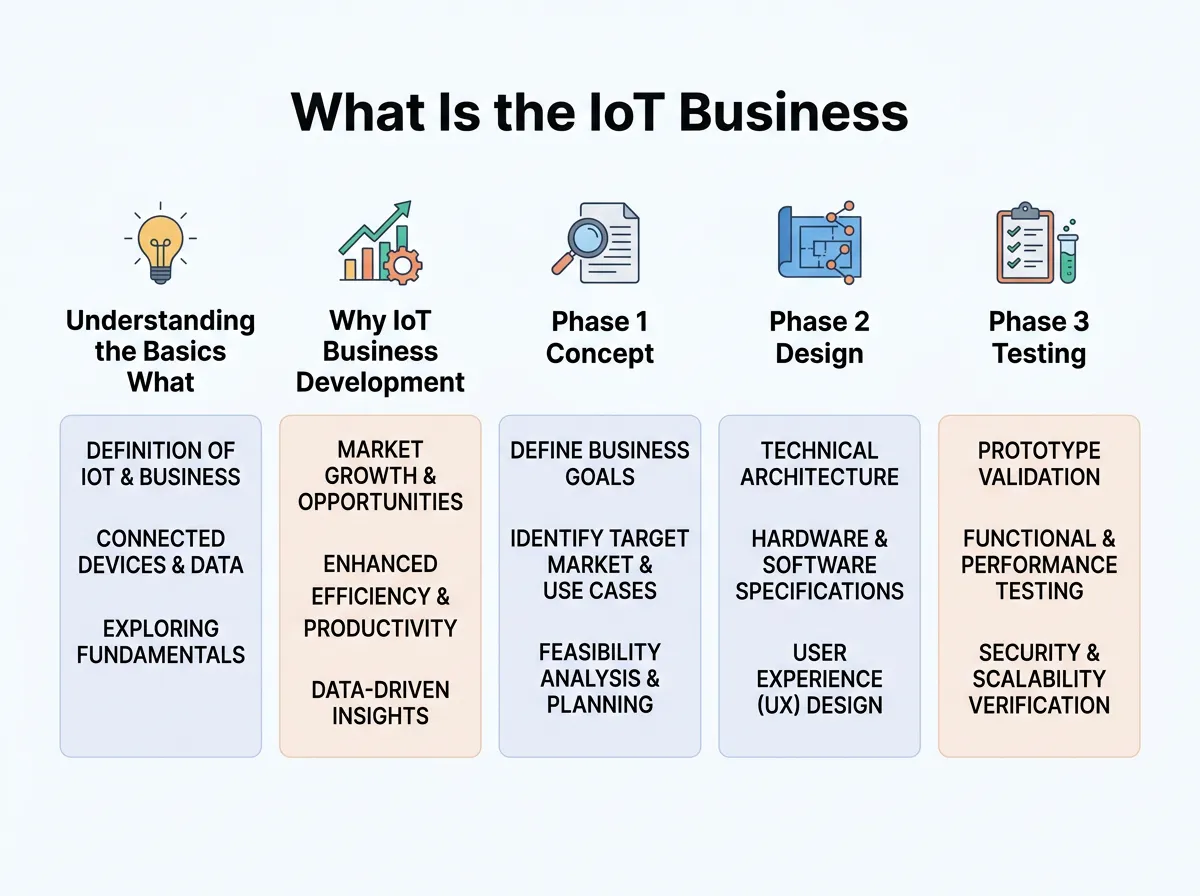
What Is the IoT Business Development Process? — key points at a glance
The Hardware Factor
If you write a software bug, you can push a patch in minutes. But if you make a mistake in your hardware design, you might have to discard thousands of physical products. Hardware has real, physical costs. It takes time to manufacture, ship, and store. The IoT business development process must account for these manufacturing timelines and costs from the very beginning.
The Connectivity Factor
IoT devices must communicate. They need to send data to the cloud. This means you have to choose the right way for them to connect. Will they use Wi-Fi, Bluetooth, or cellular networks? Each option has different costs and battery life needs. Choosing the wrong one can break your business model.
Phase 1: Concept and Market Research
Every great product starts with an idea. But in the IoT world, an idea is not enough. You must validate it before spending a single dollar on manufacturing.
Identifying the Core Problem
Do not build a smart device just because you can. Build it because it solves a painful problem. For example, a smart water valve is useful because water damage is highly expensive for homeowners. Always start with the user’s pain. Ask yourself: Who will buy this? Why do they need it? How much will they pay to solve this problem?
Choosing the Right Business Model
How will you make money? This is a vital question in the IoT business development process. Many companies make the mistake of only selling the hardware once. But hardware is expensive to make and has low profit margins.
Instead, consider an IoT business model that includes recurring revenue. You can charge a monthly fee for software access, data analytics, or continuous support. This keeps cash flowing into your business long after the initial sale. It turns a one-time customer into a long-term partner.
Phase 2: Design and Prototyping
Once you have a business model, it is time to build. This is where you turn your abstract thoughts into something you can hold in your hand.
Hardware and Software Synergy
In IoT, hardware and software are two sides of the same coin. You cannot design one without the other. Your hardware needs sensors to gather data. Your software needs to process that data and show it to the user.
If you want to understand this technical dance, look at decoding the IoT product development process. It shows how engineers keep these two elements in perfect sync. This phase is about making sure your device is reliable, energy-efficient, and easy to produce.
Building a Minimum Viable Product (MVP)
Do not try to build the perfect, feature-rich product on day one. Build an MVP first. An MVP has just enough features to satisfy early customers and prove the concept. It lets you test the market without spending your entire development budget.
Phase 3: Testing and Validation
Never launch an IoT product without testing it in the real world. Real-world conditions are very different from a cozy laboratory. If your device fails in the field, your business will suffer.
Lab Testing vs. Field Testing
Your device might work perfectly on your office desk. But will it work in a dusty factory? Will it work in freezing winter weather? Field testing helps you find these bugs early. Put your prototypes in real environments for a few weeks or months. Watch how they perform and gather feedback from early testers.
Security and Privacy Testing
IoT devices are frequent targets for hackers. A single security breach can ruin your brand. Test your device for vulnerabilities. Make sure all data sent to the cloud is fully encrypted. A secure device builds trust with your customers.
Phase 4: Launch and Scaling the Solution
You have a working product and a verified market. Now, you need to get it into the hands of your customers. This is the official launch stage of the IoT business development process.
Preparing for Launch
Launching a business requires careful prep. You must set up reliable supply chains, plan customer support, and organize marketing. To prepare, check out the steps on how to launch an IoT-enabled business. This preparation ensures you do not get overwhelmed when orders start coming in.
Scaling the Infrastructure
As you get more customers, your servers will have to handle more data. Your cloud infrastructure must be scalable. Use flexible cloud providers that can grow with your business without crashing. Ensure your customer support team is ready to handle technical questions from new users.
Common Pitfalls to Avoid in the IoT Journey
Building an IoT business is exciting, but it is easy to make mistakes. Here are three common traps to avoid:
- Over-engineering the Product: Do not add features that customers did not ask for. Keep your device simple and focused.
- Ignoring Post-Launch Costs: IoT devices require constant software updates, cloud hosting, and support. Always budget for these ongoing costs in your business plan.
- Underestimating Security: Do not treat security as an afterthought. Build it into your system from the very beginning.
Conclusion
So, What Is the IoT Business Development Process? It is your master plan for success. It is a journey that takes you from a simple idea to a scalable, revenue-generating smart product. By focusing on real customer needs, choosing the right business model, and testing thoroughly, you can avoid common traps.
Remember to take things one step at a time. Start with a solid concept, build a simple prototype, and scale up as you learn. With patience, research, and a clear process, your IoT business can truly thrive in today’s connected world.
Frequently Asked Questions
What is the IoT business development process?
It is the strategic roadmap used to design, build, launch, and scale a smart, connected physical product. It combines hardware engineering, software development, and modern business model planning to create a sustainable company.
Why is IoT development harder than software development?
IoT involves both physical hardware and digital software working together. Hardware has high manufacturing costs, longer development timelines, and cannot be easily patched after shipping, unlike pure software.
How do IoT companies make money?
Most successful IoT companies use a hybrid model. They sell the physical hardware for an upfront fee and charge a recurring monthly subscription for cloud software, data storage, and advanced analytics.
What is an IoT MVP?
An IoT Minimum Viable Product (MVP) is a basic, working version of your smart device with just enough features to solve the user’s primary problem. It is used to test the market and gather feedback before full-scale manufacturing.
How important is cybersecurity in IoT?
Cybersecurity is critical because connected devices are prime targets for hackers. Weak security can lead to data leaks, system hacks, and permanent damage to your brand’s reputation.
What is the best way to scale an IoT business?
To scale successfully, you must secure a reliable manufacturing partner, use a scalable cloud platform like AWS or Azure, and build a recurring revenue stream to support continuous software updates and customer service.
