

IoT platforms become incredibly expensive at scale due to the exponential growth of data transit fees, storage demands, and complex real-time processing requirements. As fleets expand from prototypes to millions of active nodes, minor inefficiencies in API calls, certificate management, and database queries compound into massive financial burdens. To keep costs under control, organizations must focus on edge computing, efficient data serialization, and optimized connectivity strategies.
Imagine you have just built a brilliant smart monitoring system. You start with ten devices testing the waters in your local office. They work perfectly. The dashboard is clean, the data flows smoothly, and your monthly cloud bill is less than a cup of coffee. Encouraged by this early success, your company decides to roll out 100,000 devices nationwide. You expect your costs to grow by a reasonable margin, but instead, you are hit with a cloud invoice that makes your jaw drop.
This shocking financial surprise is a common rite of passage in the hardware world. Many engineering teams find themselves asking the same frustrating question: Why Are IoT Platforms Expensive at Massive Scale? When you transition from a small proof of concept to an enterprise-grade deployment, the rules of software architecture change. What works for a few hundred devices can easily break your budget when deployed to millions of end points.
In this article, we will unpack the hidden drivers of these skyrocketing bills. We will explore how data transit, database management, security overhead, and platform pricing models conspire to inflate your costs. More importantly, we will share practical tips on how you can design your architecture to keep these expenses under control.
Key Takeaways
- Non-Linear Cost Growth: IoT costs do not scale linearly; data ingestion, processing, and cloud transit fees multiply rapidly as fleets expand.
- The Payload Penalty: Unoptimized, “chatty” protocols and large data payloads drive up cellular and cloud platform fees.
- Database Overhead: Storing and querying billions of unstructured time-series data points requires high-performance databases that are expensive to maintain.
- Security and Authentication Costs: Managing encryption keys, secure handshakes, and individual device certificates at scale demands significant computing and financial resources.
- Middleware Lock-in: Proprietary cloud platform pricing models often charge per message, making small architectural inefficiencies highly punitive at scale.
📑 Table of Contents
The Hidden Trap of Data Ingestion and Transit
The most immediate cost driver in any large IoT deployment is data ingestion. When we think of data, we often think of simple numbers. A temperature reading or a GPS coordinate seems incredibly small. However, at scale, the sheer frequency of these small packets creates a financial avalanche.
The Cost of Chatty Protocols
Devices are often programmed to report their status frequently. If a single device sends a tiny 100-byte message every ten seconds, it does not seem like a threat to your budget. But if you have 100,000 devices running 24 hours a day, that translates to over 25 billion messages a month. Many cloud IoT platforms charge you based on the absolute number of message operations. At this volume, even a fraction of a cent per thousand messages adds up to thousands of dollars every month.
Cloud Ingress and Egress Fees
Cloud providers love to charge for data moving across their network boundaries. While importing data is sometimes free, moving data between different regions, databases, or external services triggers egress fees. For those looking to control these expenses, mastering IoT connectivity cost optimization is a vital first step to preventing network fees from eating your margins.
Storage and Database Management at Petabyte Scale
Once your data safely arrives in the cloud, you have to store it. IoT data is usually time-series data. This means every single data point is tied to a specific timestamp. Storing, indexing, and querying this type of information is computationally expensive.
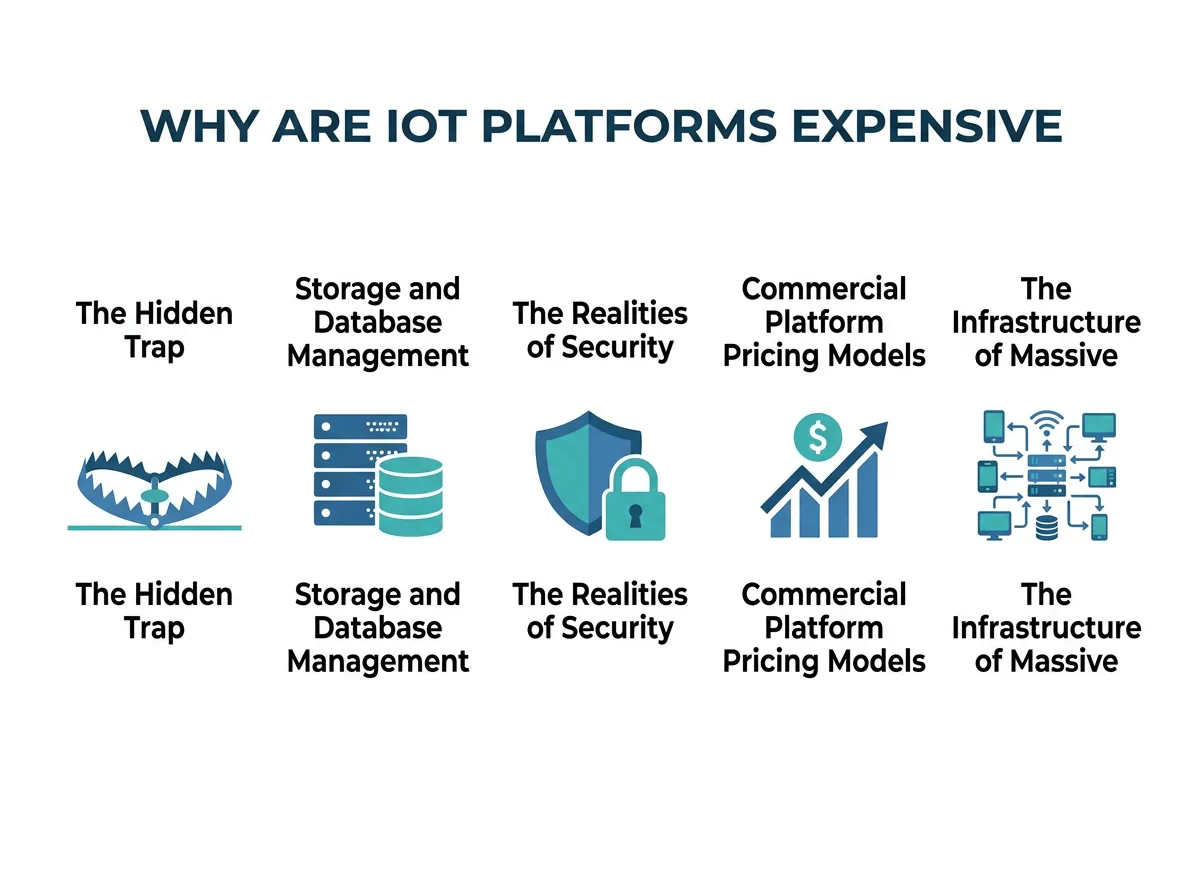
Why Are IoT Platforms Expensive at Massive Scale? — key points at a glance
Time-Series Database Bottlenecks
Standard relational databases are not built to handle the constant, rapid-fire writes that a massive IoT fleet generates. To handle this workload, you must use specialized time-series databases. These systems require high memory and storage capacity. As your database grows into the petabyte range, the cost of keeping that data hot and queryable rises fast. This database bloat is one of the biggest challenges of IoT project scalability that development teams face during rapid growth phases.
The Data Lifecycle Dilemma
Many businesses make the mistake of keeping all historical device data forever. Keeping cold data in high-performance storage is incredibly wasteful. Without a strict data retention and archiving policy, you will find yourself paying premium prices to store worthless data from three years ago that nobody will ever read.
The Realities of Security and Encryption Overhead
Security is non-negotiable for modern connected systems. However, maintaining high-level security for millions of devices introduces massive computational and administrative overhead. This reality explains another reason why are IoT platforms expensive at massive scale.
Cryptographic Handshake Costs
Every time a device establishes a secure connection with your platform, it must perform a cryptographic handshake. This process uses Transport Layer Security (TLS). The handshake requires several round-trips of communication and heavy mathematical calculations. If your devices disconnect and reconnect frequently due to poor cellular coverage, these handshakes consume massive amounts of battery power and network bandwidth. At scale, this extra overhead translates directly into larger data bills.
Certificate Management and Maintenance
To ensure secure communication, each device needs its own unique digital certificate. Managing, rotating, and validating millions of these certificates in real-time requires a robust Public Key Infrastructure (PKI). Operating a secure PKI at scale is highly complex. It requires dedicated security experts and expensive management software to avoid system-wide outages.
Commercial Platform Pricing Models vs. Open Source
The business model of your chosen IoT platform plays a massive role in your monthly expenses. Many companies choose commercial platforms for their ease of use, only to find themselves trapped in expensive pricing tiers later on.
Why Pay-Per-Message Billing Hurts
Many major cloud providers charge you based on the number of messages sent, rounded up to the nearest chunk of kilobytes. For example, if your device sends a 1.2-kilobyte payload, the platform might charge you for two full 1-kilobyte messages. When evaluating your architectural choices, choosing between commercial IoT platforms and open-source implementations is a critical decision that will impact your long-term operating costs.
The Vendor Lock-In Problem
Once your device firmware is written to work with a specific cloud provider’s proprietary SDKs, migrating to another provider is very difficult. This lock-in allows platform providers to raise prices or adjust their billing metrics, leaving you with very little leverage to negotiate better rates.
The Infrastructure of Massive IoT
To truly understand why are IoT platforms expensive at massive scale, we must look at the physical and virtual infrastructure that keeps the lights on. Many organizations look at unleashing the power of massive IoT without realizing the backend architecture required to process concurrent connections.
When millions of devices attempt to connect at the exact same moment—such as after a regional power outage—the platform experiences a massive spike in traffic. To handle these “thundering herd” scenarios, your platform must maintain over-provisioned load balancers and server clusters. This idle capacity costs money, even when your devices are sleeping peacefully.
Practical Tips to Optimize Your Massive IoT Costs
Fortunately, you do not have to accept high cloud bills as an unavoidable reality of doing business. By making smart engineering choices early on, you can drastically reduce your scaling costs.
- Embrace Edge Computing: Do not send raw data to the cloud. Program your devices to process data locally. Only upload anomalies or summary reports to reduce transmission fees.
- Optimize Your Payloads: Replace verbose JSON payloads with efficient binary formats like Protocol Buffers or MessagePack. This simple shift can cut your data transmission costs in half.
- Implement Smart Sleep Cycles: Reduce the frequency of your device updates. If a sensor only changes slightly over an hour, there is no need to report the data every ten seconds.
- Adopt a Multi-Temperature Storage Strategy: Move older data to cheaper, cold-storage tiers like Amazon S3 Glacier or Azure Archive Storage as soon as it is no longer needed for real-time analysis.
Conclusion
Building a massive IoT fleet is an exciting achievement, but it comes with unique financial challenges. Why Are IoT Platforms Expensive at Massive Scale? The answer lies in the compounding nature of data transit, storage, security, and infrastructure overhead. When you multiply tiny inefficiencies by millions of devices, your cloud bill grows exponentially.
By understanding these hidden cost drivers and designing your system with edge processing, optimized protocols, and smart data lifecycle policies, you can build a highly scalable system that remains highly profitable. Plan your architecture with scale in mind from day one, and your budget will thank you tomorrow.
Frequently Asked Questions
Why do small payloads cost so much on IoT platforms?
Even small payloads become expensive because IoT platforms often charge flat rates per message or round up payload sizes to the nearest kilobyte. When millions of devices send small packets frequently, the sheer volume of transactions and network handshakes leads to massive cumulative charges.
Can edge computing reduce my IoT platform bills?
Yes, edge computing is one of the most effective ways to lower your costs. By processing data directly on the device and only sending critical alerts or compressed summaries to the cloud, you can drastically reduce data transit and storage fees.
How does database choice affect IoT scalability costs?
IoT platforms generate continuous streams of time-series data that can quickly overwhelm standard databases. High-performance time-series databases are required to index this data, but they consume significant memory and storage resources, driving up infrastructure costs at scale.
Is open-source cheaper than a proprietary IoT platform?
Open-source platforms can reduce license and per-message fees, but they require significant internal engineering resources to set up, maintain, and secure. For some organizations, the operational labor costs of open-source software can exceed the subscription costs of commercial platforms.
How do security requirements increase IoT scaling costs?
Security at scale requires robust cryptographic handshakes, continuous certificate management, and active encryption. These tasks consume significant bandwidth, device battery life, and server-side processing power, all of which drive up overall expenses.
What is vendor lock-in in the context of IoT?
Vendor lock-in happens when your device firmware is tightly coupled with a specific cloud provider’s proprietary software development kits (SDKs). Migrating away from an expensive platform later becomes incredibly costly because it may require updating the firmware on millions of physical devices in the field.
