

To avoid hidden fees from your IoT provider, you must carefully analyze contracts for sneaky charges like activation fees, data overage penalties, and suspension costs. By choosing providers with transparent pricing and flexible data pooling, you can safeguard your budget and scale your smart device network without unexpected billing surprises.
Imagine you finally launched your smart business project. You deployed one hundred smart sensors across the city. Your team is happy, and the data is flowing perfectly. But then, the first monthly bill arrives. You open the envelope, and your jaw drops. The total is twice what you expected! This is a very common nightmare for business owners. Many teams jump into smart tech projects without realizing how complex the billing can be.
How can you protect your budget from these surprise line items? In this guide, we will break down exactly how to navigate your contract. We will look at where these sneaky charges hide and explain how to avoid hidden fees from an IoT provider once and for all. Let’s make sure your smart network remains an asset, not a massive financial drain.
Key Takeaways
- Analyze Contract Details: Always check for hidden costs like activation, SIM lifecycle, and platform access fees before signing.
- Choose Pooled Data Plans: Prevent heavy overage penalties by sharing data across all devices in your network.
- Watch Out for Suspension Fees: Some providers charge you to pause or reactivate inactive SIM cards.
- Verify Integration Costs: Avoid unexpected setup bills by ensuring API and platform integrations are included.
- Demand Transparent Pricing: Work with reputable providers who offer clear, upfront billing structures.
📑 Table of Contents
1. Demystifying the True Cost of IoT Connectivity
The Allure of Cheap Upfront Pricing
Many providers lure you in with cheap SIM cards. They might offer a card for just a few pennies. It sounds like a great deal, right? But cheap hardware is often a trap. Providers make up for low hardware prices by charging higher rates elsewhere. It is easy to fall for this trick when you want to keep initial setup costs low. However, looking only at the starting price is a mistake. You must look at the total cost of ownership over the lifetime of your devices. Learn more about the hidden cost of cheap IoT solutions before making your choice.
Where the Extra Pennies Go
The real cost of a smart device network goes far beyond the SIM card. You have to pay for data, network access, platform usage, and support. When you add these up, the actual monthly cost can skyrocket. Some companies find that their monthly bills are 50% higher than their initial estimates. This happens because minor charges are buried deep inside long contracts. Understanding where every single penny goes is the first step to keeping your budget under control.
2. Sneaky SIM Lifecycle and Activation Charges
The Hidden Costs of Just Getting Started
Did you know that some providers charge you just to turn a SIM card on? These are called activation fees. If you deploy thousands of devices, a small activation fee of two dollars per card adds up fast. There are also network access charges that sneak into your bill. Many businesses do not realize they are paying connectivity access fees just to keep their devices linked to the network. These fees apply whether your devices are active or not. Always ask your provider if they charge a fee for every new SIM you register.
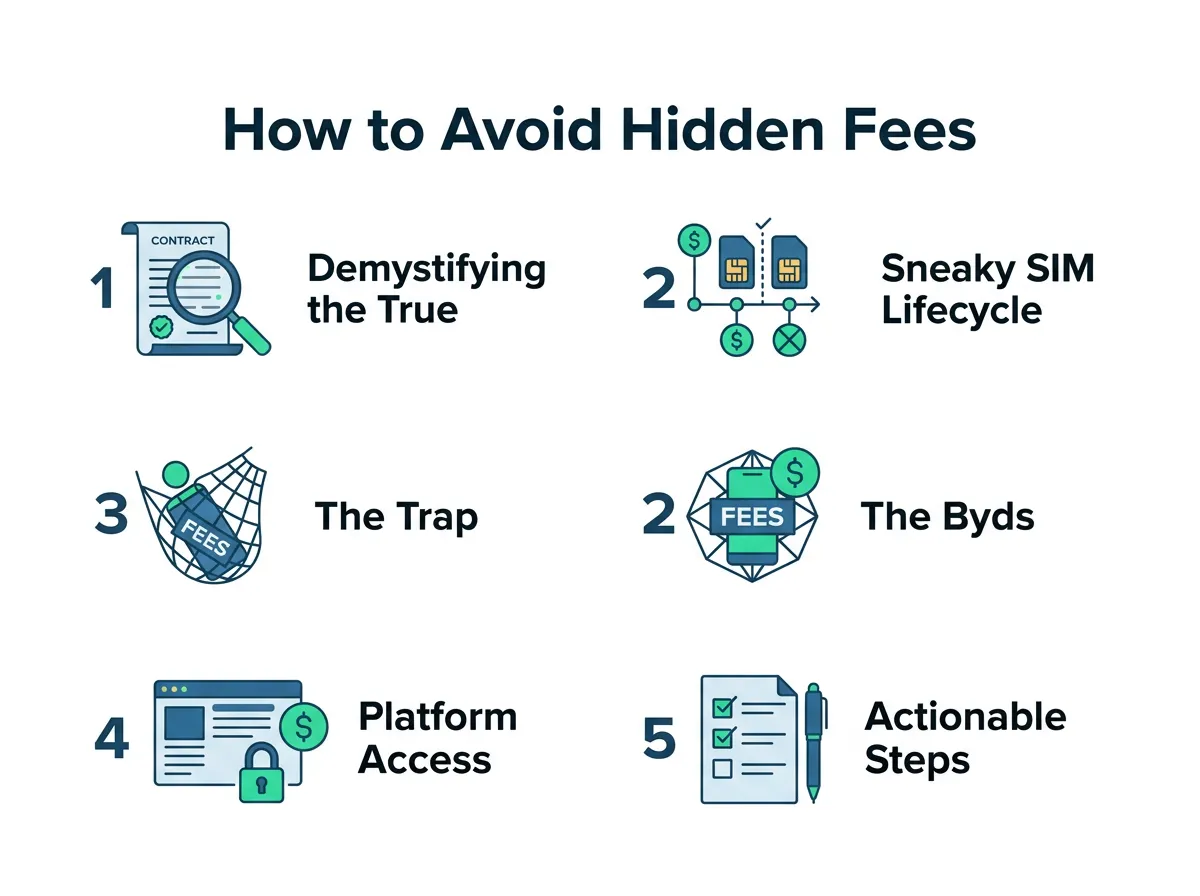
How to Avoid Hidden Fees From an IoT Provider? — key points at a glance
When planning your deployment, you must ask: how to avoid hidden fees from an IoT provider during the setup phase? The best answer is to negotiate zero activation fees for bulk orders. This keeps your initial rollout cheap and predictable.
What Happens When You Pause a Device?
Your business might be seasonal. For example, you might use smart agricultural sensors only during the summer. In the winter, you want to pause your service. But beware! Many providers charge a suspension fee to pause your SIM cards. Some will even charge you a reactivation fee to turn them back on. These lifecycle fees can drain your budget during the off-season. Make sure your contract allows you to pause and resume service for free.
3. The Trap of Rigid Data Plans and Overage Penalties
Why Fixed Plans Can Break the Bank
Many traditional cellular providers offer fixed data plans. For instance, they might give you 5 megabytes of data per device each month. If a device uses 5.1 megabytes, you get hit with a massive overage penalty. These overage rates can be ten times higher than your normal data rate. Since smart devices sometimes experience software glitches, they can suddenly consume much more data than usual. This makes fixed plans highly risky for your business budget.
How Data Pooling Saves the Day
The easiest way to avoid overage penalties is through data pooling. With a pooled plan, all your devices share a single bucket of data. If you have 100 devices with 5 megabytes each, you have a total pool of 500 megabytes. If one device uses 10 megabytes and another uses only 1, you will not face any penalties. This flexibility is essential for unpredictable networks. To understand how these structures affect your budget, look closely at the hidden costs of IoT connectivity before signing up. Knowing how to avoid hidden fees from an IoT provider means choosing plans that adapt to your actual usage.
4. Platform Access and Integration Hurdles
Paying for Your Own Data Access
Many providers offer a dashboard or cloud platform to manage your SIM cards. At first glance, this software seems free. However, some companies charge platform access fees after a trial period. They might also charge you every time your devices send data to your own servers. This is called an API call fee. If your devices update their status every minute, these API fees can quickly pile up.
Software and Security Upgrades
Keeping your devices secure is crucial. However, poor software integration can lead to massive security and operational expenses. You should always watch out for the unexpected costs of poor IoT integration which often stem from bad platform compatibility. If your provider’s software does not work well with your cloud, your team will spend hours writing custom code. This wastes time and money. Always ask if security updates and API access are fully included in your monthly subscription.
5. Actionable Steps to Protect Your Bottom Line
Negotiate Clean Contracts Upfront
Do not accept the first contract your provider offers. Everything is negotiable. Ask for a customized pricing plan that fits your specific business model. Ask them to write down all possible fees in a single document. If a fee is not on that list, you should not have to pay it. This simple step is one of the best secrets on how to avoid hidden fees from an IoT provider.
Monitor Your Fleet in Real-Time
Use management tools to track your data usage daily. Set up automated alerts to warn you if a device uses too much data. If a device goes rogue, you can pause it instantly before it racks up high charges. Keeping a close eye on your fleet ensures you are never surprised by your monthly bill.
Conclusion
Managing a fleet of smart devices is an exciting way to grow your business. But you must be smart about your expenses. By studying contract details, choosing pooled data plans, and monitoring your devices, you can keep your costs highly predictable. You do not have to fall victim to unexpected charges. Armed with the right questions, you now know how to avoid hidden fees from an IoT provider. Keep your budget safe and watch your smart business thrive!
Frequently Asked Questions
What is an IoT activation fee?
An activation fee is a one-time charge to turn on a new SIM card. Providers often charge this fee when you register a new device on their network. You can often negotiate to have this fee waived if you purchase SIM cards in bulk.
What does data pooling mean?
Data pooling allows multiple smart devices to share a single, combined bucket of data. This prevents single devices from triggering expensive overage charges if they use more data than expected. It is one of the best ways to keep your monthly bills predictable.
Are there fees for pausing an IoT SIM card?
Yes, many providers charge a suspension fee when you temporarily pause a SIM card’s active service. They may also charge a reactivation fee when you want to use the card again. Always review your contract to see if these fees apply to seasonal devices.
What is an API call fee in IoT?
An API call fee is a charge for pulling data from your provider’s platform into your own systems. If your smart devices update their status frequently, these micro-transactions can quickly add up. Be sure to ask your provider if platform and API access are included in your base rate.
Can I negotiate my IoT contract terms?
Absolutely, you can and should negotiate your IoT connectivity contract. Most providers are willing to adjust their terms, especially if you have a large number of devices. Focus on removing setup fees and creating a flexible data plan that fits your needs.
How do I monitor rogue data usage?
You can monitor your data by using your provider’s connectivity management platform to set up real-time alerts. These alerts notify you immediately if any device exceeds its daily or weekly usage limit. This allows you to pause the device before it incurs massive overage penalties.
