

The best cloud storage for IoT depends on your specific data needs, but AWS IoT Core, Microsoft Azure IoT Hub, and Google Cloud are the leading choices. These platforms excel because they handle massive streams of real-time sensor data with high security, low latency, and flexible pricing. Selecting the right option requires balancing your budget, device scaling needs, and analytical tools.
Imagine living in a world where your toaster talks to your fridge. Your fitness band tracks your steps and tells your home thermostat to lower the temperature. This is the Internet of Things (IoT) in action. Today, millions of smart devices constantly talk to each other. They gather, send, and process endless streams of data every single second.
With all this data flowing, a big question pops up. Where does all this information go? Finding the right place to store this data is a major challenge for businesses and builders. If you are asking yourself, what is the best cloud storage for IoT, you are in the perfect spot to get answers.
In this guide, we will break down the top cloud storage options for your connected devices. We will look at major cloud platforms, different storage types, and how to choose the right fit for your budget. Let us dive in and find the best home for your IoT data.
Key Takeaways
- Top Providers: AWS and Azure lead the market with dedicated, highly secure IoT hubs.
- Data Types Matter: IoT devices generate structured and unstructured data, which requires flexible, hybrid database systems.
- Security is Crucial: Look for end-to-end encryption and robust access management to protect device data from leaks.
- Scalability: Choose a cloud provider that can scale automatically as you add more smart devices.
- Cost Management: Optimize cloud costs by filtering unnecessary telemetry data at the edge before it is stored.
📑 Table of Contents
Why IoT Storage is Different from Normal Storage
You might think that storing IoT data is just like saving photos on your phone. However, IoT data is very different. Normal cloud storage often holds large, static files like documents and videos. If you want to know about general file saving, you can look at the best cloud storage apps for daily tasks. But IoT devices do not work that way.
The Speed and Volume of IoT Data
IoT devices send small bits of data very quickly. A smart meter might send a reading every second. A single device does not send much. But if you have ten thousand devices, they create a massive flood of data. This requires a system that can handle fast, continuous writes without slowing down.
Structured vs. Unstructured Data
IoT data comes in many shapes. Some devices send simple numbers, like temperature or speed. Others send voice recordings, video feeds, or complex logs. To handle this mix, you need to understand different IoT storage approaches that can manage both structured and unstructured data at scale.
The Top Cloud Platforms for IoT
When searching for the best cloud storage for IoT, the biggest tech companies offer the most robust services. They do not just store your data; they also give you tools to analyze it in real time.
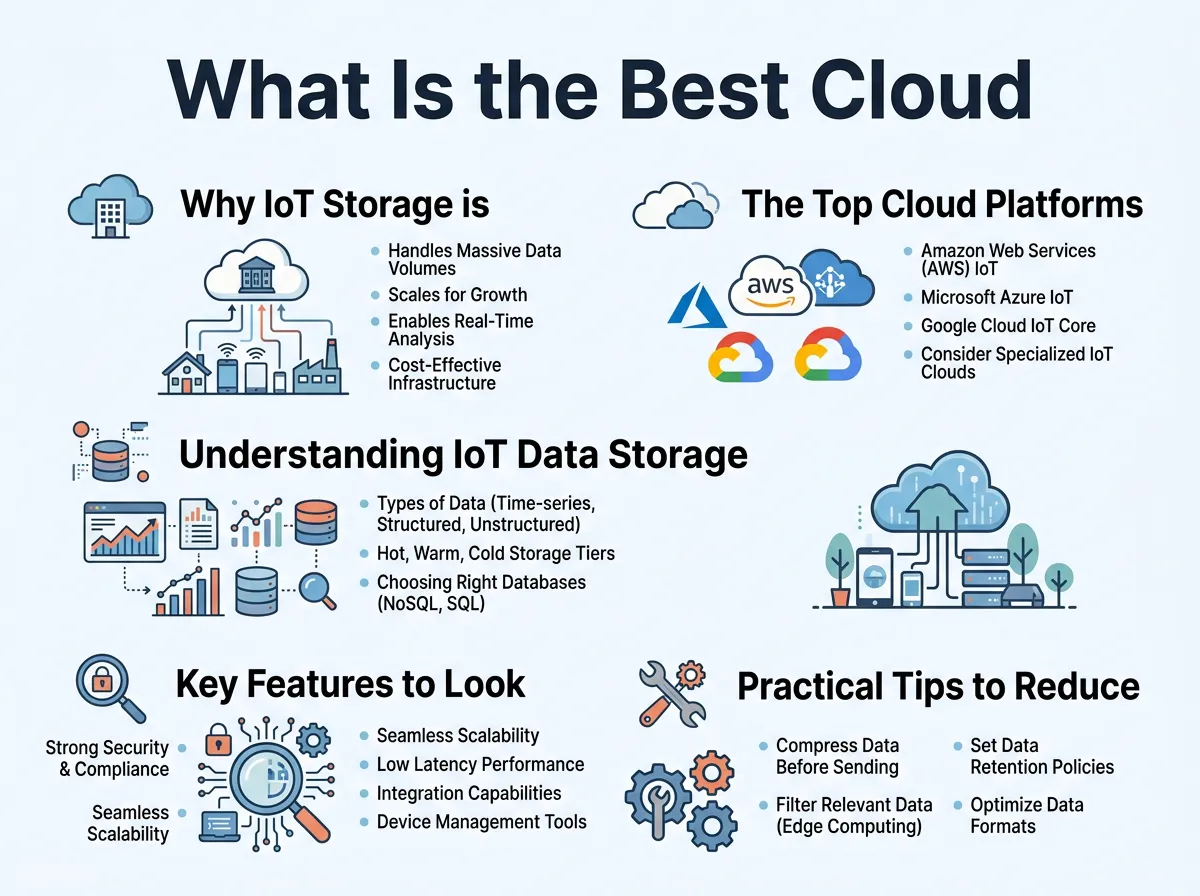
What Is the Best Cloud Storage for IoT? — key points at a glance
Amazon Web Services (AWS) IoT Core
AWS is a giant in the cloud space. Their IoT Core platform is excellent for connecting devices safely. It uses a system that lets devices talk to the cloud easily. Once the data arrives, AWS routes it to the right storage option. You can use Amazon S3 for cheap, long-term storage. You can also use Amazon DynamoDB for fast, structured database storage. AWS is highly reliable and scales to millions of devices.
Microsoft Azure IoT Hub
Microsoft Azure is another massive player. Azure IoT Hub connects almost any device to the cloud. It works very well with other Microsoft tools. If you use Windows systems or enterprise software, Azure is a great fit. It offers secure communication and integrates with Azure Cosmos DB. This database is perfect for storing fast, global IoT data with low delay.
Choosing Specialized IoT Platforms
Sometimes, the big three clouds can feel too complex. If you want a system made just for smart devices, you should look for the best IoT cloud platform tailored to your specific industry. These platforms often come with pre-built dashboards. They make it easy to see your device data without writing complex code.
Understanding IoT Data Storage Architectures
To store your data correctly, you need to know how it will be organized. You cannot just dump everything into a single folder. You need a smart architecture.
Time-Series Databases
Most IoT data is time-series data. This means every piece of data has a timestamp. For example, “Temp: 72 degrees at 10:01 AM.” Time-series databases are built to search through this time-based data very fast. They are perfect for tracking trends over days, weeks, or years.
Data Lakes and Databases
A data lake is like a giant digital pool. You can throw all your raw, unstructured data in there. It is cheap and holds vast amounts of info. Later, you can clean the data and move it to a structured database. To learn more about how to set this up, check out common iot data storage architectures that keep your systems running smoothly.
Key Features to Look For in IoT Cloud Storage
How do you pick the absolute best cloud storage for IoT? Look for these three key features before you sign up for any service.
Security and Device Safety
Smart devices can be targets for hackers. Your cloud storage must have strong security. Look for end-to-end encryption. This means your data is locked while it travels from the device to the cloud. It should also have unique keys for every single device. If one device gets hacked, the rest of your system remains safe.
Real-Time Analytics Integration
Storing data is only half the battle. You also need to use it. The best storage options connect directly to analytics tools. This lets you see live graphs of your devices. It also lets you set up alerts. For example, if a machine gets too hot, the system can send you an email immediately.
Scalability and Elasticity
Your business might start with ten smart devices today. Next year, you might have ten thousand. Your cloud storage must be elastic. This means it can grow automatically when you add new devices. You should not have to manually set up new servers every time you expand.
Practical Tips to Reduce Your IoT Cloud Costs
Cloud storage can get expensive if you are not careful. Here are a few simple tips to keep your bills low.
Filter Data at the Edge
Do you really need to send every single temperature reading to the cloud? Probably not. You can set up your devices to only send data when something changes. For example, if the temp stays at 70 degrees, the device stays quiet. If it jumps to 75, it sends an alert. This reduces the amount of data you send and store.
Set Up Data Lifecycle Policies
Not all data needs to live forever. You might need detailed sensor data for only thirty days. After that, you can delete it or move it to cheap “cold” storage. Most top cloud providers let you set up automatic rules to clean up old data.
Conclusion
So, what is the best cloud storage for IoT? The answer depends on your project. If you want a massive, proven system, AWS IoT Core or Microsoft Azure are top choices. If you want something simpler, look into specialized IoT platforms. Always focus on security, scalability, and how well the storage integrates with analytics. By planning your data architecture early, you can build a smart, safe, and cost-effective IoT system that grows with your needs.
Frequently Asked Questions
Why can’t I use normal cloud storage for IoT?
Normal cloud storage is built for large, single files like photos or documents. IoT devices send millions of tiny, rapid data points that require special databases to handle the high speed and continuous write volume.
What is a time-series database in IoT?
A time-series database is a storage system optimized for data points associated with timestamps. It makes it very fast to track, query, and analyze changes and trends over time from your smart devices.
Is AWS IoT Core safe to use?
Yes, AWS IoT Core is highly secure. It offers end-to-end encryption, unique device identities, and fine-grained access control to keep your device communication safe from hackers.
How does edge computing help reduce storage costs?
Edge computing processes data directly on your physical devices before sending it to the cloud. By filtering out useless or repetitive data at the source, you store less and save money on your cloud bill.
What is the cheapest way to store old IoT data?
The cheapest way is to use a combination of hot and cold storage. Keep fresh data in fast databases for active use, and set up automatic rules to move old data to low-cost archival storage like Amazon S3 Glacier.
Can I build my own IoT storage system?
Yes, you can build your own system using open-source databases like InfluxDB or Apache Cassandra. However, using a managed cloud provider is usually much easier and requires far less manual maintenance.
