

An Internet of Things (IoT) operating system is a specialized, lightweight software platform designed to run on resource-constrained devices like smart sensors, wearables, and appliances. Unlike heavy computer operating systems, it manages tiny amounts of memory and power while ensuring reliable communication and task processing. These systems act as the digital brain that enables everyday objects to connect to the internet and work together seamlessly.
Imagine waking up in the morning. Your smart alarm clock gently turns on the lights. Your coffee maker starts brewing a fresh pot right on time. Your thermostat adjusts to the perfect temperature. All of these devices work together to make your life easy. We often use these smart gadgets without thinking about how they actually function. They seem like magic, but they rely on very clever software to run.
You might wonder what makes these small gadgets so smart. They do not have a big computer tower or a laptop screen. Yet, they can talk to each other, connect to the internet, and make decisions in real time. The secret behind this magic is a special type of software. In this guide, we will explore the technology that powers our smart world and answer the big question: what is an Internet of Things operating system?
We will break down how these systems work in simple terms. We will look at why they are different from normal computer systems. We will also explore the key features to look for and show you some real-world examples. By the end, you will understand how these tiny systems keep our connected world moving every single day.
Key Takeaways
- Specialized Design: These operating systems are built specifically for small devices with limited power and memory.
- Real-Time Processing: Many IoT systems require instant responses, making Real-Time Operating Systems (RTOS) highly valuable.
- Resource Efficiency: They use very little RAM and storage, sometimes fitting into just a few kilobytes.
- Vital Security: Built-in security features protect smart devices from cyber threats and unauthorized access.
- Diverse Options: Popular choices range from FreeRTOS and Zephyr to specialized versions of Linux.
📑 Table of Contents
Understanding the Basics of IoT
Before we dive into the software, we need to understand the hardware. The Internet of Things is a giant network of physical objects. These objects collect and share data over the internet. You can find them in homes, factories, cars, and hospitals. If you want to learn more about the foundation of this network, you can read about the fundamentals of the Internet of Things to see how it links our physical and digital lives.
Every smart device has physical parts. These parts include sensors to gather data and microchips to process information. However, the hardware cannot do anything on its own. It needs instructions. It needs a way to manage its power, speak to other devices, and run applications. This is where a dedicated operating system comes into play.
What Is an Internet of Things Operating System?
So, what is an Internet of Things operating system? At its core, it is a lightweight software platform. It acts as the bridge between the hardware of a smart device and the applications running on it. Think of it as the manager of a very busy, very small office. This manager decides which tasks get done first, how to share limited supplies, and how to send messages to the outside world.
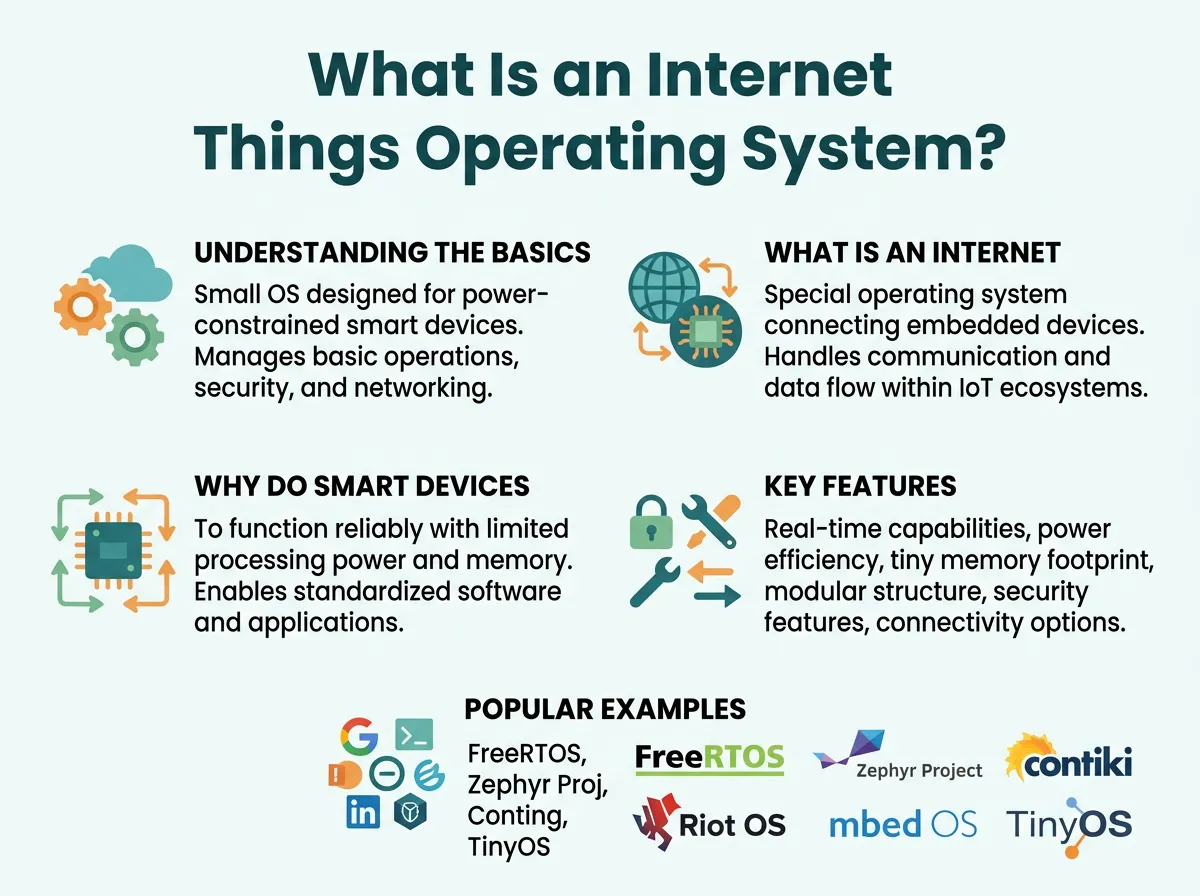
What Is an Internet of Things Operating System? — key points at a glance
Unlike a regular computer, a smart device does not need to run web browsers, video games, or heavy office software. It usually has one specific job to do. For example, a smart water sensor only needs to check for leaks and send an alert if it finds water. Because of this, an highly efficient software platform is designed to be as small and simple as possible. It strips away all the extra weight of a normal operating system to focus purely on the essentials.
Why Do Smart Devices Need Their Own Operating System?
You might wonder why we cannot just use Windows, macOS, or standard Linux on these devices. The simple answer is that those systems are far too large. Your laptop has gigabytes of RAM and a powerful processor. A smart lightbulb might only have a few kilobytes of memory and a very simple chip. A normal operating system would crush a small smart device under its own weight.
There are several critical reasons why smart devices require their own specialized software:
1. Extreme Resource Constraints
Most smart devices are tiny. They have very little storage space and memory. A standard operating system requires a lot of space just to turn on. An IoT operating system can run on a fraction of a megabyte. This small footprint allows manufacturers to make smaller and cheaper devices.
2. Power Management
Many smart sensors live in remote places. They might sit in a farm field or inside a wall. These devices often run on small batteries that need to last for years. A standard computer system drains batteries very quickly. IoT systems are built to save every drop of power. They put the device into a deep sleep when it is not working and wake it up only when needed.
3. Real-Time Performance
Some smart devices perform critical tasks. Think of a medical heart monitor or the brakes in a smart car. These devices cannot afford a delay. If a system gets stuck loading, the results could be dangerous. IoT systems often use real-time scheduling. This means they guarantee that important tasks happen instantly, without any lag.
Key Features of an IoT Operating System
To understand the role of operating systems in IoT, we must look at their core features. These features help them handle the tough demands of the connected world. Here are the most important elements:
- Small Footprint: The software must use very little memory. It should only include the absolute necessary code for the device to function.
- Connectivity Support: It must know how to talk to other systems. This includes built-in support for Wi-Fi, Bluetooth, Zigbee, and cellular networks.
- Security Protocols: Because these devices connect to the internet, they are targets for hackers. Good systems have strong, built-in security to encrypt data and protect users.
- Portability: Smart devices use many different types of microchips. The software must be able to run on various hardware designs easily.
Popular Examples in the Industry
There is no single system that runs every smart device. Instead, developers choose from a variety of options based on their specific needs. Understanding the architecture of IoT systems helps developers pick the perfect match. Here are some of the most common options used today:
FreeRTOS
FreeRTOS is a very popular, open-source real-time operating system. It is incredibly small and simple. It is trusted by top companies all over the world. It is a great choice for simple devices like smart home sensors and small appliances.
Zephyr
Zephyr is another open-source system. It is supported by the Linux Foundation. It is highly modular, which means developers can easily add or remove features. It is built with security in mind and works well on devices with limited resources.
Embedded Linux
For larger smart devices, like smart TVs or advanced robotics, developers often use a stripped-down version of Linux. It requires more power and memory than FreeRTOS, but it offers massive flexibility and can run complex applications.
How to Choose the Right System
If you are planning to build a smart device, choosing the right software platform is a big decision. Here are a few practical tips to help you make the best choice:
First, look at your hardware. Check how much memory and storage you have. If your resources are very low, look at simple real-time systems like FreeRTOS. If you have a bit more power, a lightweight Linux system might work better.
Second, think about power. Will your device plug into a wall, or will it run on a battery? If it runs on a battery, choose a system that has excellent power-saving sleep modes.
Finally, look at the community. Choose a system that has active developers and good documentation. When you run into a problem, a strong community will help you find a solution quickly.
The Future of Connected Devices
The world of connected devices is growing faster than ever. Every day, more objects join the global network. As artificial intelligence grows, our smart devices will need to become even smarter. They will need to process complex data right on the device rather than sending it all to the cloud.
This means that IoT operating systems will continue to evolve. They will become more secure, more efficient, and better at handling advanced tasks. They will remain the quiet, unseen heroes of our digital lives, working behind the scenes to keep us connected, safe, and comfortable.
Frequently Asked Questions
What is an IoT operating system?
An IoT operating system is a lightweight software platform designed specifically for smart devices. It manages the hardware resources, handles connectivity, and runs applications on devices with limited memory and power.
How does an IoT OS differ from a normal OS?
A normal OS like Windows is large and needs a lot of memory and power to run computer programs. An IoT OS is extremely small, uses very little power, and focuses only on simple, specific tasks.
What is an RTOS in the context of IoT?
An RTOS, or Real-Time Operating System, is a system that processes data and events instantly without any delay. It is crucial for critical smart devices, like medical equipment or self-driving car sensors, where timing is everything.
Can a smart device run without an operating system?
Yes, some very simple smart devices run on bare-metal firmware without a full operating system. However, as devices become more complex and need secure internet connections, an operating system becomes necessary.
Is Linux used for the Internet of Things?
Yes, stripped-down versions of Linux, known as Embedded Linux, are widely used for more powerful smart devices. These include smart hubs, security cameras, and advanced industrial machinery.
Are IoT operating systems secure?
Most modern IoT operating systems are built with strong security features, such as data encryption and secure boot processes. However, keeping the device secure also depends on regular software updates and safe network practices.
