

The best eUICC SIM for IoT devices is one that combines global multi-carrier coverage, robust security, and an easy-to-use platform. By choosing a provider that blends multi-IMSI fallback with eUICC standards, you ensure your devices never lose their signal. A great choice will also offer flat-rate pricing to keep your scaling costs low and predictable.
Imagine deploying thousands of smart sensors across different countries. You feel proud of your hard work. Then, a local cellular carrier goes out of business. Suddenly, your smart devices go dark. To fix this, you have to send a team to swap thousands of plastic cards. This nightmare is why companies love modern connectivity solutions.
Choosing the right tool is a big decision for any smart project. You might ask yourself, what is the best eUICC SIM for IoT devices? The answer depends on your business goals, your locations, and your data needs. There is no single card that fits every project perfectly.
In this guide, we will explore how these smart cards work. We will look at key features you should look for in a provider. We will also share tips to help you choose the ideal option for your business.
Key Takeaways
- Over-the-Air Updates: eUICC technology lets you change carriers remotely without swapping physical cards.
- Global Coverage: The best SIMs offer multi-carrier access to avoid dead zones in different countries.
- Cost Savings: eUICC reduces truck rolls and maintenance costs by managing profiles digitally.
- Future-Proofing: You can update security settings and network profiles as technology evolves over time.
- Unified Platform: A single management portal helps you track and control thousands of devices at once.
📑 Table of Contents
Understanding eUICC Technology
What is eUICC? It stands for Embedded Universal Integrated Circuit Card. It is not just a piece of plastic. It is a software standard that runs on a chip. This technology allows you to store multiple network profiles on one single card.
The Difference Between eSIM and eUICC
Many people get confused by these terms. They often use them to mean the same thing. However, they are different. eSIM refers to the physical hardware. It is the chip soldered onto the device board. On the other hand, eUICC is the software on that chip. It is the engine that lets you change carrier profiles over the air. You can read more about eUICC standards and specifications to see how this software keeps things secure.
How Remote Provisioning Works
Remote provisioning is like magic for tech teams. It sends new carrier details through the cellular network. When your device boots up, it asks for a profile. The server sends the profile down to the chip. The chip saves it. Now, your device connects to the new network. You do not need to touch the physical device at all.
Why IoT Devices Need eUICC SIMs
Traditional SIM cards lock you into one carrier. If that carrier has bad signal in a certain town, you are stuck. This is a major issue for mobile assets like trucks or cargo ships.
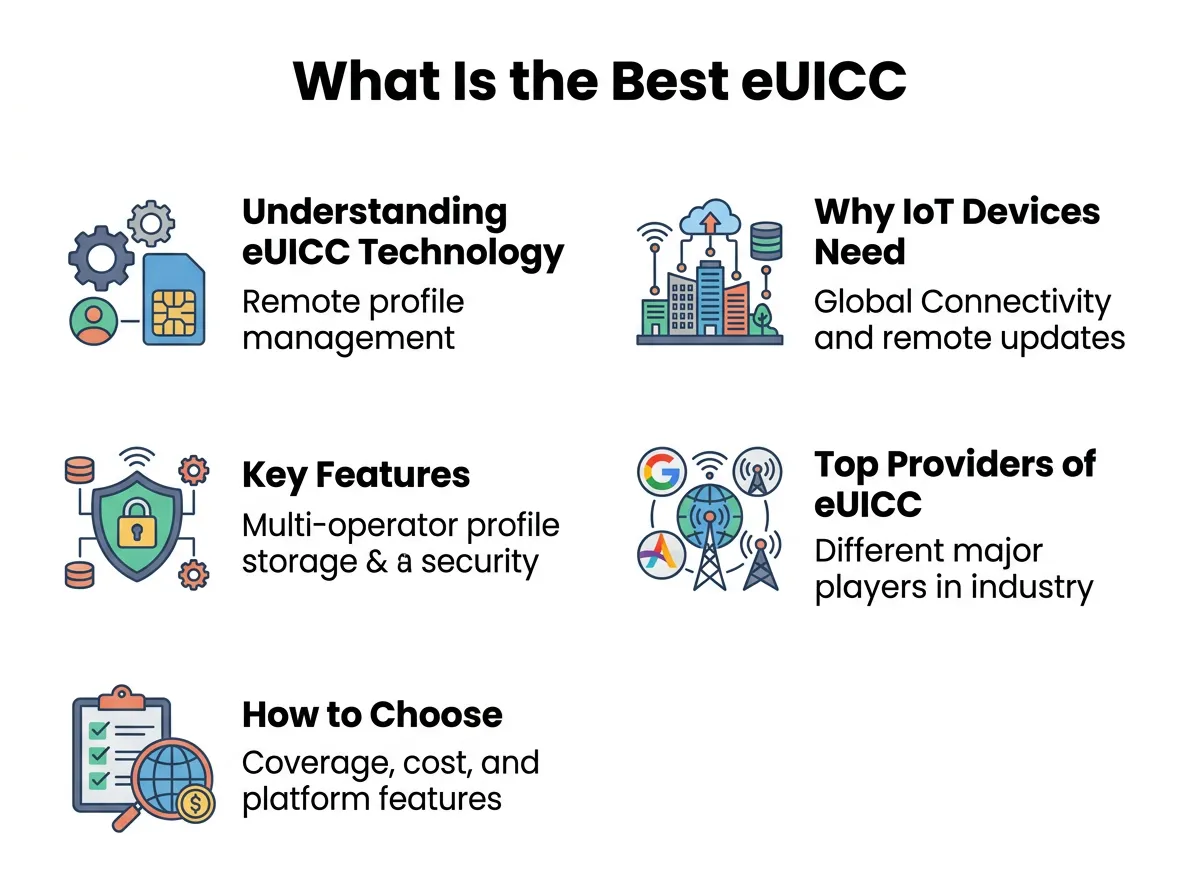
What Is the Best eUICC SIM for IoT Devices? — key points at a glance
No More Physical Swaps
Swapping cards is costly. It requires manual labor. If your devices are deep underground or high on a pole, swapping is almost impossible. An eUICC card removes this task completely. You change networks with a few clicks on your computer screen.
Global Scalability
With standard cards, you must buy different cards for different regions. With eUICC, you can use the same card everywhere. You ship one product to all your global customers. When the product arrives, it downloads the local profile automatically. This simplifies your supply chain.
Key Features of the Best eUICC SIMs
Not all eUICC solutions are the same. Some offer basic features, while others provide advanced tools. Here are the main features you should seek out.
Multi-IMSI Integration
The best providers do not rely on eUICC alone. They combine multi-IMSI and eUICC technology on the same card. Multi-IMSI allows the card to switch networks instantly if a signal drops. If that fails, eUICC acts as a backup. This double layer of protection keeps your devices online at all times.
User-Friendly Management Platform
You need an easy way to view your devices. A good provider offers a clean portal. This portal should show you data usage, location, and active profiles. If the portal is too complex, your team will waste valuable time trying to manage it.
Flexible Data Plans
Your devices might use very little data, like smart utility meters. Or, they might use a lot of data, like security cameras. Look for a vendor that lets you pool your data. Data pooling means active devices can share data with low-use devices. This prevents unexpected overage fees.
Top Providers of eUICC SIMs for IoT
Finding the right partner is critical. Let’s look at what the industry leaders offer to help you with choosing the right SIM technology for your IoT deployment.
Flat-Rate Pricing Pioneers
Some modern providers offer a simple flat-rate model. You pay once for the card and a set amount of data. This is great for startups. It helps you calculate your costs far into the future. You do not have to worry about monthly bills that change constantly.
Global Network Powerhouses
Large telecom groups offer vast coverage. They have contracts with hundreds of partners worldwide. These providers are best for large enterprises with huge fleets. They offer high-speed 4G and 5G connections. However, their management platforms can be complex to learn.
Specialist IoT Vendors
These companies focus only on smart devices. They do not sell phones or consumer plans. Because of this, their support teams understand your unique problems. They offer highly optimized cards with reliable IoT eSIM features built for low power consumption.
How to Choose the Right Provider for Your Project
Now you know the features to look for. How do you make the final choice? Use these practical steps to guide your decision.
Assess Your Coverage Needs
Make a list of the countries where your devices will go. Some providers have strong networks in Europe but weak networks in Asia. Make sure your provider has local roaming agreements in your target regions. This prevents high roaming fees.
Test Before You Buy
Never buy thousands of cards without testing them first. Ask providers for a few test cards. Place them in your devices. Run tests in real-world conditions. Check the signal strength and the time it takes to switch profiles.
Review the Security Features
Smart devices are targets for hackers. Ensure your provider offers private APNs and VPN options. These features keep your data off the public internet. They create a secure tunnel from your device to your cloud server.
Common Myths About eUICC SIMs
There are many misconceptions about this technology. Let us clear up some of the most common myths.
Myth 1: They Are Too Expensive
Many believe these cards cost too much. While the initial card price might be slightly higher than a basic SIM, you save money over time. You avoid the cost of sending workers to swap cards. The long-term savings are massive.
Myth 2: They Are Only for Big Businesses
This is no longer true. Many vendors now offer small starter packs. You can buy as few as ten cards to begin your project. This allows small businesses to access the same global tools as huge corporations.
Myth 3: They Use Too Much Power
Some think downloading profiles drains device batteries. In reality, profile updates happen very rarely. Most of the time, the card uses no more power than a standard SIM. It is perfect for battery-powered devices in the field.
Conclusion
Finding the best eUICC SIM for your project requires careful planning. You must look past the price tag. Focus on global coverage, ease of use, and network reliability. By choosing a solution that supports over-the-air updates and multi-IMSI backup, you set your business up for long-term success. Take your time, test your options, and enjoy a seamless wireless connection.
Frequently Asked Questions
What is the main benefit of an eUICC SIM?
The main benefit is the ability to switch cellular carriers over the air without changing physical cards. This saves businesses time and money on manual labor. It also keeps devices online even if a local network fails.
Can I use eUICC SIMs in any IoT device?
Yes, as long as the device modem supports eUICC standards. Most modern cellular modems are fully compatible with this technology. You should always verify compatibility with your hardware vendor before purchasing.
Do eUICC SIMs work in rural areas?
Yes, they work very well in rural areas because they can switch to whichever carrier has the strongest local signal. If one network drops out, the card automatically connects to another available partner network. This ensures continuous data transmission.
Is eUICC more secure than a standard SIM?
Yes, eUICC offers advanced security features like encrypted profile transfers and secure remote management. It allows you to update security credentials over the air to prevent hacking. This keeps your entire device fleet highly secure.
What physical formats do eUICC SIMs come in?
They come in all standard sizes, including Mini, Micro, and Nano formats. They are also available as MFF2 chips that can be soldered directly onto your device circuit board. This makes them ideal for small or rugged hardware designs.
How much do eUICC SIM cards cost?
While the hardware itself may cost slightly more than a traditional SIM, the total cost of ownership is usually much lower. You save money by avoiding physical card swaps and reducing administrative overhead. Many providers offer affordable pricing for any business scale.
