

Open-source IoT platforms differ mainly in their target audience, scalability, and ease of use. While home automation tools like Home Assistant focus on local control and user-friendly setups, enterprise systems like ThingsBoard excel at device management and big data visualization. Choosing the right platform depends on your specific scale, budget, and development skills.
Imagine walking into a room. The lights turn on automatically. The temperature adjusts to your favorite setting. Your music starts playing softly. All of this happens without any human touch. It feels like magic. But behind this magic lies a complex network of smart devices. They all need a central brain to talk to each other. This brain is called an IoT platform.
You might want to build your own smart system. But you do not want to pay monthly fees to big tech companies. You also want to keep your data private. This is where open-source tools come in. They give you full control over your hardware and data. But with so many options out there, you might ask yourself: How Do Open-Source IoT Platforms Compare?
In this guide, we will break down the top tools. We will look at what they do best. We will also help you choose the right one for your needs. Whether you are a hobbyist or building a big business system, we have you covered.
Key Takeaways
- Target Audience: Platforms like Home Assistant suit smart homes, while ThingsBoard and OpenRemote target industrial and enterprise setups.
- Scalability: Enterprise platforms handle millions of data points effortlessly, whereas lightweight platforms work best with fewer local nodes.
- Ease of Deployment: Some tools offer drag-and-drop dashboards, while others require advanced coding, Docker, or Kubernetes skills.
- Security and Control: Open-source options keep your data private and local, avoiding vendor lock-in and high cloud subscription costs.
- Community Support: A large active community ensures regular security patches, fresh integrations, and helpful troubleshooting forums.
📑 Table of Contents
Understanding the IoT Platform Landscape
An IoT platform connects your hardware to the digital world. It handles three main jobs. First, it connects to your devices. Second, it stores the data they send. Third, it lets you control those devices from a dashboard.
When looking at options, you will find two paths. You can choose a paid cloud service, or you can go open-source. Many developers prefer open-source because it offers freedom. You can read about the differences between open-source vs managed IoT platforms to see how they match up. In short, open-source lets you host everything on your own computer. You own your data. You can change the code to fit your exact needs.
The Heavyweights: Who is Who?
To understand the market, we must look at the top players. Each platform has its own style and goal. Here are the three most popular options today.
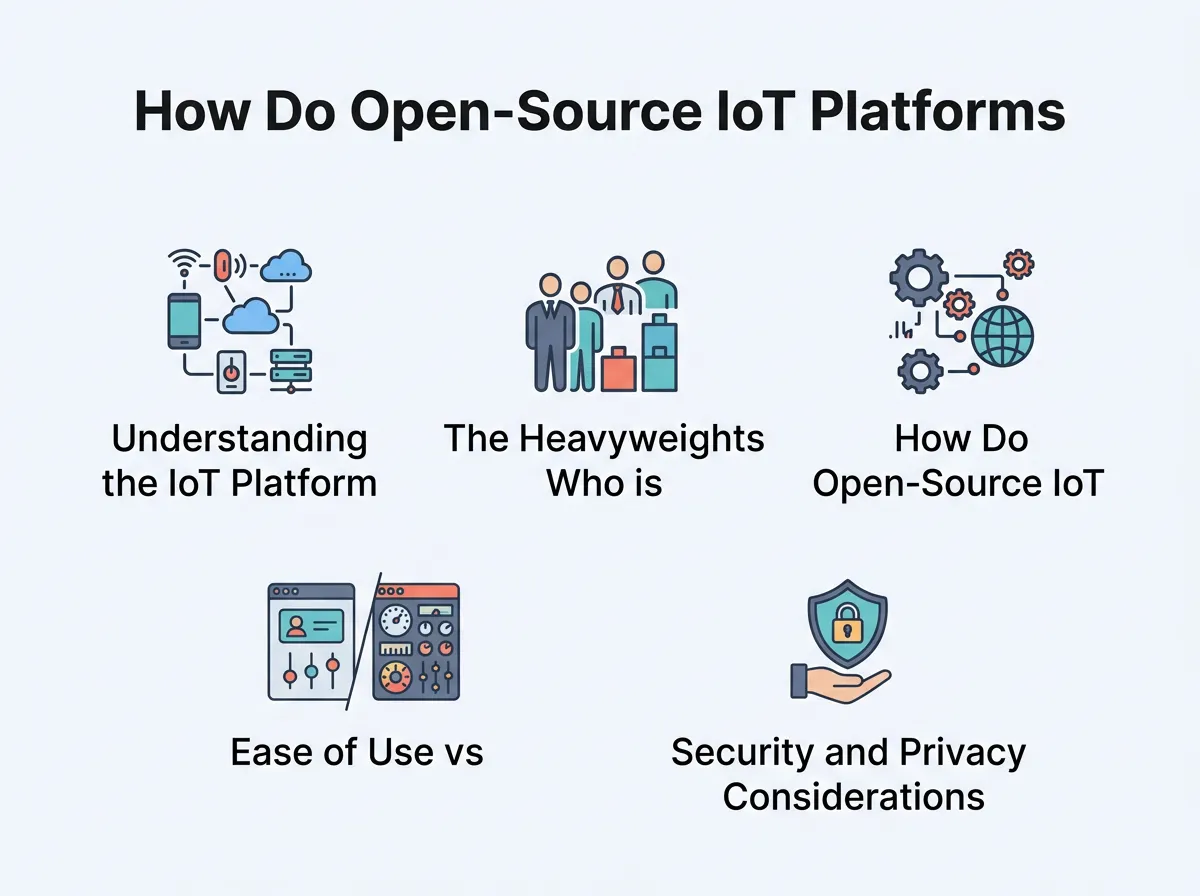
How Do Open-Source IoT Platforms Compare? — key points at a glance
ThingsBoard
ThingsBoard is a very popular choice for business projects. It is built to scale up. It can handle thousands of devices at the same time. The interface is clean. It has great tools for making graphs and charts. It uses a drag-and-drop rule engine. This makes it easy to set up alerts. For example, you can get an email if a sensor gets too hot.
Home Assistant
This is the king of home automation. It has a massive community of users. Home Assistant can connect to almost any smart device in your house. It runs locally on a small computer like a Raspberry Pi. It is fast, secure, and highly customizable. It is perfect for personal projects.
OpenRemote
OpenRemote is designed for professional use. It works well for smart cities, energy grids, and large buildings. It helps you manage different types of assets. It has a built-in map view. This lets you track devices across a real-world location.
How Do Open-Source IoT Platforms Compare on Key Features?
Now, let us look at the details. How Do Open-Source IoT Platforms Compare when we look at features side-by-side?
Device Management
ThingsBoard shines here. It makes it easy to register new devices in bulk. You can group devices and update their software remotely. Home Assistant is also great but in a different way. It auto-detects devices on your home network. You do not have to type in complex code to add a smart bulb. OpenRemote offers professional asset management that links devices to locations.
Data Visualization
A platform needs to show your data in a way that makes sense. ThingsBoard has beautiful, ready-made dashboards. You can build charts, maps, and control buttons without writing code. Home Assistant uses a card-based layout. It is very clean and looks great on phones. OpenRemote focuses on map-based views, which is great for tracking fleet vehicles or city lights.
Rule Engines and Automation
How do you make things happen automatically? ThingsBoard uses a visual node system. You connect boxes with lines to create logic. Home Assistant uses simple “if-this-then-that” rules. You can write these rules in plain text or use a visual editor. Both ways are very powerful.
Ease of Use vs. Advanced Customization
Are you good at coding? Or do you prefer a simple setup? This is a huge factor when picking a platform.
Some platforms are very easy to install. Home Assistant has an all-in-one installer. You burn it to an SD card, plug it in, and it works. ThingsBoard and OpenRemote are more complex. They often run inside Docker containers. This requires some knowledge of command-line tools.
If you want to avoid common mistakes, it helps to read about making sense of open-source IoT platforms. Many beginners pick a tool that is too complex for them. They get stuck on the installation step. Start simple, and scale up as you learn.
Security and Privacy Considerations
Security is vital for smart devices. You do not want strangers controlling your locks or viewing your cameras.
Open-source platforms give you a big advantage here. You can run them entirely offline. This means your data never leaves your house or office. However, you are responsible for updates. You must install security patches when they come out.
Enterprise platforms like ThingsBoard offer advanced security. They use secure keys and tokens for every device. This prevents unauthorized devices from joining your network.
How to Choose the Right Platform for Your Project
To make a final decision, you must ask: How Do Open-Source IoT Platforms Compare in daily use? Here is a quick guide to help you choose.
For Smart Homes and Hobbyists
Choose Home Assistant. It has the best integrations for consumer brands. It is easy to use and has a helpful community.
For Startups and Smart Products
Choose ThingsBoard. It scales well and has great client-facing dashboards. It lets you manage many customers on one server.
For Smart Cities and Large Infrastructure
Choose OpenRemote. Its map features and asset management are built for large-scale physical environments.
If you are still unsure, check out this guide on choosing the best open-source IoT platform for your next development project.
Conclusion
Choosing an IoT platform is a big step. But open-source tools make it safe to experiment. They cost nothing to try. You can download one today and run it on your laptop.
Take your time to test different options. Look at how easy they are to set up. Think about how many devices you will have in five years. With the right platform, you can build a system that is powerful, secure, and entirely yours.
Frequently Asked Questions
What is the easiest open-source IoT platform to learn?
Home Assistant is the easiest platform for beginners. It features an automated setup process and a large community to help you. It is perfect for smart homes but less suited for industrial scaling.
Can I use open-source IoT platforms for business purposes?
Yes, many platforms like ThingsBoard and OpenRemote are built for enterprise use. They offer open-source editions that you can use for free, along with paid support options. Always check the specific license before launching your commercial product.
Do I need coding skills to use these platforms?
It depends on the platform you choose. Home Assistant offers many drag-and-drop tools that require zero coding. However, enterprise options like ThingsBoard may require some coding knowledge for custom features.
Are open-source IoT platforms secure?
Yes, they are highly secure because you have full control over your server environment. You can keep your system completely offline to protect your data. However, you must manually install security updates to keep it safe.
Can I run these platforms without an internet connection?
Yes, one of the biggest benefits of open-source IoT platforms is local control. Tools like Home Assistant run entirely on your local network. Your automation will still work even if your internet goes down.
What hardware do I need to host an open-source IoT platform?
You can run lightweight platforms like Home Assistant on a cheap Raspberry Pi. For larger systems with thousands of devices, you will need a dedicated server or cloud hosting. Docker is commonly used to install these platforms easily.
