


Choosing the right smart eSIM options for IoT platforms is vital for seamless global connectivity and hassle-free deployment. Leading providers like Soracom, Onomondo, and floLIVE offer robust eUICC capabilities that allow remote provisioning and carrier switching. By selecting a top-tier eSIM solution, businesses can future-proof their IoT fleets and simplify device management worldwide.
Imagine you are launching a fleet of smart tracking devices across three different continents. Some of your devices are in Germany, others are in Chicago, and a few are moving through rural parts of Australia. If you use standard, old-school plastic SIM cards, you are facing a massive logistical headache. If a local carrier changes its pricing or goes out of business, you would have to track down every single device and manually swap the SIM card. For thousands of devices, that is practically impossible.
This is where smart embedded SIMs (eSIMs) come to the rescue. They allow you to change cellular carriers and manage profiles remotely with just a few clicks. But with so many connectivity providers on the market, how do you choose the right one? To help you navigate this fast-growing technology, we will break down the absolute best smart eSIM options for IoT platforms and explain how to pick the right one for your business needs.
In this guide, we will look at the technical standards behind these chips, review the top market providers, and share practical deployment tips. Let us dive in!
Key Takeaways
- eUICC is Essential: True smart eSIMs use eUICC technology, allowing you to swap profiles over-the-air without physical SIM swaps.
- Global Coverage: The best eSIM options provide multi-network access to prevent dead zones and dropouts.
- Security First: Top-tier platforms integrate advanced security features directly into the eSIM chip.
- Cost Efficiency: Smart eSIMs eliminate physical logistics costs, making large-scale global deployments much cheaper.
- Flexible APIs: Leading providers offer developer-friendly APIs to automate billing, monitoring, and provisioning.
📑 Table of Contents
Understanding Smart eSIMs and eUICC Technology
To choose the best connectivity provider, it is helpful to understand how this technology works. Many people confuse the physical form factor of a SIM with its software capabilities. You can buy a tiny, vacuum-sealed MFF2 chip that soldered directly onto a circuit board, but if it lacks the right software, it is still just a static SIM card.
The magic behind smart eSIM options for IoT platforms is called eUICC (Embedded Universal Integrated Circuit Card). This software standard allows you to store multiple carrier profiles on a single chip. You can switch between these profiles remotely using Over-the-Air (OTA) technology. If you want to dive deeper into how these elements differ, you can read about the differences between traditional physical SIMs and eSIMs to see how they impact your hardware design.
When searching for a solution, always ensure the provider supports the global eUICC standard for cellular modules. This standard guarantees that your devices are not permanently locked to a single carrier network. It keeps your hardware independent, flexible, and future-proof.
Why IoT Platforms Need Smart eSIMs
Traditional cellular solutions are simply too rigid for modern IoT deployments. Here is why smart eSIMs have become the gold standard for scaling connected devices:
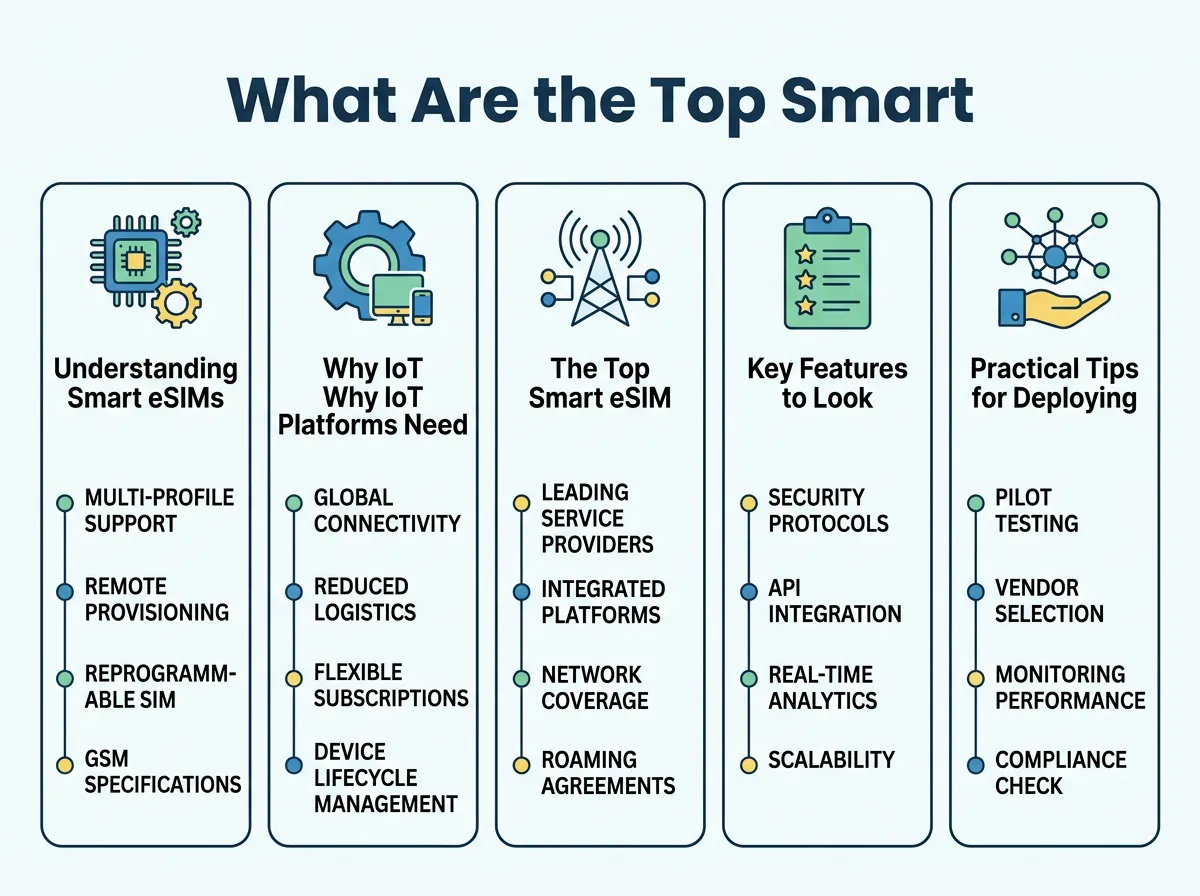
What Are the Top Smart eSIM Options for IoT Platforms? — key points at a glance
No More Physical Swaps
If your device is buried inside a smart water meter underground, or welded inside a shipping container, you cannot easily reach it. Smart eSIMs let you update cellular profiles remotely. This drastically lowers your long-term maintenance and field service costs.
Simplified Manufacturing
Instead of keeping different piles of SIM cards for different destination countries, you can solder a single eSIM onto your circuit board during manufacturing. The device can automatically download the correct local carrier profile when it boots up in its final destination country.
Enhanced Security and Reliability
Security is a major concern for any connected system. Smart eSIMs offer a much safer approach than standard plastic cards. They are soldered directly onto the board, making them physically tamper-proof. Furthermore, the GSMA-compliant architecture ensures that data transmission is highly secure. Experts often highlight the role of eSIM for IoT security and provisioning as a primary reason why enterprise companies are making the switch.
The Top Smart eSIM Options for IoT Platforms
Now that we know why they are so valuable, let us look at the top companies leading the market. These platforms offer excellent smart eSIM options for IoT platforms, along with easy-to-use management portals.
1. Soracom
Soracom is a favorite among developers and enterprise teams alike. They offer highly flexible eSIM configurations, including both physical cards and soldered chips. Their cloud-native platform integrates seamlessly with major cloud services like AWS, Microsoft Azure, and Google Cloud. Soracom provides excellent pay-as-you-go pricing, making it easy to start small and scale up as your business grows.
2. Onomondo
Onomondo has redesigned cellular connectivity from the ground up. Instead of relying on traditional roaming agreements that can cause lag and high costs, Onomondo operates its own virtual core network. This allows them to offer incredibly fast carrier switching and deep packet-level visibility into your device traffic. They are widely regarded as one of the best IoT connectivity solutions for large fleets that move across borders frequently.
3. floLIVE
floLIVE offers a massive, localized global network. They solve the issue of permanent roaming restrictions by maintaining a library of local IMSIs (International Mobile Subscriber Identities). When your device enters a new region, floLIVE can dynamically swap the profile to a local one. This keeps your device compliant with local regulations and keeps your data costs low.
4. Things Mobile
If you are looking for a straightforward, cost-effective option for smaller deployments, Things Mobile is an excellent choice. They offer global coverage with multi-network connectivity, meaning your devices will automatically connect to the operator with the strongest signal in the area. Their user platform is clean, intuitive, and great for managing a few dozen to a few thousand devices without complex contracts.
Key Features to Look for in an eSIM Platform
Not all eSIM platforms are created equal. When evaluating your options, keep these key features in mind to ensure you get the best performance:
- Over-the-Air (OTA) Management: Can you push updates to your devices easily? Make sure the platform has a proven track record of reliable OTA profile switches.
- Multi-IMSI Support: A great platform should support multiple profiles on a single SIM. This provides an extra layer of backup if a primary network goes down.
- Robust APIs: Your engineers will want to automate tasks. Look for platforms that offer RESTful APIs so you can integrate data usage and device status directly into your own software dashboards.
- Flexible Billing: Look for pooled data plans. This allows your high-usage devices to share data limits with low-usage devices, preventing unexpected overage bills.
Practical Tips for Deploying Smart eSIMs
Ready to get started? Here are a few practical tips to make your deployment go smoothly:
First, always test your hardware in real-world scenarios before ordering thousands of units. Network environments inside a lab are very different from a remote farm or a dense urban basement. Order a developer kit from your chosen provider and test the network switching times in your target locations.
Second, pay close attention to local roaming laws. Some countries, like Brazil and India, have strict rules against permanent roaming. If your devices stay in these regions for more than a few months, standard roaming SIMs might get blocked. Ensure your eSIM provider has local bootstrap profiles for these specific countries.
Lastly, keep an eye on battery life. When an eSIM searches for a new network profile, it can consume extra power. Optimize your device’s firmware to manage these search cycles efficiently, especially if your hardware relies on small battery cells.
Conclusion
Finding the right smart eSIM options for IoT platforms does not have to be overwhelming. By focusing on eUICC technology, robust management portals, and flexible global coverage, you can easily find a partner that fits your specific needs. Whether you choose the developer-friendly features of Soracom, the high-performance core network of Onomondo, or the localized reach of floLIVE, moving to eSIM is the best way to future-proof your connected business. Start small, run thorough tests, and enjoy the peace of mind that comes with truly global, remote-controlled connectivity.
Frequently Asked Questions
What is the difference between an eSIM and eUICC?
An eSIM refers to the physical chip or embedded SIM hardware. eUICC is the software technology running on that chip that allows you to store and switch multiple carrier profiles remotely over-the-air.
Can I use smart eSIMs anywhere in the world?
Yes, smart eSIMs can download local or global profiles to connect almost anywhere. However, you should check with your provider to ensure coverage in countries with strict permanent roaming laws, like Brazil.
Do smart eSIMs save money on data costs?
Yes, they save money by allowing you to easily switch to cheaper local networks without needing to buy and ship physical SIM cards. They also offer pooled data options to prevent expensive overage charges.
Can I turn an existing physical SIM slot into an eSIM?
Yes, you can buy smart eSIMs in standard plastic formats (2FF, 3FF, 4FF) that plug directly into existing slots. This gives you all the remote-switching benefits of eUICC without redesigning your hardware.
How secure are smart eSIM options for IoT platforms?
They are highly secure because soldered eSIMs cannot be easily stolen or tampered with. Additionally, the software architecture complies with strict global GSMA security standards for encryption and profile delivery.
Is it easy to switch providers once I deploy my eSIMs?
Yes, as long as your eSIMs support the open GSMA eUICC standard. You can download and install a new carrier profile over-the-air without ever touching the physical device.
