


Choosing the right database for IoT depends on your specific data needs, but time-series databases like InfluxDB and TimescaleDB are generally the best options. These systems are built to handle high-speed, timestamped data from millions of smart sensors. NoSQL databases like Cassandra also work well for huge, unstructured datasets.
Imagine you have a smart home. Your lights turn on automatically. Your fridge talks to your phone. Your smart thermostat tracks the room temperature. All these devices send out small bits of data every single second. This flow of data is fast, constant, and massive. Where does all of this information go? It has to live in a secure, fast, and reliable digital home.
This home is called a database. If you are building a smart system, you might ask: What Is the Best Database for the Internet of Things? This is a huge question for developers today. Choosing the wrong system can slow down your devices, cause crashes, or cost you a lot of money in cloud fees.
In this guide, we will look at how to store smart device data. We will share the best choices for your projects. You will learn about speed, scale, and cost. By the end, you will know exactly which system fits your needs.
Key Takeaways
- Time-Series Databases Are King: Databases like InfluxDB are built specifically for timestamped IoT sensor data.
- NoSQL Offers Great Flexibility: Systems like MongoDB and Cassandra handle diverse and unstructured data types easily.
- SQL Is Best for Small Scale: Traditional databases work well for simple projects but struggle with high-speed scaling.
- Write Speed Is Critical: IoT systems are write-heavy, meaning they save far more data than they read.
- Compression Saves Money: Good data compression reduces disk space and cuts cloud storage costs.
📑 Table of Contents
Why IoT Needs a Special Database
Smart tools are not like old computer apps. They do not just save a simple username and a password. Instead, they send thousands of small data points every single minute. This creates a mountain of data very quickly. The way we connect devices has changed a lot since the early days of the history of the global Internet. Today, we need systems that can think and act in real time.
The Speed of Incoming Data
IoT data moves at extreme speeds. A smart car might send speed and engine data every millisecond. A normal database cannot keep up with this rush. It will slow down, queue up tasks, and eventually crash. You need a database that writes data very quickly without dropping any points.
The Volume of Connected Devices
Think about a big modern city. It might have millions of smart streetlights. They all send data at the exact same moment. This is why people ask, What Is the Best Database for the Internet of Things? The database must handle many incoming writes at once without any lag. It must be built to scale up as you add more devices.
Time-Series Databases: The Top Contenders
For most smart tech, time is everything. Every data point has a time stamp. You want to know the temperature at 2:01 PM, then 2:02 PM, and so on. This is why time-series databases are so popular. They are built for this exact task. They make it easy to find out what happened at a specific second.
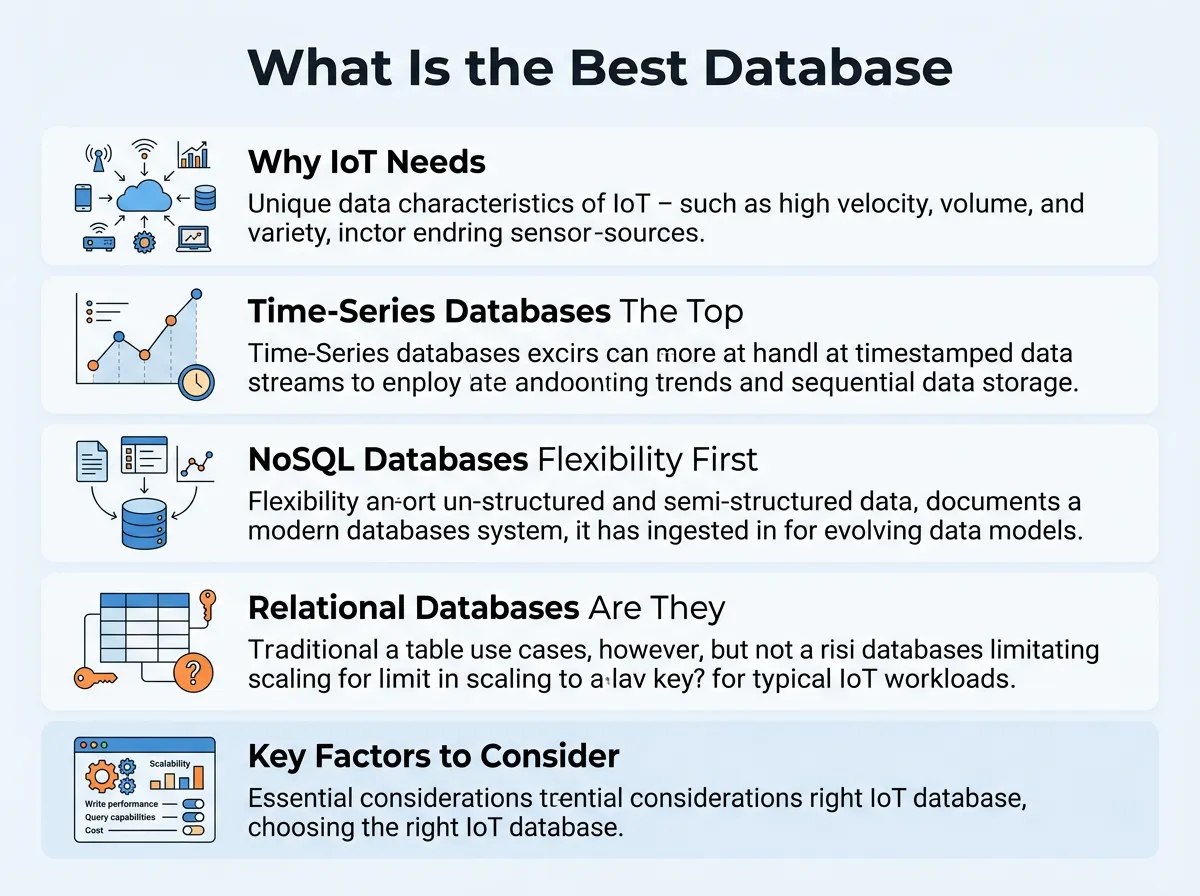
What Is the Best Database for the Internet of Things? — key points at a glance
InfluxDB
InfluxDB is a top choice in the tech world. It is open-source and very fast. It can handle millions of data points per second. It also compresses data to a very small size. This means it uses less disk space, which keeps your costs low. If you want to know What Is the Best Database for the Internet of Things, InfluxDB is often the first answer you will hear.
TimescaleDB
TimescaleDB is built on top of PostgreSQL. It gives you the power of traditional SQL with the speed of a time-series database. This is great if your team already knows how to write SQL. You do not have to learn a new language to use it. It is reliable, fast, and handles time data like a dream.
NoSQL Databases: Flexibility First
NoSQL offers a different path when searching for What Is the Best Database for the Internet of Things. Sometimes your devices send different types of data. One day they send numbers. The next day they send text, status codes, or images. In this case, NoSQL is a great path to take because it does not use rigid tables.
MongoDB
MongoDB is a document database. It stores data in a format that looks like JSON. This makes it very flexible. You can change your data shape at any time without breaking the system. Many tech teams love it because it is easy to set up. It is a solid choice when you look at What Is the Best Database for the Internet of Things.
Cassandra
Cassandra is built for giant systems. Big firms use it to handle massive scales across many servers. It has no single point of failure. This means your system stays online even if a server dies. To stay updated on these tech choices, you can read reports on technology trends which often highlight how big companies handle massive scale.
Relational Databases: Are They Outdated?
Can you use a traditional database like MySQL or PostgreSQL for IoT? The answer is yes, but with a warning. You must know their limits before you build your system.
The Limits of SQL
Traditional databases are great for relationships. They link users to accounts. But they struggle with high-speed sensor data. They can become slow when they get too big. They require strict structures, which makes it hard to change things later.
When to Use SQL
You should use SQL if you have a small number of devices. It is also good if you need to run complex queries on your data. But if you have millions of sensors, you should look elsewhere. This helps us answer, What Is the Best Database for the Internet of Things? Traditional SQL works for small projects, but fails at massive scale.
Key Factors to Consider When Choosing
How do you pick the right tool? You must look at a few main things before you make a choice.
Write Speed
Your database must write fast. IoT is write-heavy. It writes much more than it reads. If a database cannot write fast, your devices will lose data.
Data Storage Costs
IoT data grows fast. You need a database that keeps files small. Look for good compression tools. This keeps your cloud bills low and manageable.
Query Tools
Can you get your data out easily? Make sure the query language is easy for your team to use. This is a key part of finding What Is the Best Database for the Internet of Things.
How to Make Your Final Choice
Do not just pick the most popular tool. Look at your team. If they know SQL, TimescaleDB is a great fit. If you have unstructured data, go with MongoDB. For pure speed and time tracking, choose InfluxDB.
When you ask yourself, What Is the Best Database for the Internet of Things?, the choice comes down to your skills and your project scale. Take your time to test each one. Run a small test with a few devices. See how it handles the load. This will guide you to your perfect match.
Conclusion
Finding the right tool is a journey. There is no single answer for everyone. But by looking at time-series and NoSQL options, you are on the right track. You now have the facts to answer, What Is the Best Database for the Internet of Things? Choose the one that fits your scale, your team, and your budget today.
Frequently Asked Questions
What is the difference between SQL and NoSQL for IoT?
SQL databases use structured tables and are great for small projects with complex relations. NoSQL databases offer more flexibility and scale much better for large, unstructured IoT data.
Why are time-series databases good for IoT?
They are built specifically to handle timestamped data from sensors. They allow for very fast writes and offer great data compression to save disk space.
Is InfluxDB free to use?
Yes, InfluxDB offers a free open-source version that you can run on your own servers. They also offer paid cloud plans if you want them to manage the servers for you.
Can I use MongoDB for IoT data?
Yes, MongoDB is highly flexible and works well for IoT projects with changing data types. However, it might require more storage space compared to a dedicated time-series database.
What does write-heavy mean in IoT?
It means your system spends most of its time saving new data from sensors rather than reading or searching through old data. IoT databases must be optimized for fast and frequent writes.
How do I reduce storage costs for my IoT database?
You can use database compression tools to make files smaller. You can also set up data retention policies to automatically delete old or useless data after a set period of time.
