


Internet of Things software development is the specialized process of building code, cloud platforms, and user applications that allow physical smart devices to collect, process, and share data. This software acts as the digital nervous system that connects hardware sensors directly to the internet. Ultimately, it is what transforms ordinary physical objects into smart, responsive tools that improve our daily lives.
Imagine waking up on a cold morning. Before you even open your eyes, your bedroom heater turns on. In the kitchen, the coffee machine starts brewing your favorite roast. Your smart watch gently vibrates, showing you a quick report of how well you slept last night. None of these physical things used to talk to each other. Today, they work together like a well-rehearsed orchestra.
This magic does not happen by accident. While physical devices look sleek, the true power lies deep inside them. This is where code comes into play. If you have ever wondered how these gadgets communicate, you are looking at the core of this technology. So, what is Internet of Things software development, and how does it shape our modern lives?
In this article, we will take a friendly look at this fascinating field. We will break down how this code works, the different parts that make it run, and the programming languages developers use. We will also look at real-life examples and explore what the future holds for this exciting technology.
Key Takeaways
- The Core Connection: It bridges the gap between physical hardware and digital networks.
- Three Main Layers: It involves device-level code, cloud platforms, and user-facing apps.
- Diverse Languages: Developers use languages like C, C++, Python, and Java depending on the layer.
- Security is Critical: Protecting data at every endpoint is the most vital step in the process.
- Real-World Impact: It powers smart homes, industrial automation, and modern healthcare.
📑 Table of Contents
- The Architecture of Internet of Things Software Development
- How IoT Software Differs from Traditional Software
- Common Languages Used in Internet of Things Software Development
- Key Steps in the IoT Development Lifecycle
- Real-World Examples of IoT Software in Action
- Key Challenges and the Future of IoT
- Conclusion
The Architecture of Internet of Things Software Development
When you build a normal mobile app, you usually only worry about the phone screen and a server. But Internet of Things software development is a bit different. It requires building code for several different layers. Think of it like building a house. You need a solid foundation, strong walls, and a nice roof. Let us look at the three main layers that developers must build.
Device-Level Firmware
Firmware is the code that lives directly on the physical hardware. It is the brain of the smart device. This software tells sensors when to turn on, how to read data, and when to send that data to the next step. Because smart devices are often very small, this code must be light and fast. Developers write this software to use as little battery power as possible.
Cloud Platforms and Middleware
Once a device collects data, it needs a place to go. This is where cloud platforms come into play. Middleware acts as a bridge between the physical device and the internet. It collects data from thousands of devices at the same time. Then, it organizes the data and decides what to do with it. To learn more about the basic concepts of connected devices, you can explore this overview of the Internet of Things and its impact.
User Applications and Interfaces
The final layer is what you and I actually see. It is the mobile app on your phone or the dashboard on your computer screen. This software lets you interact with your smart devices. For example, when you press a button on your phone to lock your front door, this app sends a signal all the way back down to the physical lock.
How IoT Software Differs from Traditional Software
You might wonder how Internet of Things software development differs from regular web or mobile app development. While they share some tools, the mindset is very different. Here are the main ways they stand apart.
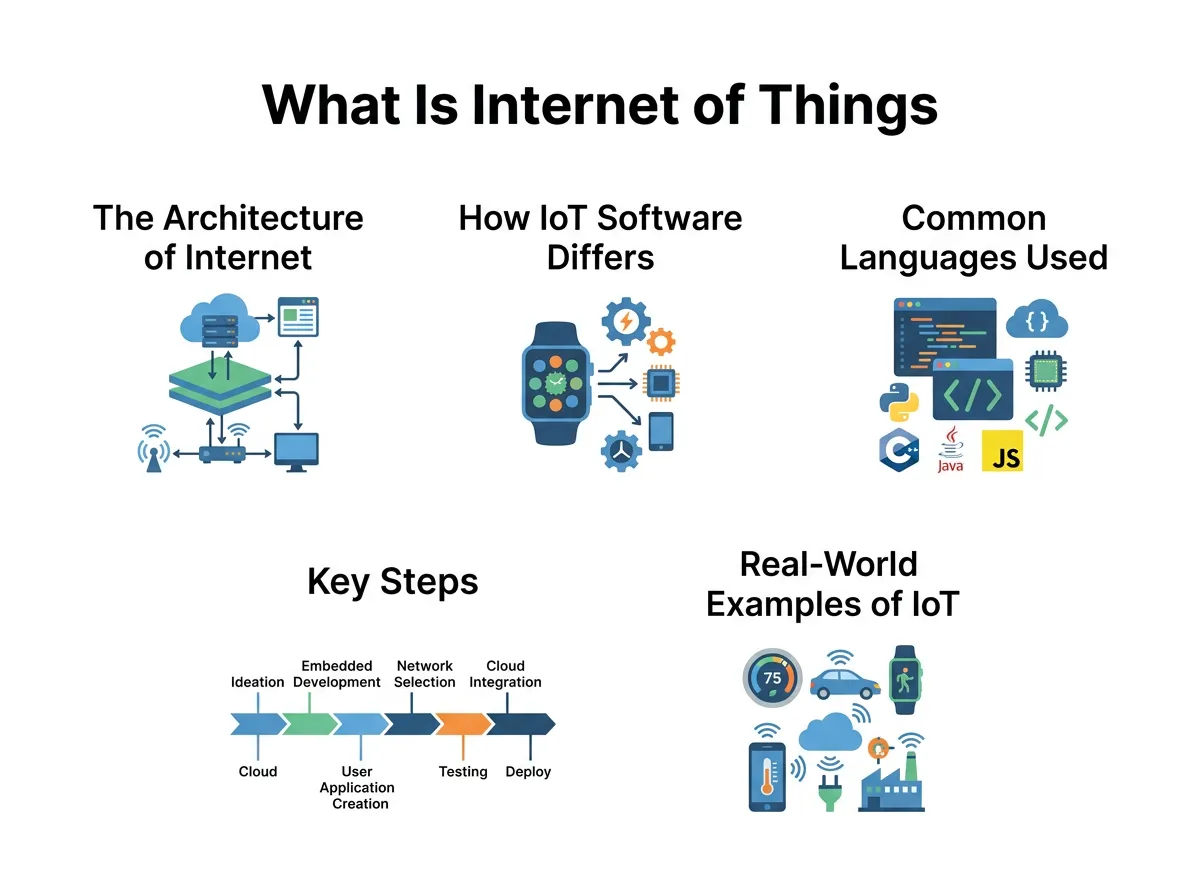
What Is Internet of Things Software Development? — key points at a glance
Dealing with Hardware Constraints
Traditional software runs on powerful computers or smartphones. These devices have plenty of memory and fast processors. In contrast, many smart devices run on tiny microchips. They have very little memory and limited battery life. Developers must write extremely clean, efficient code. If the code is too heavy, the device will run out of power in a few hours.
Real-Time Data Processing
Many smart systems must react instantly. For example, a smart car needs to process sensor data in milliseconds to avoid an accident. There is no room for lag or slow loading screens. This means Internet of Things software development often focuses on real-time operating systems (RTOS) and instant data pipelines. If you are interested in starting a career in this field, you can review this educational guide on how to get started with the Internet of Things.
Common Languages Used in Internet of Things Software Development
Because this type of development covers so many layers, developers use a wide variety of tools. No single programming language can do it all. When choosing a language for Internet of Things software development, developers have to think about speed, memory, and compatibility. Here are the most popular languages used in the industry today.
C and C++
For device firmware, C and C++ remain the absolute kings. These languages allow developers to talk directly to the hardware. They are incredibly fast and give developers complete control over memory usage. Almost every small smart sensor in your home runs on code written in C or C++.
Python
Python is highly popular for the cloud and data analysis layers. It is easy to write and read, which makes development much faster. Python is also the go-to language for machine learning. This is very helpful when developers want to make their smart devices adapt to user behavior over time.
Java and JavaScript
Java is widely used for building gateways and cloud platforms because it can run on almost any computer. JavaScript, especially with Node.js, is very popular for managing the communication between devices and servers. It is great at handling many connections at once without slowing down.
Key Steps in the IoT Development Lifecycle
The process of Internet of Things software development requires a structured lifecycle. Building a smart system is a journey. It takes careful planning and teamwork. Many businesses partner with specialized teams that offer professional IoT software development services to ensure their systems are scalable and secure. Let us look at the steps a typical team goes through when building a new project.
1. Planning and Hardware Selection
First, the team must decide what the device will do and what hardware it needs. They choose the sensors, microchips, and communication tools. This step is crucial because the software must match the hardware perfectly.
2. Writing Firmware and Prototyping
Next, developers write the initial code for the device. They build physical prototypes to test if the sensors can read data correctly. They also test how much power the device uses under different conditions.
3. Cloud Integration and App Development
Once the physical device works, developers build the cloud systems to receive the data. They also build the mobile or web apps that users will interact with.
4. Rigorous Security Testing
Security testing is the most important step. Because these devices connect to the internet, they can be vulnerable to hackers. Developers must test the system to ensure that all data is encrypted and safe from outside attacks.
Real-World Examples of IoT Software in Action
We see the results of Internet of Things software development all around us every day. Here are a few practical examples of how this technology is changing different industries.
Smart Homes and Consumer Tech
This is the most common example. Smart thermostats learn your daily routine and adjust the temperature to save energy. Smart lights can turn off automatically when you leave the house. These systems rely on smart software to coordinate multiple devices at once.
Industrial Automation
In factories, smart sensors monitor heavy machines. They can detect tiny vibrations that suggest a machine is about to break. The software then alerts workers to fix the machine before it stops the entire assembly line. These diverse applications show why custom IoT software development is growing so rapidly across different industries.
Connected Healthcare
Smart pacemakers, insulin pumps, and wearable vitals monitors are saving lives daily. They track patient health in real-time and send instant updates to doctors if something goes wrong. The software inside these devices must be incredibly reliable, as lives depend on it.
Key Challenges and the Future of IoT
While this technology is exciting, it also faces some big challenges. Developers must work hard to overcome these hurdles as the industry grows.
Security and Privacy
With billions of connected devices, security is a major concern. If a hacker gains access to a smart camera or a smart lock, they can cause serious harm. Developers must make sure that security is built into the software from day one, not added as an afterthought.
Interoperability
Today, we have many different companies making smart devices. Often, a smart light from one brand will not talk to a smart hub from another brand. Creating common software standards is a major focus for developers today. They want to ensure that all devices can speak the same language.
The Future: AI and Edge Computing
The future of this field is highly bright. We are moving toward edge computing. This means smart devices will do more data processing on the device itself, rather than sending everything to the cloud. By adding artificial intelligence to this software, devices will become even smarter and more independent.
Conclusion
Internet of Things software development is the invisible thread that connects our physical world to the digital realm. It turns simple metal and plastic objects into smart, helpful tools that make our lives easier, safer, and more efficient. From the tiny code running on a microchip to the massive cloud servers handling petabytes of data, this field requires a unique blend of skills. As more devices connect to the internet, the demand for smart, secure, and reliable software will only continue to rise.
Frequently Asked Questions
What is the difference between IoT and traditional software development?
Traditional software runs on powerful devices like computers or phones with large amounts of memory. Internet of Things software development focuses on resource-constrained physical devices, requiring lightweight, highly efficient code that consumes minimal battery power.
What programming languages are best for IoT software development?
Developers use C and C++ for writing low-level device firmware because they are fast and control hardware directly. For cloud services, data processing, and user interfaces, developers commonly use Python, Java, and JavaScript.
Why is security so important in IoT software?
Smart devices collect personal data and connect directly to the internet, making them attractive targets for cyberattacks. Strong security in IoT software prevents unauthorized access to home devices, medical equipment, and industrial networks.
What is firmware in the context of IoT?
Firmware is the specific type of software programmed directly into a physical device’s non-volatile memory. It acts as the brain of the device, enabling it to communicate with sensors, process physical signals, and send data to the cloud.
How do smart devices communicate with each other?
Smart devices communicate using specialized wireless protocols such as Wi-Fi, Bluetooth, Zigbee, and cellular networks. These networks allow devices to send data to gateway systems or directly to cloud platforms for analysis.
Can I build IoT software without physical hardware?
Yes, you can use hardware simulators and virtual devices to test your software before buying physical components. Many cloud platforms offer virtual device testing tools that let you simulate data streams and verify that your system works properly.
