


Choosing the right cellular partner is critical for smart device deployments. The top IoT SIM card providers today include global leaders like Hologram, EMnify, and Soracom, alongside telecom giants like AT&T and Vodafone. Selecting the best one depends on your coverage needs, platform management tools, and scaling plans.
Picture this scenario: you just launched your first batch of smart devices. They are tracking high-value cargo trucks across the country. Suddenly, a truck crosses a state line, and the signal dies. Your customer calls, angry and confused. This is a common nightmare for hardware creators. How do you keep your devices online no matter where they go?
The secret lies in selecting the right connectivity partner. The market is full of choices, but not all cellular services are built equal. Today, we will explore the landscape of modern cellular connectivity. We will look at top companies, compare their features, and help you find the perfect match for your business.
By the end of this guide, you will know exactly who can help you scale your hardware project. Let us dive in and see how these tools work to keep your business running smoothly.
Key Takeaways
- Multi-Network Roaming: Top providers offer SIMs that jump between different carriers automatically to prevent downtime.
- Advanced Management Portals: A strong cloud platform lets you activate, pause, and monitor thousands of devices instantly.
- Flexible Pricing Models: Look for pay-as-you-go or pooled data plans to avoid unexpected costs.
- Low-Power Networks: Top providers support LTE-M and NB-IoT to extend the battery life of your smart hardware.
- Industrial Durability: IoT SIMs are physically tougher than standard phone SIMs, resisting extreme temperatures.
📑 Table of Contents
Understanding IoT SIM Cards vs. Standard SIMs
You might wonder why you cannot just use a regular phone SIM card. After all, they both connect to cellular networks. But standard SIM cards are built for humans, while machine-to-machine SIMs are built for automated devices.
What Makes an IoT SIM Special?
Standard SIMs have simple plans for voice, text, and data. They are designed for phones that get charged daily. IoT SIMs are different. They are built for long-term use in tough environments. They can withstand extreme heat and cold. They also use very little power, which is crucial for battery-powered sensors in the field.
The Power of Multi-Network Roaming
Standard SIMs tie you to one specific network operator. If that network goes down, your device goes dark. IoT SIM card providers solve this with multi-network roaming. Their SIM cards can jump between different networks automatically. If Carrier A has a weak signal, the SIM switches to Carrier B instantly. This keeps your devices online constantly, even in remote areas.
Top-Tier Global IoT SIM Card Providers
Now, let us address the big question: who are the best IoT SIM card providers in the market today? Several modern startups and established tech firms lead the pack with great software and reliable coverage.
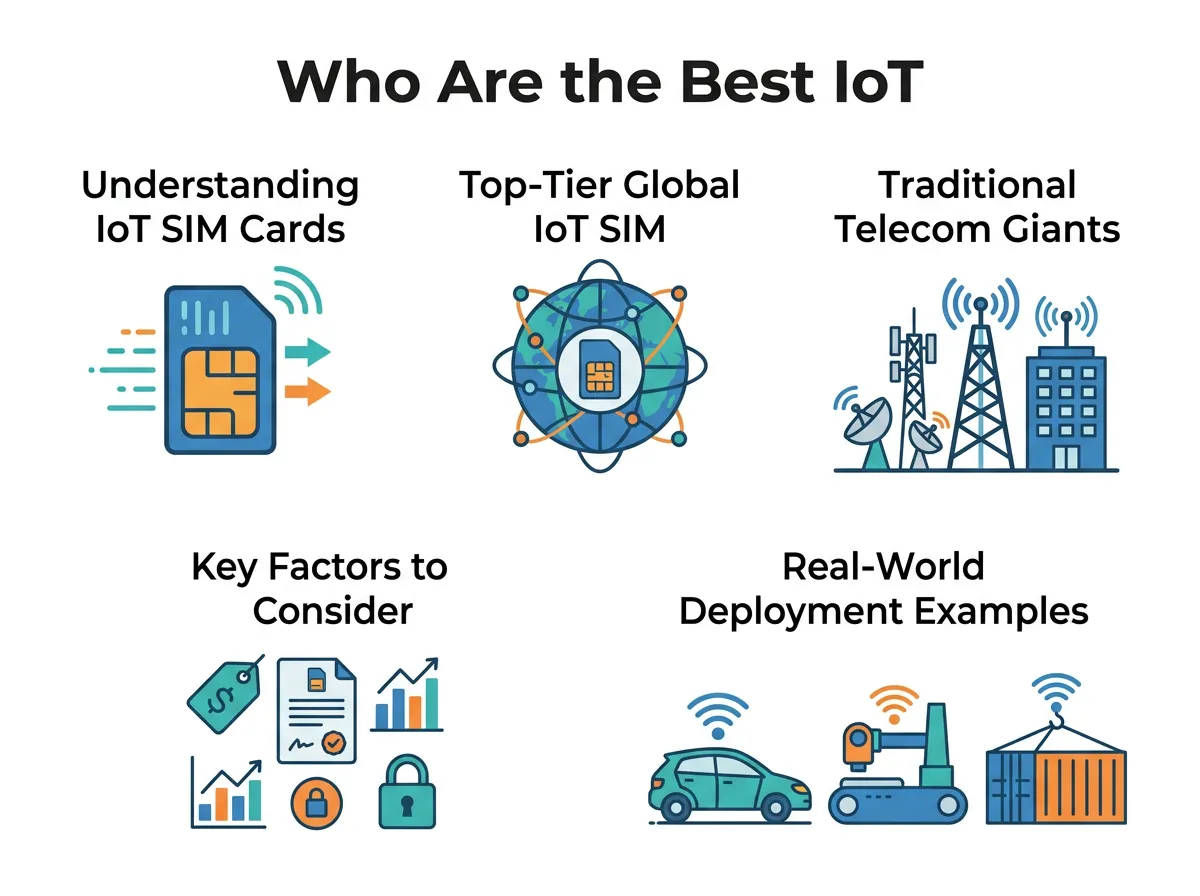
Who Are the Best IoT SIM Card Providers? — key points at a glance
Hologram: Best for Flexible Scaling
Hologram is a favorite for many growing businesses. They offer a global cellular platform built specifically for IoT. Their SIM cards can connect to hundreds of networks worldwide without requiring manual configuration.
- Why choose them: Hologram has an amazing, easy-to-use dashboard. You can activate, pause, or monitor your SIMs in seconds. They offer pay-as-you-go pricing with no hidden fees, which is perfect for startups testing their first devices.
EMnify: Best for Cloud Integration and Security
EMnify offers a cloud-native engine for cellular IoT. They focus heavily on security and integration with your existing cloud systems.
- Why choose them: EMnify connects directly to big cloud providers like AWS and Azure. This means your data travels securely from the device to your cloud database. They also have excellent tools to block unauthorized data usage on stolen devices.
Soracom: Best for Advanced Developer Tools
Soracom was built by developers, for developers. They offer highly customizable connectivity solutions that allow you to control your network architecture.
- Why choose them: If you need deep control over your network traffic, Soracom is a top choice. They offer cloud-side protocol conversion, which helps save device battery and reduces data usage fees.
Traditional Telecom Giants with Strong IoT Offerings
Sometimes, you need the massive scale and backing of a global telecom giant. These companies own the physical cell towers and can offer great rates for massive deployments.
AT&T IoT Solutions
AT&T is a household name for a reason. They have massive network coverage in North America and offer robust LTE-M and NB-IoT options. These are low-power networks built specifically for smart devices. If your business operates mostly in the United States, AT&T is a highly reliable choice.
Vodafone Business IoT
Vodafone is a global leader in IoT connections. They have a massive footprint across Europe, Asia, and Africa. Their managed IoT platform is highly advanced and supports large-scale enterprise rollouts that span multiple continents.
Key Factors to Consider When Choosing a Provider
How do you pick the right partner from this list? You should evaluate a few key aspects before signing any contracts.
Coverage and Network Types (LTE-M, NB-IoT)
Not all cellular networks are the same. Some devices need high-speed 4G or 5G. Others only need to send small text updates once a day. Make sure your provider supports LTE-M or NB-IoT if you need to save battery. Also, verify that they have reliable coverage in your target countries.
Management Platform and API Access
If you have five devices, you can manage them manually. If you have five thousand, you need automation. Look for a provider with a robust application programming interface (API). This lets your software talk directly to the SIM platform to automate activations and monitor data usage easily.
Pricing Structures and Contract Terms
Some providers lock you into long contracts with monthly minimums. Others let you pay month-to-month. Avoid providers with complex pricing sheets. Look for pooled data plans, where all your devices share one large bucket of data. This prevents a few high-use devices from driving up your bill.
Real-World Deployment Examples
Let us look at how these choices play out in real life with different business cases.
Example 1: Asset Tracking
A logistics firm needs to track shipping containers. These containers travel across borders. They need a provider like Hologram or EMnify. The multi-network roaming ensures the tracker stays connected on trains, ships, and trucks without losing the signal.
Example 2: Smart Agriculture
A farmer wants to place soil moisture sensors across a massive field. These sensors must run on battery for five years. The data packets are tiny. The farmer should choose a provider like AT&T or Soracom that offers NB-IoT connectivity. This protocol uses very little energy and keeps the sensors alive for years.
How to Make Your Final Decision
Ready to take the plunge? Start small. Most top IoT SIM card providers offer cheap starter kits. Buy three or four SIMs from different vendors and test them in your actual hardware. Test them in the field where your devices will eventually live.
Pay attention to how easy it is to set up their platforms. Check their customer support response times when you have a question. Once you find the one that feels right, you can confidently order your first bulk shipment.
Conclusion
Finding the best cellular partner does not have to be stressful. By looking at coverage, platform features, and your specific hardware needs, you can easily find the perfect match. Your smart devices deserve a reliable, secure connection. With the right provider by your side, you can focus on building great products and growing your business.
Frequently Asked Questions
What is an IoT SIM card?
An IoT SIM card is a specialized memory card built for smart devices and machines. It connects devices to cellular networks so they can send and receive data automatically. Unlike regular SIMs, they are designed for durability, low power use, and global roaming.
Can I use a regular phone SIM card for my IoT devices?
You can use a regular SIM for basic testing, but it is not recommended for actual deployments. Regular SIM cards lack multi-network roaming, durably designed hardware, and the centralized management tools needed for scaling. They also have higher pricing plans that are not optimized for machine data.
What is the difference between LTE-M and NB-IoT?
LTE-M is built for higher bandwidth applications and supports voice and mobile tracking. NB-IoT is designed for simpler, stationary devices that only send small data packets occasionally. Both are low-power networks, but NB-IoT is usually better for battery life and indoor penetration.
How do IoT SIM card providers charge for data?
Most providers charge a small monthly active fee per SIM card, plus a flat rate per megabyte of data used. Many companies offer pooled data plans, which allow all of your active devices to share a single bucket of data. This helps balance out the costs of high-use and low-use devices.
What is multi-carrier roaming?
Multi-carrier roaming is a feature that allows a single SIM card to connect to multiple cellular networks. If the primary network signal drops, the SIM automatically switches to another available network. This ensures your smart devices remain online even when moving across different regions.
Can I manage my IoT SIM cards remotely?
Yes, professional providers offer online management dashboards and API access. These tools allow you to activate, pause, limit, or terminate SIM cards from anywhere in the world. This is essential for managing security and data costs across large fleets of devices.
