


Choosing the right cellular partner depends on your specific business scale, coverage needs, and hardware setup. Top-tier providers like Pelion, Onomondo, and Hologram stand out for their global coverage, robust management platforms, and seamless eUICC switching capabilities. The ideal choice will offer flexible pricing and reliable multi-network access to keep your devices online anywhere.
Imagine you run a growing business. You have smart devices spread all over the world. Some are on trucks driving across borders. Some are on remote farms measuring soil wetness. Others are in busy city buildings tracking energy use. All these devices need to talk to the cloud to do their jobs. They need to share data fast and without any breaks.
But how do they connect to the internet? In the past, you had to use plastic SIM cards. If you wanted to change your phone company, you had to swap every card by hand. That is a giant headache. It costs a lot of money and takes too much time. You cannot send a worker to swap a card inside a machine built deep into a wall.
Now, smart companies use eSIM cards. These tiny chips stay inside your devices forever. You can change their network settings over the air. But with so many brands out there, how do you choose the right one? Let us dive in and find the perfect match for your needs.
Key Takeaways
- Global Coverage is Vital: Choose a provider that offers access to multiple local networks to avoid dropped signals.
- Look for True eUICC: Ensure your eSIM cards allow over-the-air profile updates to prevent physical swap headaches.
- Test Before You Buy: Always run a pilot test with a few devices before placing a massive hardware order.
- Check for Hidden Fees: Review payment terms closely for extra costs like platform fees or SMS charges.
- Select a Simple Dashboard: A user-friendly control panel makes it easy to monitor and manage large fleets of devices.
📑 Table of Contents
Why Traditional SIM Cards Are Failing in the IoT Age
Old plastic SIM cards were made for phones. They were not made for thousands of smart machines. If you use old cards, you will run into big problems fast. Let us look at why the old way does not work anymore.
The Hassle of Physical Swaps
If you have ten devices, swapping cards is easy. If you have ten thousand devices, it is impossible. You would have to travel to every device. Some might be in different countries. An eSIM lets you change networks with a few clicks on your computer. This keeps your team focused on real work.
The Lack of Network Flexibility
Old SIM cards lock you into one network carrier. If that carrier has a bad signal in a certain town, your device goes offline. An eSIM can hold profiles from different carriers. It can switch networks when the signal gets too weak. This keeps your devices online all the time.
What Makes an eSIM Provider Great?
To find the absolute best option, you must know what matters most. Not all providers are the same. Some focus on low prices, while others focus on amazing customer support.
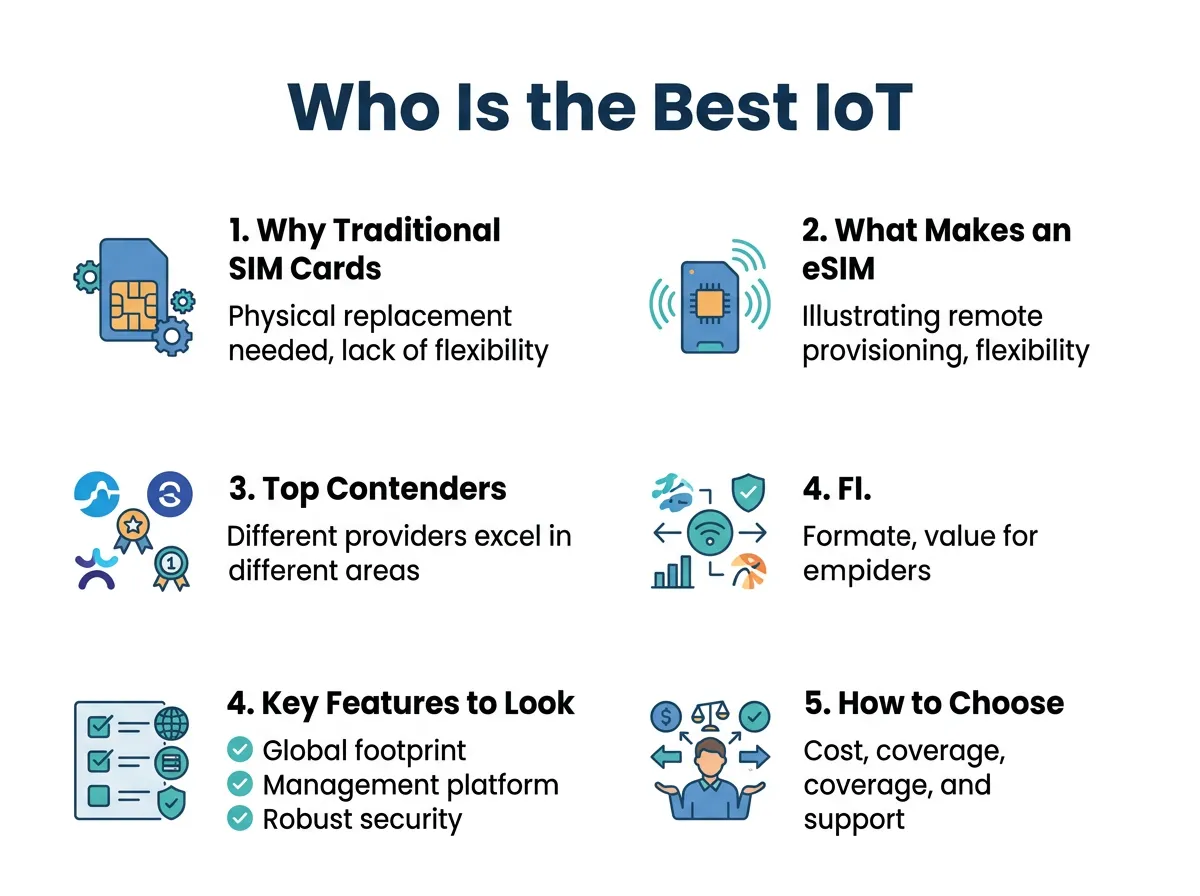
Who Is the Best IoT eSIM Provider? — key points at a glance
When looking at options, you will ask: Who Is the Best IoT eSIM Provider? To answer this, you must look at how they handle their networks and software. Here are the core things to look for.
Global Network Coverage
Your devices might travel. They might cross state lines or country borders. You need a partner with multi-network deals. This means your devices can connect to many different towers. If one tower goes down, the device connects to another one instantly.
Easy Management Platforms
You do not want to manage your chips one by one. You need a simple dashboard. A good dashboard lets you see all your devices on one screen. You can turn them on or off with one click. You can also monitor how much data they use each day. This helps you avoid high bills.
Top Contenders in the IoT eSIM Market
Let us look at some of the best companies today. These brands are leaders in the smart space. They help businesses of all sizes stay connected.
Pelion
Pelion is a famous name in the tech world. They offer great tools for managing your devices. They make it simple to scale up your business from ten devices to millions. If you want deep comparisons, check out this guide to the best IoT eSIM providers on the market. They focus heavily on security and ease of use.
Onomondo
Onomondo is known for its smart core network. They do not just buy and resell other networks. They built their own. This gives you much more control over your data. If you have a large fleet of devices, you can learn more about the top cellular connectivity partners for large fleets to see how they keep costs very low. Their platform is fast and highly secure.
Hologram
Hologram is perfect for developers. Their platform is very easy to use. They offer fast setups and clear pricing. If you want to start small and grow fast, Hologram is a great choice. They have a massive global reach and excellent customer support.
Key Features to Look For
When you compare providers, look past the brand name. You need to look at the tech inside the chip.
eUICC Technology Explained
This is a very important term in the industry. It stands for embedded Universal Integrated Circuit Card. It is the software that lets you switch carriers over the air. Make sure your provider supports true eUICC. Some companies call their cards eSIM but do not let you switch networks without buying new cards. You can see how this works by checking lists of the top IoT eSIM providers in the UK and Europe to see real-world examples.
Security and API Access
Your data must stay safe from hackers. Look for providers that offer private networks. They should also have strong APIs. An API lets your own software talk to the eSIM platform. This lets you automate tasks easily, like turning off suspended devices.
How to Choose for Your Specific Industry
Your choice depends on your daily work. Different jobs need different features.
Logistics and Asset Tracking
If you track trucks, your devices move fast. They cross state lines or country borders. You need fast switching between networks. A dropped signal could mean lost cargo. Look for a provider with great global roaming deals.
Smart Agriculture and Utilities
These devices stay in one place, but they are often in remote areas. The signal can be very weak. You need a provider with strong low-power network options. These are called LTE-M or NB-IoT. They help your device batteries last for years.
Practical Tips for a Smooth Rollout
Getting started can feel hard, but these simple steps will help you succeed.
Test with Pilot Devices
Do not buy thousands of eSIMs on day one. Buy a small test pack first. Put them in your devices. Test them in the real world. See how they connect inside buildings and out in the open. See how the dashboard works for your team. This saves you from making big, expensive mistakes.
Watch Out for Hidden Fees
Some companies charge extra for things you do not expect. They might charge you for platform access. They might charge to send simple SMS messages to your devices. Always ask for a clear list of all costs before you sign any contract.
Conclusion
Finding the right partner takes some time, but it is worth the effort. The right eSIM provider will help your business grow. They keep your smart devices online without any hassle. Focus on global coverage, easy software, and strong security. With the right choice, your smart network will run smoothly for years to come.
Frequently Asked Questions
What is an IoT eSIM?
An IoT eSIM is a smart chip built into a device that connects to cellular networks. It lets you change network profiles over the air without swapping physical cards. This makes it easy to manage large fleets of devices anywhere in the world.
Can I use a normal phone eSIM for IoT?
No, normal phone eSIMs are not made for IoT devices. Phone eSIMs lack the rugged design needed for harsh weather and industrial use. They also do not offer the central management dashboards that businesses need to track thousands of devices.
How do I switch carriers on an eSIM?
You can switch carriers remotely using your provider’s software platform. You simply choose a new network profile on your online dashboard and send it to the device. The device receives the update over the air and connects to the new network instantly.
What is eUICC in IoT?
eUICC is the software technology that allows an eSIM to hold multiple carrier profiles. It is the key feature that lets you swap networks over the air. Without eUICC, a SIM card cannot be reprogrammed once it is deployed in the field.
Are IoT eSIMs secure?
Yes, IoT eSIMs are highly secure because they are soldered directly onto the device’s circuit board. This physical integration prevents theft and tampering. They also support private networks and secure data encryption to keep your information safe.
How much does an IoT eSIM plan cost?
Pricing varies based on how much data your devices use and where they are located. Many providers offer flexible plans starting at less than a dollar per month for low-data devices. Always check for hidden costs like platform fees before choosing a plan.
