


The best eSIM for IoT devices is one that offers global multi-network coverage, robust security, and a centralized management platform to control all your connected hardware. Top industry solutions stand out because they simplify carrier switching and lower operational costs. Choosing the right provider depends on your deployment scale, geographic reach, and specific data needs.
Imagine deploying thousands of smart sensors across the globe. Some monitor soil moisture in rural farms. Others track shipping containers crossing deep oceans. Now, imagine having to manually change physical SIM cards in every single one of those sensors whenever a network operator changes their pricing or goes out of business. It sounds like a total logistics nightmare, doesn’t it?
This is exactly why businesses and tech enthusiasts are moving toward embedded SIMs. But with so many options popping up, you might find yourself asking: What Is the Best eSIM for IoT Devices?
In this guide, we will unpack the top eSIM choices for the Internet of Things (IoT). We will look at what makes an eSIM great, explore the top providers, and give you practical tips to choose the perfect match for your smart tech.
Key Takeaways
- Global Coverage: Multi-carrier support keeps devices connected across borders without swapping physical cards.
- Remote Provisioning: Over-the-air (OTA) updates let you manage profiles and switch networks instantly.
- Cost Efficiency: Pooled data plans prevent single-device overages and lower overall connectivity bills.
- Enhanced Security: Modern eSIMs use advanced encryption to protect data transfers from hackers.
- Durability: Industrial-grade eSIMs can withstand extreme weather, vibrations, and harsh environments.
- Future-Proofing: Choosing an eUICC-compatible eSIM protects your smart network from outdated network standards.
📑 Table of Contents
Why Traditional SIMs Fail in the IoT World
Traditional SIM cards were made for consumer phones. They work well when you can easily slide open a tray and swap a plastic card. However, this design falls short when it comes to industrial machinery, smart city infrastructure, or medical devices.
The Hassle of Physical Swaps
If you have devices scattered across a city or the country, sending technicians to replace physical SIM cards is incredibly expensive. In many cases, the devices are sealed to protect them from weather, water, or dust. Opening them up ruins their protective seal. This makes physical swaps highly impractical.
The Power of eUICC Technology
To truly understand how eSIMs solve this, we must look at eUICC (Embedded Universal Integrated Circuit Card). This technology allows you to download and change carrier profiles over the air. You do not need to touch the physical device. To learn more about this underlying technology, you can read about how it works to understand what an eSIM is and how it functions in modern hardware networks.
Key Features to Look For in an IoT eSIM
Not all eSIMs are created equal. When researching What Is the Best eSIM for IoT Devices, you need to look beyond cheap data rates. Here are the core features that separate the average options from the industry leaders.
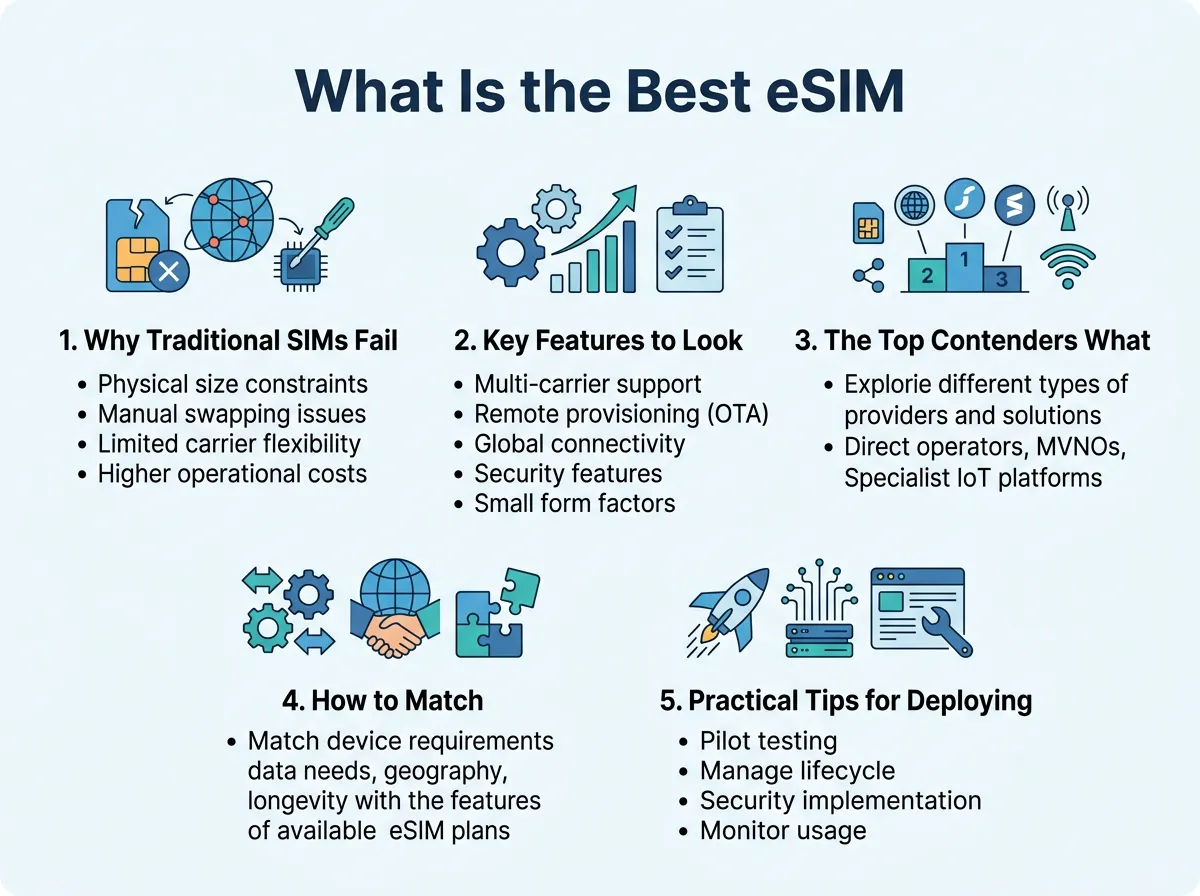
What Is the Best eSIM for IoT Devices? — key points at a glance
Multi-Network and Global Roaming
An IoT device must stay connected. If a single network goes down, your device should automatically switch to another available network. The best eSIMs offer bootstrap profiles that can connect to hundreds of networks worldwide. This ensures constant uptime, even in remote locations.
Centralized Management Platforms
You cannot manage thousands of devices individually. You need a centralized platform, often called a Connectivity Management Platform (CMP). This software lets you track data usage, activate new devices, set usage limits, and push firmware updates to your entire fleet from a single screen.
Robust Security Standards
IoT devices are frequent targets for cyberattacks. A secure eSIM should offer private APNs (Access Point Names), VPN tunnels, and fixed IP addresses. If you want to dive deeper into how these features keep your data safe, consider looking into the benefits of eSIM for IoT security and provisioning.
The Top Contenders: What Is the Best eSIM for IoT Devices?
Let us look at some of the top-performing providers in the market today. Each of these companies offers unique advantages depending on your specific project needs.
Things Mobile
Things Mobile is a major player in the IoT space. They focus heavily on affordability and flexibility. Their platform allows you to connect devices in over 165 countries. This makes them a strong choice for both small startups and larger operations. If you want to see how their business packages work, you can explore Things Mobile business solutions to compare pricing and coverage tiers.
KORE Wireless
KORE is a giant in the global IoT connectivity space. They offer highly specialized eSIM solutions designed for critical applications like healthcare and fleet logistics. Their eUICC offerings allow seamless transitions between major carrier networks. This ensures your devices never lose connection, no matter where they travel.
Onomondo
Onomondo has redesigned the mobile core network from the ground up. Instead of relying on traditional roaming agreements that can cause lag, Onomondo connects your devices directly to local networks. This reduces power consumption. It is an ideal setup for battery-powered devices that need to last for years in the field.
How to Match an eSIM to Your Specific IoT Use Case
The right answer to What Is the Best eSIM for IoT Devices depends heavily on your specific application. Different industries have different demands.
Smart Agriculture and Remote Sensors
For smart agriculture, devices are often left in fields for years. They do not send much data, but they must survive extreme weather. For this, you need industrial-grade, soldered eSIMs with low-power wide-area network (LPWAN) support, such as LTE-M or NB-IoT.
Fleet Management and Logistics
When tracking trucks or cargo containers, your devices constantly cross borders. You need an eSIM with excellent international roaming agreements. Look for providers that offer flat-rate global pricing so you do not get hit with surprise roaming fees when a truck crosses a border.
Smart Home and Wearable Tech
Smart home devices usually have access to Wi-Fi but need cellular backup. For these consumer-facing devices, a standard pluggable eSIM chip might work fine. Here, look for providers that offer fast setup processes and quick activation times.
Practical Tips for Deploying Your IoT eSIMs
Transitioning to eSIMs can seem daunting. Here are a few practical tips to make your deployment as smooth as possible.
Start with a Pilot Program
Never buy thousands of eSIMs at once. Start by ordering a small batch of 10 to 20 test units. Deploy them in real-world conditions to test network switching speed, signal strength, and the platform interface. This helps you catch potential issues early.
Monitor Your Data Pooling
Look for providers that offer pooled data plans. In a pooled plan, if one device uses less data and another uses more, they balance each other out. This prevents expensive overage charges. Make sure to set up automatic alerts on your management dashboard to notify you if your overall pool is running low.
Keep Your Firmware Updated
Take advantage of remote provisioning. Regularly update your devices’ connection profiles to ensure they are always using the most efficient and cost-effective networks available in their region.
Conclusion
So, What Is the Best eSIM for IoT Devices? The truth is, there is no single brand that fits every single project. If you are looking for simple, pay-as-you-go pricing for a growing fleet, Things Mobile is an excellent choice. If you are running a massive, mission-critical corporate operation, KORE Wireless or Onomondo might be better suited for you.
The key is to focus on global coverage, strong security, and a management platform that makes your life easier. By choosing a flexible, eUICC-compatible eSIM, you ensure your IoT network remains reliable, secure, and ready to grow for years to come.
Frequently Asked Questions
Can I use a normal consumer eSIM in an IoT device?
While it is technically possible in some cases, it is not recommended. Consumer eSIMs lack the rugged physical design, specialized management portals, and pooled data plans needed for industrial or large-scale IoT projects.
What is eUICC, and why does it matter?
eUICC is the software technology that allows an eSIM to hold multiple carrier profiles. This lets you switch network operators over the air without physically changing the card, which is essential for managing remote devices.
How do IoT eSIMs handle roaming fees?
Most dedicated IoT eSIM providers offer flat-rate global data plans. This means you pay a consistent price per megabyte across multiple countries, avoiding the expensive roaming charges typical of consumer mobile plans.
What is data pooling in IoT eSIM plans?
Data pooling combines the data allowances of all your active devices into a single shared pool. This prevents you from paying overage fees for high-use devices if other devices on your network are under their limits.
Are IoT eSIMs physically different from regular SIM cards?
Yes, many IoT eSIMs are soldered directly onto the device’s circuit board during manufacturing. These are called MFF2 chips, and they are much more resistant to heat, dust, water, and physical vibration than plastic SIM cards.
How long do industrial IoT eSIMs last?
Industrial-grade eSIMs are built to last up to 10 to 15 years, even in harsh environments. Their soldered design and durable components ensure they can withstand extreme temperatures and constant movement over their long lifespan.
