


IoT satellite connectivity is transforming global industries by providing seamless, borderless data transmission where terrestrial networks fail. From agriculture and maritime shipping to energy and environmental monitoring, organizations leverage space-based networks to track assets, improve safety, and optimize operations. By bridging the digital divide, satellite IoT ensures that no remote asset is left in the dark.
Imagine standing in the middle of a vast, silent desert or sailing across the deep blue of the Pacific Ocean. If you look at your smartphone, you will likely see the dreaded “No Service” message. For a casual traveler, this is a minor inconvenience. But for a global business managing millions of dollars in heavy machinery, cargo, or environmental sensors, this lack of signal is a massive blind spot.
Traditional cellular networks only cover a tiny fraction of our planet’s surface. They cluster around cities, highways, and suburban areas. What happens to the vital assets that operate far outside these boundaries? This is the exact problem that space-based technology solves. In this article, we will dive deep into a critical question: Which Industries Benefit From IoT Satellite Connectivity? We will explore how modern businesses are using satellites to stay connected, optimize their workflows, and keep their workers safe.
To understand the scale of this technological shift, we can look at a comprehensive guide to satellite IoT. These systems use networks of satellites orbiting high above the Earth to send and receive data from small, low-power devices on the ground. Let’s look at the specific sectors that are gaining the most from this modern space race.
Key Takeaways
- Universal Coverage: Satellite IoT fills the massive coverage gaps left by traditional cellular and Wi-Fi networks, especially in oceans, deserts, and rural areas.
- Agriculture Optimization: Farmers use satellite sensors to monitor remote soil conditions, track wandering livestock, and manage water resources.
- Maritime Efficiency: Shipping companies track cargo containers and vessel diagnostics across deep ocean routes in real time.
- Infrastructure Protection: Energy sectors monitor remote pipelines, offshore wind farms, and power grids to prevent leaks and outages.
- Cost-Effective Hybrid Solutions: Modern hardware can automatically switch between cheap cellular networks and reliable satellite connections.
📑 Table of Contents
1. Agriculture and Smart Farming
Agriculture may be one of the oldest industries in human history, but it is quickly becoming one of the most tech-heavy. Modern farms often span thousands of acres. Much of this land sits far beyond the reach of standard cellular towers.
Precision Soil and Crop Monitoring
Farmers place sensors directly into the soil to measure moisture levels, nutrient content, and temperature. This data helps them decide exactly when to water or fertilize their crops. Without satellite connectivity, collecting this data would require driving miles across rough terrain to read sensors manually. With satellite IoT, this data flows continuously to a central dashboard, saving time and water.
Livestock Tracking in Remote Areas
Ranchers often let cattle graze across vast, open public lands. Finding a lost cow can take days of searching on horseback or in trucks. Smart collars equipped with satellite transmitters allow ranchers to locate their entire herd instantly on a map. This prevents livestock loss to predators or theft and ensures animals stay within designated boundaries.
2. Maritime and Ocean Shipping
The maritime industry is perhaps the most obvious answer when asking which industries benefit from IoT satellite connectivity. Once a ship leaves port, it enters a digital black hole. Satellites are the only way to maintain a steady flow of data from these floating giant warehouses.
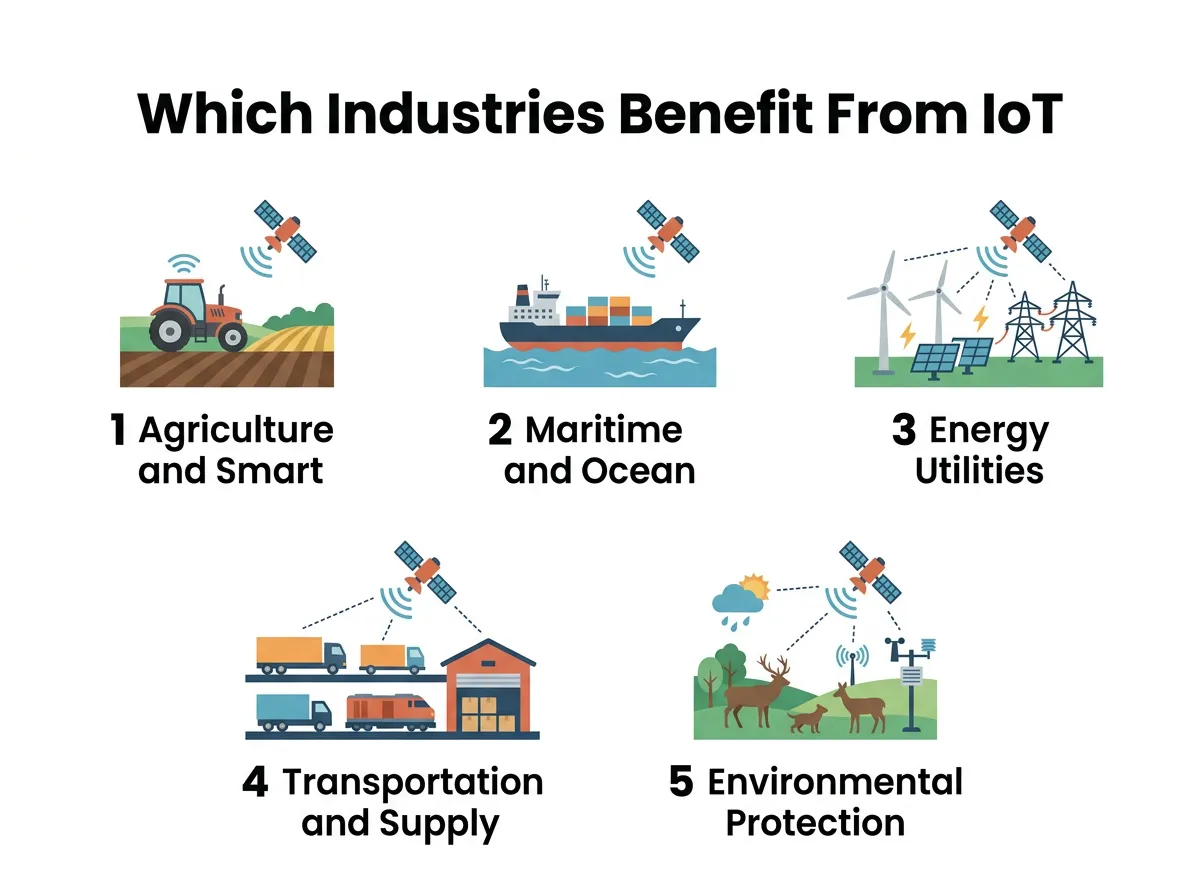
Which Industries Benefit From IoT Satellite Connectivity? — key points at a glance
Continuous Asset and Cargo Tracking
Global supply chains rely on cargo ships carrying thousands of metal containers. Many of these containers hold sensitive goods, such as fresh food or life-saving medicines. Satellite-connected sensors monitor the internal temperature, humidity, and security of these containers. If a refrigeration unit fails in the middle of the Atlantic, the crew is alerted immediately, preventing costly spoilage.
Vessel Performance and Safety
Modern ships are packed with engines, generators, and pumps. Satellite IoT systems monitor these components in real time. They transmit diagnostic data back to headquarters on land. This allows engineers to spot mechanical problems before they cause a breakdown at sea, keeping the crew safe and keeping deliveries on schedule.
3. Energy, Utilities, and Heavy Infrastructure
Energy companies operate in some of the most hostile and remote environments on Earth. From offshore oil rigs to wind turbines spinning on mountain peaks, keeping tabs on these valuable assets is a major challenge.
Remote Pipeline Monitoring
Oil and gas pipelines stretch across thousands of miles of frozen tundra and dense forests. Even a tiny leak can cause severe environmental damage and trigger massive fines. By installing satellite-linked sensors along the pipeline, operators can detect drops in pressure instantly. This allows them to shut off valves remotely long before a human inspection team could reach the site.
This level of automated oversight is transforming how heavy industries operate safely. In fact, satellite connectivity optimizes industrial IoT by providing a reliable safety net for critical infrastructure that simply cannot afford to go offline.
Renewable Energy Management
Solar arrays and wind farms are often built in open, sun-drenched plains or windy coastal waters where cellular signals are weak or non-existent. Satellite IoT allows utility companies to monitor energy production, adjust solar panel angles, and detect structural issues without sending technicians on long, expensive field trips.
4. Transportation and Supply Chain Logistics
Trucks and trains carry the lifeblood of our economy across borders and through deep mountain passes. When a truck enters a rural valley, its cellular GPS tracker can go dark. This makes it impossible for logistics managers to give accurate arrival estimates to customers.
Seamless Cross-Border Tracking
A truck driving from Canada, through the United States, and into Mexico might have to switch between several cellular providers. This switching process can cause data gaps. Satellite IoT devices remain connected to the same satellite constellation regardless of national borders, providing continuous, uninterrupted tracking.
Optimized Cold Chain Logistics
For high-value goods like vaccines, maintaining a strict temperature range is critical. Satellite-linked temperature sensors send alerts the moment a cooling system fluctuates. This lets fleet managers reroute the truck to the nearest facility to save the cargo, reducing waste and protecting public health.
5. Environmental Protection and Disaster Response
To protect our planet, scientists need accurate, real-time data from the most remote ecosystems. Satellite IoT has become an invaluable tool for environmental conservation and disaster prevention.
Early Warning Systems for Natural Disasters
Sensors placed on active volcanoes, in wildfire-prone forests, or near rivers can detect early warning signs of danger. For example, a sudden rise in water levels in a remote mountain stream could signal an oncoming flood. Satellites transmit these warnings instantly, giving downstream communities precious time to evacuate.
Wildlife Conservation and Research
Biologists tag endangered animals, like polar bears or sea turtles, with satellite trackers. These tags send back location data, helping researchers map migration routes and identify habitats that need strict protection from human development.
Tips for Implementing Satellite IoT in Your Business
If your business operates in remote areas, you might be wondering how to start using this technology. Here are a few practical tips to help you take the first step:
- Use Hybrid Devices: Look for devices that use cellular networks when they are available and automatically switch to satellite when cellular signals fade. This approach saves money on data costs.
- Focus on Low-Power Solutions: Changing batteries in the middle of a desert is difficult. Choose low-power devices designed to run for years on a single charge.
- Start with a Small Pilot: Test the technology on a small batch of assets to see how the data flows before investing in a full-scale rollout across your entire operation.
As technology advances, setting up these systems is becoming easier and more affordable. The primary satellite IoT market growth drivers include the launch of hundreds of new low-Earth orbit satellites and the falling cost of hardware, making space-tech accessible to businesses of all sizes.
Conclusion
When we ask ourselves, “Which Industries Benefit From IoT Satellite Connectivity?”, the answer is clear. Any business that operates beyond the edge of the city grid can find immense value in space-based data. Whether it is tracking cattle in Australia, keeping a watchful eye on cargo ships in the Atlantic, or protecting remote pipelines from leaks, satellite IoT is rewriting the rules of global business. By keeping every asset connected, no matter how remote, this technology helps us build a safer, more efficient, and more connected world.
Frequently Asked Questions
Which industries benefit from IoT satellite connectivity the most?
The industries that benefit most are agriculture, maritime shipping, energy, transportation, and environmental monitoring. These sectors operate across vast, remote areas where traditional cellular networks and Wi-Fi cannot reach.
What is the difference between cellular IoT and satellite IoT?
Cellular IoT relies on ground-based cell towers, which only cover populated areas and major roads. Satellite IoT connects directly to spacecraft in orbit, providing truly global coverage even in the middle of oceans or deserts.
Is satellite IoT expensive for small businesses?
While historically expensive, the cost of satellite IoT has dropped significantly due to the launch of low-Earth orbit (LEO) satellites. Many businesses now use budget-friendly hybrid systems that only switch to satellite when cheap cellular signals are unavailable.
How long do batteries last in satellite IoT devices?
Modern satellite IoT devices are designed for extreme energy efficiency, often using low-power protocols. Many of these sensors can operate on a single set of batteries for five to ten years without maintenance.
Can satellite IoT track assets in real time?
Yes, satellite IoT can track assets in real time or at scheduled intervals. This allows businesses to monitor the exact location and health of cargo, vehicles, and equipment as they move across the globe.
What are hybrid IoT devices?
Hybrid IoT devices are dual-mode trackers that contain both cellular and satellite chips. They use cellular networks as their primary connection to save money and automatically switch to satellite when they move out of cell tower range.
