


The most reliable IoT SIM is a multi-network roaming eSIM (eUICC) that automatically switches to the strongest available cellular carrier. Unlike standard consumer SIM cards, these specialized industrial IoT SIMs bypass single-network downtime to keep smart devices online 24/7. By utilizing robust hardware and global network access, they offer unmatched connection uptime for any IoT deployment.
Imagine deploying hundreds of smart sensors across a busy city, deep inside rural fields, or on a fleet of delivery trucks driving cross-country. You spend weeks configuring the software, calibrating the hardware, and testing the sensors. Everything works beautifully in your office. But the moment your devices hit the real world, they start dropping off the grid. Data gaps appear, alerts fail to send, and your team is forced to travel miles just to reboot a device. It is a nightmare scenario for any business owner or network administrator.
At the heart of this problem lies a simple component: the subscriber identity module, or SIM card. If you are setting up smart devices, you are likely asking yourself: What Is the Most Reliable IoT SIM? It is a question that sounds simple but requires looking deep into how cellular networks operate globally. To find the right answer, we have to explore the technology that keeps our machines talking to each other without interruption.
In this guide, we will break down what makes an IoT SIM dependable. We will look at why standard consumer SIMs fall short and why multi-network roaming is a game-changer. We will also explore the physical durability of SIM hardware and how modern software helps you manage your devices. By the end, you will know exactly what features to look for to keep your IoT network online 24/7.
Key Takeaways
- Multi-Network Roaming is Crucial: The best IoT SIMs connect to multiple carriers, ensuring backup coverage if one network fails.
- eSIM (eUICC) Adds Flexibility: This technology lets you update carrier profiles over-the-air, eliminating physical SIM swaps.
- Industrial Grade Hardware Matters: Ruggedized SIM cards withstand extreme temperatures, vibrations, and harsh environments.
- Steer Clear of Steering: True reliability requires non-steered SIMs that prioritize signal quality over carrier cost.
- Centralized Management Tools: A reliable SIM is only as good as its platform, which helps you monitor data use and troubleshoot issues instantly.
📑 Table of Contents
Understanding True Reliability in IoT
Before we can find the best cellular solution, we must define what we mean by the word “reliable.” According to the Merriam-Webster definition of reliable, it means something that is fit to be trusted or relied on. In the world of tech, we often look at synonyms for reliable like dependable, trustworthy, and steady. For the Internet of Things (IoT), reliability translates to near-perfect uptime. It means your smart water meters, GPS trackers, or medical monitors never lose their connection to the cloud.
Many businesses make the mistake of using standard consumer SIM cards for their smart projects. Consumer SIMs are designed for mobile phones. They are meant for high-speed web browsing, video streaming, and voice calls. They work well when you are in a crowded city with great coverage from a single carrier. However, if that carrier suffers an outage, your phone goes silent. For a human, this is an inconvenience. For an automated industrial machine, a lost connection can stop production lines or delay life-saving alerts.
Why Consumer SIMs Fail IoT Devices
Consumer SIMs are locked to one specific home network. If your device moves behind a concrete wall or into a rural zone where that network is weak, it cannot switch to a competitor. IoT devices often sit in remote, harsh environments. They do not have a human operator to manually search for another network. This is why specialized IoT SIM cards are required for industrial and commercial projects.
The Anatomy of an IoT SIM Card
An IoT SIM is built on different firmware than a standard phone SIM. It is programmed to prioritize network stability over raw speed. It handles network handshakes more efficiently. It can also manage power-saving modes. This helps devices that run on small batteries last for ten years or more without needing a battery swap.
Multi-Network Roaming: The Secret to Constant Coverage
When asking, What Is the Most Reliable IoT SIM?, the answer almost always points to multi-network roaming. Just as major infrastructure projects rely on back-ups—such as how power grids rely on nuclear energy as a highly reliable power source to prevent blackouts—your IoT network needs a backup plan. A multi-network SIM can connect to several different cellular operators in a single country.
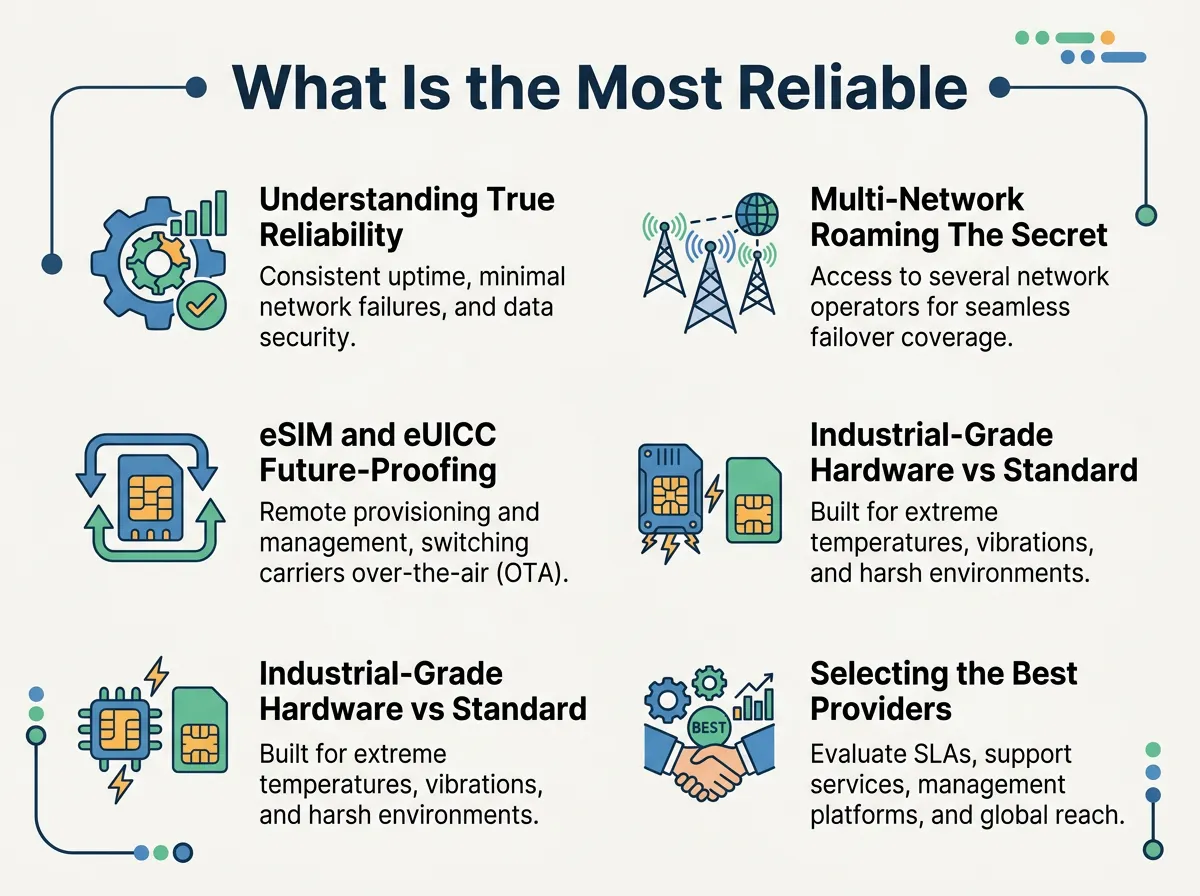
What Is the Most Reliable IoT SIM? — key points at a glance
If Carrier A has a weak signal or an unexpected outage, the SIM instantly switches to Carrier B or Carrier C. This network redundancy is the single biggest factor in achieving 99.9% uptime. It ensures your devices remain online even when individual local networks go down.
The Trap of “Steered” Roaming
Not all multi-network SIMs are created equal. Many providers use what is called “steered” roaming. In this setup, the SIM is programmed to prefer the network provider that has the cheapest data rate. Even if that cheap network has a terrible, weak signal, the SIM will fight to stay connected to it. It will only switch to a stronger network when the cheap one disappears completely. This causes frequent drops and slow data transfer.
The Power of Non-Steered SIMs
For true reliability, you need a “non-steered” multi-network SIM. Non-steered SIMs do not care about carrier costs. Instead, they scan the area and connect to the strongest signal available. If the current connection drops below a certain quality threshold, the SIM switches to a stronger network immediately. This keeps your data flowing smoothly without any artificial delays.
eSIM and eUICC: Future-Proofing Your Connection
Another major leap in reliability is the rise of eSIM technology, specifically eUICC (Embedded Universal Integrated Circuit). In the past, changing your cellular provider meant sending a technician to physically swap out the plastic SIM card in every single device. If you had thousands of devices deployed across the globe, this was impossible.
With eUICC, the SIM profile is managed over-the-air (OTA). This means you can download new carrier profiles to the device remotely. You do not have to touch the physical hardware. This flexibility protects your deployment from future network changes.
How eUICC Prevents Carrier Lock-In
If your current carrier decides to raise prices or shut down a specific network band (like 2G or 3G), you are not trapped. You can send a software update to your devices to switch to a new network provider. This prevents your hardware from becoming useless bricks overnight.
Streamlining Global Deployments
If you build products in one country and ship them worldwide, eUICC is incredibly helpful. You can install a single bootstrap profile at the factory. When the device powers up in its destination country, it automatically downloads the local network profile that offers the best coverage and price. This greatly simplifies your supply chain.
Industrial-Grade Hardware vs. Standard Plastic
Reliability is not just about wireless signals and software. It is also about the physical card itself. Standard plastic SIM cards are made for phones that live in comfortable pockets or purses. They do not handle extreme conditions well. Over time, heat, cold, and vibration can cause standard SIMs to crack, warp, or lose contact with the device tray.
For industrial applications, you must use industrial-grade SIM hardware. These cards are built with stronger plastics and gold-plated contacts. They can survive extreme temperatures, high humidity, and constant physical shaking.
Industrial SIM Form Factors
- Standard Plug-In SIMs (2FF, 3FF, 4FF): These look like regular SIM cards but are made with industrial-grade materials. They work in standard SIM slots but are ruggedized to handle temperatures from -40°C to +85°C.
- Solderable SIMs (MFF2): These are tiny chips that are soldered directly onto the device’s circuit board during manufacturing. Because they are soldered down, there is no physical slot that can get dirty or loose. They offer the highest level of physical reliability. They can withstand temperatures up to +105°C and intense vibrations.
Choosing the Right Form Factor
If your devices are placed outdoors, on vibrating engines, or inside moving vehicles, the solderable MFF2 form factor is your best bet. It removes the physical point of failure entirely. For less intense environments, like indoor smart building sensors, a ruggedized plug-in SIM will work perfectly.
Selecting the Best Providers and Platforms
When searching for the ultimate IoT SIM, you also need to look at the management platform that comes with it. A reliable SIM card is only as good as the software you use to manage it. You need a platform that gives you real-time visibility into your entire fleet of devices.
A good connectivity management platform (CMP) lets you see how much data each device is using. It allows you to troubleshoot connection issues remotely. You can set up automated alerts to warn you if a device goes offline or starts using too much data. This helps you catch problems before they turn into major network outages.
Key Features of a Great IoT Platform
- Real-Time Diagnostics: The ability to ping devices, reset connections, and check signal strength from a single dashboard.
- Automated Cap Alerts: Safeguards that temporarily pause data to prevent massive overage bills from runaway devices.
- Geofencing: Alerts that notify you if a SIM card is physically removed from a device and placed into another one. This prevents data theft.
Practical Checklist for Your IoT Deployment
To help you decide on the right option for your business, we have put together a quick checklist. Use these questions to evaluate different providers when deciding What Is the Most Reliable IoT SIM? for your project.
Your IoT SIM Checklist
- Does the SIM support non-steered multi-network roaming?
- Is the physical SIM rated for the temperature range of your deployment environment?
- Does the provider offer eUICC capability to future-proof your hardware?
- Can you manage all your SIM cards from a single, centralized web platform?
- Are there clear service level agreements (SLAs) regarding network uptime and support response times?
- Does the provider offer flexible data pooling to help manage costs across your fleet?
Conclusion
Finding the right connection is about more than just buying the cheapest data plan. To ensure your devices stay online, you need to look at the big picture. The ideal solution combines non-steered multi-network roaming, rugged industrial hardware, and flexible eUICC technology. By avoiding steered networks and standard consumer plastic cards, you protect your business from costly downtime and physical failures.
Invest the time upfront to select a provider that offers global reach and a powerful management platform. With the right technology in place, your devices will remain connected, secure, and ready to deliver the valuable data your business relies on every single day.
Frequently Asked Questions
What is the difference between an IoT SIM and a standard SIM?
An IoT SIM is built for machine-to-machine communication, offering features like multi-network roaming, remote management, and industrial durability. Unlike standard consumer SIMs, they focus on persistent uptime and efficient, low-bandwidth data transfers rather than high-speed consumer media streaming.
Can I use a normal phone SIM in my IoT device?
While a normal phone SIM might work temporarily, it is highly discouraged for commercial projects because it lacks network redundancy and is locked to a single carrier. Additionally, consumer SIMs violate most carrier terms of service when used for machine-to-machine applications and may be shut down without notice.
What does “non-steered” mean for an IoT SIM?
A non-steered SIM connects to the strongest available cellular signal regardless of which carrier network is the cheapest. This prevents your device from lingering on a weak, cheap network and ensures a constantly reliable connection.
How long do industrial IoT SIMs last?
Industrial IoT SIMs are engineered to last up to 10 to 15 years, even when exposed to harsh environmental conditions. They use ruggedized silicon and specialized packaging to resist physical wear, extreme temperatures, and moisture.
What is eUICC in IoT?
eUICC is a technology that allows you to change mobile network operators remotely over-the-air without physically swapping the SIM card. This future-proofs your hardware deployments and prevents your devices from being locked into a single cellular carrier.
Why are solderable SIMs (MFF2) highly reliable?
Solderable SIMs, also known as MFF2 chips, are soldered directly onto a device’s circuit board during manufacturing, removing physical slots. This eliminates mechanical points of failure like dust build-up, corrosion, or shifting contacts caused by intense vibrations.
