


The Internet of Things, or IoT, is a vast network of physical devices connected to the internet that collect and share data. These smart gadgets range from simple household items like smart thermostats to complex industrial tools. By communicating with each other without human intervention, they make our daily lives more efficient and automated.
Imagine waking up on a chilly winter morning. Your alarm goes off at 7:00 AM. Instantly, your bedroom heater turns on. Down in the kitchen, your coffee machine starts brewing a fresh pot. Your smart window blinds slide open to let in the morning light. You did not touch a single button. You did not even have to speak. This is not magic. It is the power of connected technology.
Many people hear buzzwords like “smart tech” or “the cloud” every day. But what is really happening behind the scenes? In this guide, we will explore the big picture. We will answer the question: What Is the Internet of Things (IoT)?
We will look at how everyday objects talk to each other. We will see how this technology helps us save time, energy, and money. We will also talk about how to keep your private data safe. Let us dive in and explore this amazing digital web.
Key Takeaways
- Seamless Connectivity: IoT connects everyday physical objects to the internet to share data.
- Smart Automation: These devices work behind the scenes to automate tasks and save energy.
- Data-Driven Decisions: IoT sensors collect real-time data to help businesses work smarter.
- Everyday Convenience: Smart homes use IoT for security, comfort, and entertainment.
- Security Challenges: Keeping connected devices secure is vital to protect personal privacy.
- Massive Growth: Billions of devices connect to the web daily, shaping our future.
📑 Table of Contents
How Does the Internet of Things Work?
To understand how this system operates, think of the human body. Our eyes and ears gather clues. Our nerves send those clues to our brain. Our brain then tells us how to react. The Internet of Things works in a very similar way. It relies on a network of smart physical devices that talk to each other.
Sensors and Devices
Everything starts with the physical device. This could be a light bulb, a camera, or a water pump. Each of these devices has a tiny computer inside. It also has a sensor. A sensor acts like the eyes and ears of the device. It detects changes in the world. For example, a smart thermostat has a sensor to measure temperature. A fitness band has a sensor to count your steps. These sensors gather data from the world around them all day long.
Connectivity
Once a sensor gathers data, it must send it somewhere. This is where connectivity comes in. Devices can use many ways to share data. Some use home Wi-Fi. Others use Bluetooth or cellular networks. The choice depends on where the device is. A smart watch might use Bluetooth to talk to your phone. A smart tractor in a farm field might use satellite signals. The main goal is to get the data from the device to a central storage space.
Data Processing and Cloud Software
Now, the data arrives at its destination. This is usually a cloud server. Here, powerful software analyzes the information. This is where cloud platform solutions come into play. The software looks at the data and makes a quick decision. For instance, if the room temperature drops below 68 degrees, the software knows it is too cold. It immediately sends a command back to the heater. The heater turns on, and the room warms up. All of this happens in less than a second.
Common Examples of IoT in Everyday Life
You might not know it, but you likely use this technology already. It is in our homes, our cars, and our offices. Let us look at some common ways we use these smart tools every day.
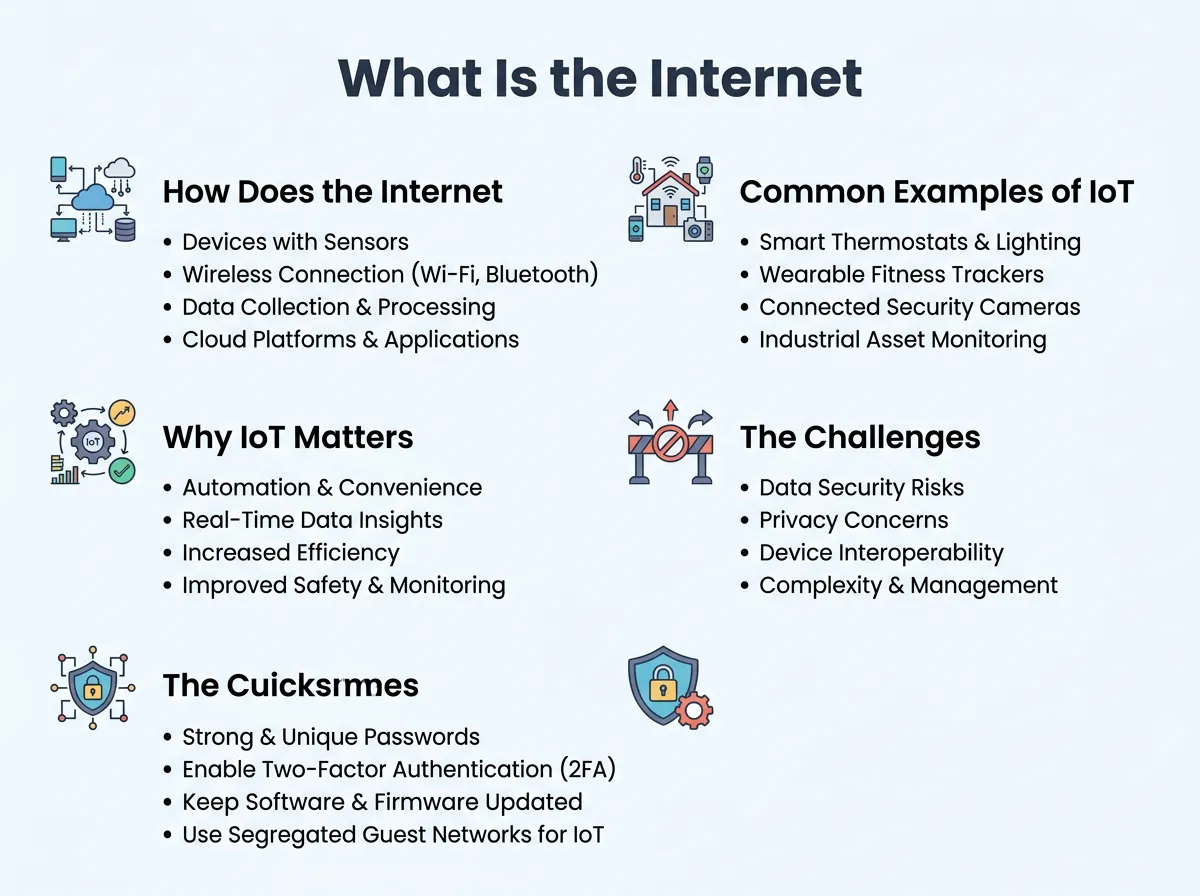
What Is the Internet of Things (IoT)? — key points at a glance
Smart Home Devices
Smart homes are the most popular example of this technology. Think of voice assistants that play your favorite songs on command. Think of video doorbells that show you who is at the door, even when you are at work. You can also buy smart plugs. These plugs let you turn any old lamp into a smart light. You can control these lights with an app on your phone.
Wearable Technology
Wearable devices are another great example. Millions of people wear smartwatches and fitness trackers. These devices monitor your heart rate. They track how well you sleep. Some advanced trackers can even tell if a user falls down. If a fall happens, the watch can call for help. This technology literally saves lives.
Smart Cities
Cities are also getting smarter. Many local governments use sensors to manage traffic. When a street gets crowded, smart traffic lights change their timing. This keeps cars moving and cuts down on pollution. Some cities use smart trash cans. These cans tell the trash truck when they are full. The trucks only stop when needed. This saves gas and taxpayer money.
Why IoT Matters: The Big Benefits
Why is everyone talking about this technology? It is because it offers major benefits for people and businesses. Here are some of the biggest reasons why it is a game-changer.
Saving Time and Effort
Life can be busy. This technology helps by doing simple tasks for us. You do not have to worry about locking the front door. Your smart lock does it for you. You do not have to check if your plants need water. A smart garden sensor can water them automatically. This frees up your time for more important things.
Saving Energy and Money
Connected devices are great for your wallet and the planet. Smart lights turn off when they do not detect motion. Smart thermostats learn your daily routine. They lower the heat when you are at work. They raise it right before you get home. This keeps you cozy while lowering your energy bills.
Helping Businesses Work Better
Businesses use IoT-enabled business tools to track their inventory. Sensors can tell a factory manager if a machine is about to break. This allows the team to fix the machine before it stops working. In agriculture, farmers use sensors to check soil moisture. This helps them grow more food using less water.
The Challenges of a Connected World
Every great technology comes with some risks. The Internet of Things is no different. It is important to know these challenges so we can use the technology safely.
Security and Privacy Concerns
This is the biggest challenge. Every smart device is a small computer connected to the internet. If a device does not have good security, hackers can break in. A hacker could access your home Wi-Fi through a smart light bulb. They might also view your security camera feed. This is why keeping devices secure is so vital.
Compatibility Issues
Today, many different companies make smart devices. Sometimes, these devices do not speak the same language. A smart bulb from one brand might not work with a hub from another brand. Tech companies are working to solve this. They are building new standards so all devices can work together.
Quick Tips to Secure Your Smart Devices
You do not have to be a tech expert to protect your home. Here are some easy steps you can take today:
- Change default passwords: Many devices come with simple passwords like “admin” or “1234.” Change these right away to something strong.
- Update your software: Companies send out updates to fix safety bugs. Always install these updates as soon as they are ready.
- Use a guest network: Set up a separate Wi-Fi network just for your smart devices. This keeps your main computer and phone safe if a smart bulb gets hacked.
- Turn off what you do not use: If a device does not need to be online, turn off its internet connection.
What Lies Ahead for the Internet of Things?
The future of this technology is incredibly bright. We are moving toward a world where almost everything is connected.
The Power of AI
Artificial Intelligence (AI) will make these devices even smarter. Instead of just following rules, devices will learn from your habits. Your home will know what you want before you even ask.
Faster 5G Networks
The rollout of 5G cellular networks will change everything. 5G is much faster than older networks. It can connect millions of devices at once with no delay. This will make self-driving cars safer. It will also allow doctors to perform surgery from thousands of miles away using smart tools.
Conclusion
So, What Is the Internet of Things (IoT)? It is not just a collection of cool gadgets. It is a massive digital network that brings physical objects to life. It helps us save time, save energy, and live more comfortable lives.
While there are security risks to keep in mind, the benefits are hard to ignore. By taking simple steps to protect our data, we can enjoy a smarter world. The connected future is already here, and it is only going to get better.
Frequently Asked Questions
What is a simple definition of IoT?
The Internet of Things, or IoT, refers to physical objects that connect to the internet to collect and share data. These objects include everything from smart fridges to wearable fitness trackers. They communicate automatically without needing human input.
Is my smartphone an IoT device?
A smartphone is not typically classified as a basic IoT device on its own, but it acts as the primary control center for them. You use your smartphone to run apps that manage your smart bulbs, cameras, and thermostats. It serves as the gateway to your connected world.
Do IoT devices need Wi-Fi to work?
No, they do not always need Wi-Fi to communicate. While many home devices do use Wi-Fi, others use Bluetooth, cellular networks, or satellite connections. The choice depends on the device’s location and power source.
Are IoT devices safe from hackers?
Like any device connected to the internet, smart gadgets can be targeted by hackers. Many cheaper devices lack strong built-in security features. You can stay safe by changing default passwords and keeping device software updated.
How does IoT help the environment?
Connected devices help save energy by only running when necessary. Smart thermostats turn off heating when rooms are empty, and smart irrigation systems water crops only when the soil is dry. This reduces waste and conserves precious natural resources.
What is the difference between the internet and IoT?
The internet is the global network that connects people to information through computers and phones. The Internet of Things is a subset of this network that specifically connects physical objects to each other. It allows machines to talk directly to other machines.
