

The best smart eSIM for multi-carrier IoT connectivity provides seamless network switching, global coverage, and centralized remote provisioning. Top providers like KORE Wireless, FloLive, and Onomondo lead the market by offering robust multi-IMSI and eUICC capabilities. Choosing the right solution depends on your device deployment locations, data needs, and carrier redundancy requirements.
Imagine deploying thousands of tracking sensors across Europe, North America, and Asia. Halfway through the journey, one major telecom network goes down. Suddenly, your valuable cargo goes completely dark. This is a nightmare scenario for any operations manager, but it happens more often than you might think.
In the past, solving this issue required manual work. You had to physically swap out SIM cards or accept massive roaming charges to keep your devices online. Today, smart eSIMs solve this headache once and for all. They allow your devices to connect to multiple networks seamlessly, ensuring they never lose signal.
With so many options on the market, finding the right provider can feel overwhelming. Let us dive deep into the technology, top providers, and practical selection tips to answer the ultimate question: What Is the Best Smart eSIM for Multi-Carrier IoT Connectivity?
Key Takeaways
- Unmatched Reliability: Smart eSIMs automatically switch to the strongest network, eliminating single-carrier downtime.
- Future-Proof Tech: eUICC technology allows you to update carrier profiles over-the-air without swapping physical cards.
- Global Reach: A single smart eSIM can access hundreds of networks worldwide, simplifying global logistics.
- Cost Efficiency: Multi-carrier solutions help avoid expensive roaming fees by using local carrier agreements.
- Unified Management: The best providers offer a single dashboard to monitor, manage, and scale your entire IoT fleet.
📑 Table of Contents
- Understanding the Power of Multi-Carrier IoT Connectivity
- Why Smart eSIMs Are the Future of IoT
- Key Features to Look For in a Smart eSIM
- Top Contenders for the Best Smart eSIM
- How to Choose the Best Smart eSIM for Your Business
- Real-World Use Cases for Multi-Carrier eSIMs
- Making Your Final Choice on IoT Connectivity
Understanding the Power of Multi-Carrier IoT Connectivity
For many businesses, using a standard single-network SIM card is simply too risky. A single network outage can halt operations, lose data, and cost thousands of dollars. That is where multi-carrier SIMs for IoT come into play. They allow a single device to connect to several different cellular networks.
But how does a smart eSIM do this? It uses a technology called eUICC (embedded Universal Integrated Circuit Card). This technology allows the SIM to store multiple operator profiles. If one network loses signal, the eSIM automatically switches to another available network. This happens in seconds without any human intervention.
This auto-switching feature is a game-changer. It means your devices always stay connected to the strongest local signal. Whether your device is static in a warehouse or moving across country borders, it remains online constantly.
Why Smart eSIMs Are the Future of IoT
Traditional SIM cards are static. When you buy a traditional SIM, it is locked to one carrier. If you want to change carriers, you must physically replace the card. For an IoT fleet with thousands of devices in the field, this is physically and financially impossible.
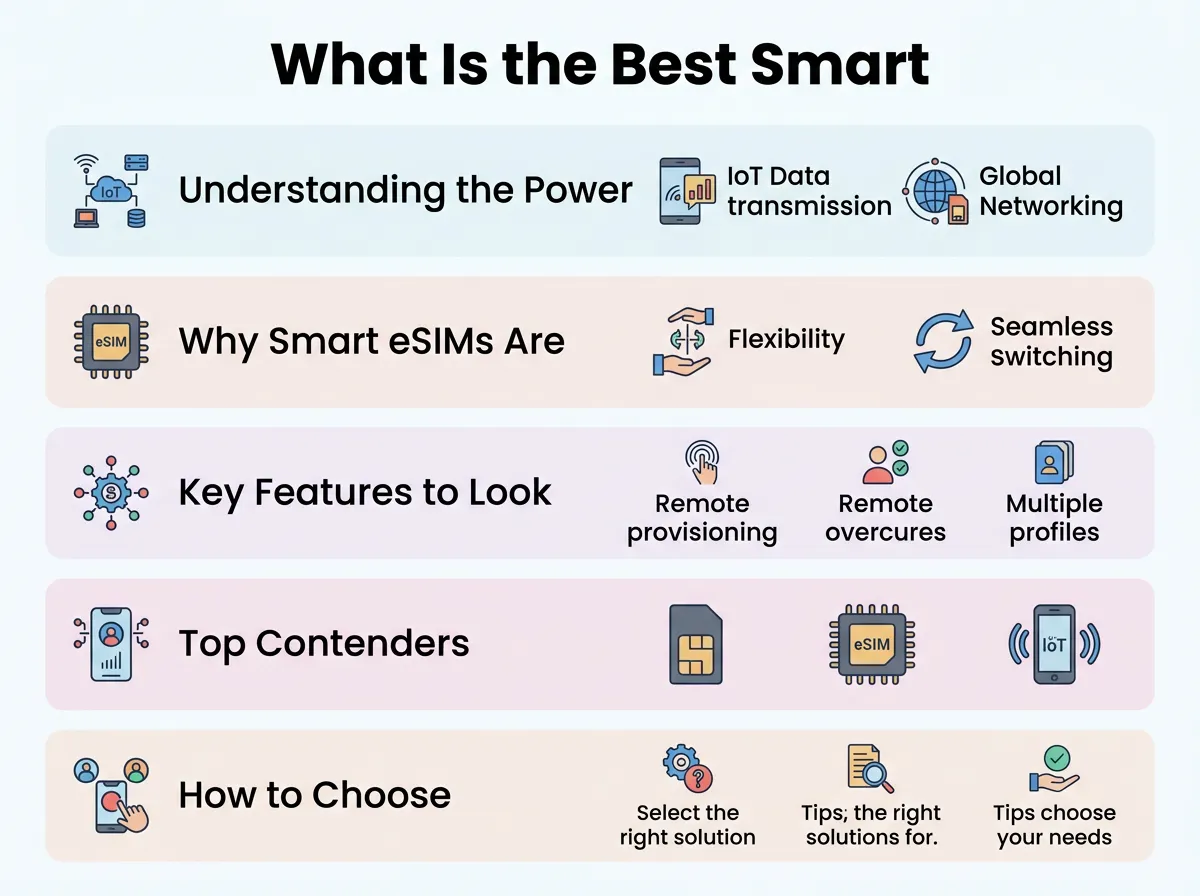
What Is the Best Smart eSIM for Multi-Carrier IoT Connectivity? — key points at a glance
Smart eSIMs solve this problem through Over-the-Air (OTA) provisioning. This means you can update, delete, or add carrier profiles remotely. You can change your network provider with a few clicks on a computer screen. This future-proofs your business. If a carrier changes its pricing or goes out of business, you can switch to a new carrier instantly.
Reducing Physical Waste and Logistical Costs
Using eSIMs also simplifies your supply chain. You do not need to buy and store different SIM cards for different countries. You can install the same smart eSIM into your devices during manufacturing. Once the devices arrive at their final destinations, they download the correct local network profile automatically. This saves time, reduces plastic waste, and cuts down shipping costs.
Key Features to Look For in a Smart eSIM
Not all eSIMs are created equal. When researching What Is the Best Smart eSIM for Multi-Carrier IoT Connectivity?, you must look closely at the underlying features. Here is what separates the best from the rest:
Multi-IMSI Capabilities
Multi-IMSI (International Mobile Subscriber Identity) technology allows a single SIM card to hold multiple subscriber identities. This works hand-in-hand with eUICC. While eUICC lets you change profiles, multi-IMSI lets the SIM switch networks locally. This ensures your devices always get local rates instead of expensive roaming rates.
Centralized Management Platform
You need a clean, easy-to-use platform to manage your devices. The best smart eSIM providers offer a single glass pane dashboard. From this dashboard, you can monitor data usage, activate or deactivate eSIMs, and troubleshoot connection issues in real-time.
Robust Security Protocols
IoT devices are frequent targets for cyberattacks. A great smart eSIM provider offers advanced security features. Look for private APNs (Access Point Names), VPN support, and fixed IP options to keep your data encrypted and secure.
Top Contenders for the Best Smart eSIM
Several industry leaders offer exceptional smart eSIM solutions. Let us take a look at the top choices currently leading the market.
KORE Wireless
KORE Wireless is a giant in the IoT space. They provide highly resilient connectivity options. When searching for the right provider, look for companies that offer advanced IoT SIM cards with dynamic profile switching. KORE excels at providing seamless coverage across multiple carriers, making them a top choice for global fleets.
Onomondo
Onomondo takes a unique approach by redesigning the core network architecture. Another excellent option is a global multi-network SIM card solution designed to bypass traditional roaming issues. Onomondo offers real-time control, no roaming overheads, and direct integration into cloud services like AWS and Azure.
FloLive
FloLive operates the world’s largest local cellular network. They offer a hyper-local global cellular network that complies with local data privacy laws. This is perfect for businesses that need to deploy devices in countries with strict data sovereignty laws, such as Brazil or China.
How to Choose the Best Smart eSIM for Your Business
To find the absolute best smart eSIM for your specific needs, you should ask yourself a few key questions. Your answers will guide you to the perfect provider.
Where Are Your Devices Deployed?
Different providers have different network strengths. If your devices are mostly in North America, you need a provider with strong partnerships with major US carriers. If your devices travel globally, look for a provider with a wide network of international agreements.
What Are Your Data Needs?
Are your devices sending small temperature readings once an hour, or are they streaming live video? For low-data applications, look for low-power wide-area network (LPWAN) support, such as LTE-M or NB-IoT. For high-data applications, ensure your eSIM provider offers high-speed 4G and 5G multi-carrier support.
Is the Pricing Flexible?
Avoid providers that lock you into rigid contracts. Look for pay-as-you-go models or shared data pools. Shared data pools allow active devices to use the leftover data from inactive devices, saving you money.
Real-World Use Cases for Multi-Carrier eSIMs
To see the true value of this technology, let us look at how businesses use it in the real world.
Smart Logistics and Asset Tracking
A shipping container travels across oceans, train tracks, and highways. Along the way, it passes through dozens of network zones. A smart eSIM ensures the tracking device on the container never loses its connection. If one network signal fades in a rural area, the eSIM switches to another carrier instantly. This keeps the supply chain transparent.
Connected Healthcare Devices
Medical devices like pacemakers or patient monitors must stay online 24/7. A dropped connection can put lives at risk. By using multi-carrier eSIMs, healthcare providers ensure these critical devices stay connected to the strongest network available, even during local network outages.
Making Your Final Choice on IoT Connectivity
Finding the right answer to What Is the Best Smart eSIM for Multi-Carrier IoT Connectivity? comes down to your business’s unique scale and geographical footprint. If you need global compliance and massive scale, FloLive or KORE Wireless are top-tier choices. If you want deep network integration and developer-friendly tools, Onomondo is a fantastic option.
Investing in a smart eSIM solution today saves you from major operational headaches tomorrow. It protects your devices from downtime, simplifies your supply chain, and ensures your data keeps flowing no matter what happens to local cell towers. Take the time to evaluate your needs, test a few test SIMs, and choose the partner that will help your business grow smoothly.
Frequently Asked Questions
What is an eSIM for IoT?
An eSIM for IoT is a digital SIM card that allows devices to connect to cellular networks without needing a physical, plastic SIM. It supports remote provisioning, meaning you can update carrier profiles over-the-air. This makes managing global device deployments much simpler and more cost-effective.
How does a multi-carrier eSIM switch networks?
A multi-carrier eSIM uses built-in smart logic to monitor network signal strength. If the active network drops below a certain threshold or loses connection entirely, the eSIM automatically switches to another preloaded carrier profile. This process occurs in seconds without requiring manual physical intervention.
What is the difference between eSIM and eUICC?
eSIM is the overall term for the software-based SIM technology, while eUICC is the physical component or software architecture that enables remote provisioning. Essentially, eUICC is the technology inside the eSIM that allows it to store and switch between multiple operator profiles. They are often used interchangeably in the industry.
Can I use a smart eSIM anywhere in the world?
Yes, most smart eSIMs are designed for global use and have partnerships with hundreds of carriers worldwide. However, coverage depends on the specific provider you choose. It is always best to verify that your provider has active carrier agreements in your target deployment countries.
Are smart eSIMs secure?
Yes, smart eSIMs are highly secure and often safer than traditional physical SIMs. They cannot be easily stolen or swapped out of a device. Additionally, top providers offer advanced network security features like private APNs, dedicated VPNs, and encrypted data transmission.
Do smart eSIMs support 5G?
Yes, many modern smart eSIMs support 5G connectivity alongside 4G LTE, LTE-M, and NB-IoT. The availability of 5G depends on your hardware capabilities, your eSIM provider’s carrier agreements, and the local network infrastructure in your area.
