

Choosing the right cellular connectivity is critical to the success of your smart device deployment. The market leaders include global giants like Hologram, EMnify, Twilio, Soracom, and Things Mobile, which offer robust multi-network coverage and flexible pricing. Selecting the ideal provider depends on your deployment scale, geographic needs, and management platform preferences.
Imagine you just built a smart fleet of delivery e-bikes. Or perhaps you designed a network of environmental sensors to monitor forest fires. You spent months building the hardware and writing the perfect software. But as you prepare to launch, a major question pops up. How will these smart devices talk to the internet when there is no local Wi-Fi? This is where cellular IoT connectivity saves the day. Without a reliable network, your brilliant devices are just expensive paperweights.
Finding the right partner to keep your devices online is vital to your business. You might ask yourself, who are the top IoT SIM providers today? The answer is not always simple. The best partner for a small smart-home startup might not work for a massive logistics firm. In this guide, we will break down the leading options on the market. We will look at their unique strengths, their coverage maps, and how they help your business grow.
By the end of this article, you will know exactly what to look for. You will also understand how to match a provider’s strengths with your specific project needs. Let us dive in and explore the world of IoT connectivity.
Key Takeaways
- Global Coverage is Key: The top providers offer multi-network roaming so your devices stay online across borders.
- Look for eSIM Technology: eSIM and eUICC allow you to update carrier profiles over the air without swapping physical cards.
- Platform Usability Matters: A clean, API-friendly management dashboard saves hours of troubleshooting and manual monitoring.
- Flexible Pricing Wins: Choose pay-as-you-go or pooled data plans to avoid paying for unused data across your fleet.
- Test Before You Scale: Always run pilot tests with multiple SIMs in your target environments before buying in bulk.
📑 Table of Contents
What Makes an IoT SIM Different From Your Phone SIM?
It is easy to think that any SIM card will do the job. However, using a standard phone SIM in a smart device is a recipe for trouble. Standard consumer SIMs are made for high-speed data, phone calls, and heavy streaming. They operate on single networks and require manual setup. IoT SIMs are built for a very different world.
Standard SIMs vs. IoT SIMs
IoT devices often send tiny bursts of data at set times. They need to live in the field for years without human touch. IoT SIM cards are rugged. They can withstand extreme heat, freezing cold, and constant vibrations. Additionally, they come with specialized data plans. These plans protect you from high roaming fees. They also let you pool your data across thousands of devices.
The Power of eSIM and eUICC
Older SIM cards locked you into one network carrier. If that carrier raised its prices, you had to physically swap out every card. Today, top providers use eSIM and eUICC technology. This tech allows you to change carrier profiles over the air. You do not need to touch the physical device. This feature saves thousands of hours of labor for large fleets.
Who Are the Top IoT SIM Providers in the Industry?
The IoT space has grown rapidly over the last decade. Several key players have emerged as industry leaders. Each of these companies offers unique features, pricing models, and coverage strengths.
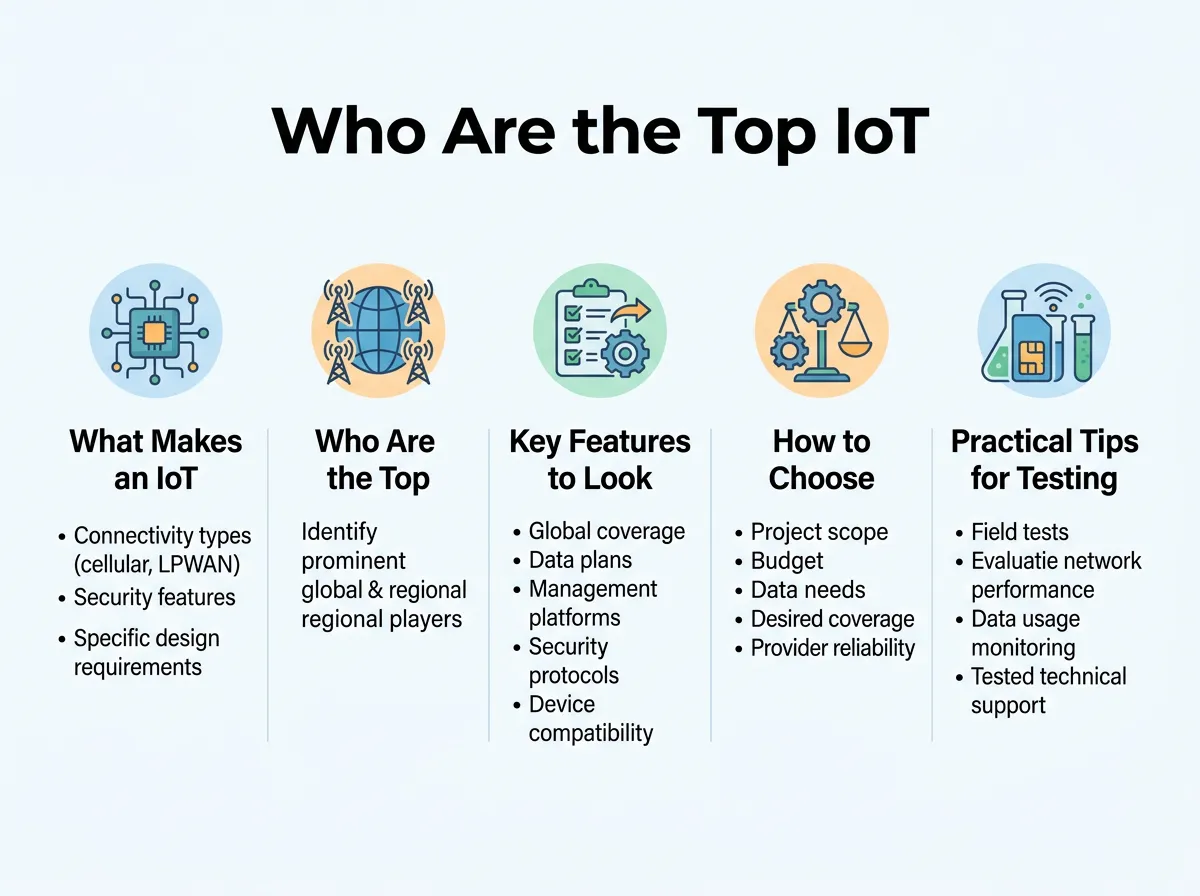
Who Are the Top IoT SIM Providers? — key points at a glance
Hologram
Hologram is a favorite among developers and scaling businesses alike. They offer a cellular platform built specifically for IoT. With Hologram, your devices can connect to hundreds of carriers globally. Their dashboard is clean and very easy to use. It gives you real-time details on data usage and network status. Hologram is perfect if you need quick setup and hassle-free global roaming.
EMnify
EMnify is a cloud-native option that focuses on security and integration. They integrate deeply with major cloud services like AWS and Azure. This makes it easy to route your device data straight to your secure servers. EMnify also offers robust security features. These features block unauthorized traffic at the network level, keeping your data safe from hackers.
Soracom
Soracom was created by developers, for developers. They offer advanced cloud integration tools and pay-as-you-go pricing. This model is great for startups that want to keep initial costs low. Soracom also offers unique features like secure private networking. This allows your devices to communicate without ever exposing their data to the public internet.
Twilio Super SIM
Twilio is famous for its communication APIs, and their Super SIM product lives up to that reputation. It offers great global coverage with a single API interface. If your team loves writing code and wants deep control over device connectivity, Twilio is an outstanding choice. You can control connection states, send SMS commands, and monitor data via simple API calls.
Things Mobile
If you run a small business or have a low-budget project, Things Mobile is worth a look. They offer highly competitive rates and simple pricing plans. They have no fixed monthly costs on some plans, meaning you only pay for the exact bytes your devices use. It is a very accessible entry point into the IoT world.
Key Features to Look for When Choosing a Provider
Every IoT project has its own unique needs. When you compare different companies, keep these crucial features in mind to ensure a smooth deployment.
Multi-Network Coverage and Redundancy
Devices that move around can easily enter signal dead zones. A good provider must offer multi-network access. This means the SIM card can jump from one carrier to another automatically to maintain the best signal. If you want your assets to stay connected no matter where they travel, finding the best multi-network SIM for IoT is a vital step in your research.
Management Platform and API Access
Managing ten devices is easy. Managing ten thousand is a different story. You need a platform that lets you pause, activate, or limit SIM cards in bulk. Look for a provider that offers a powerful dashboard. It should also have open APIs. APIs allow you to build connectivity management directly into your own internal business software.
Scalability and Fleet Management
Your business will grow over time. Your connectivity partner must be able to scale with you. Large-scale deployments require bulk pricing, dedicated support, and automated tools. If you are managing mobile assets across multiple borders, you should look closely at the top IoT connectivity providers for large fleets to find a partner that understands high-volume demands.
How to Choose the Right Provider for Your Region
Geographic coverage is often the deciding factor when choosing a provider. A company that works perfectly in Europe might have poor coverage in rural parts of North America.
Global Deployments vs. Local Focus
If your devices stay in one country, a local carrier might offer the lowest rates. But if your products ship worldwide, you need a global provider. Global providers negotiate contracts with hundreds of local carriers. This gives you a single point of contact and one invoice for all your global assets. For those launching projects specifically in North America, choosing the best IoT SIM card provider in the USA requires looking closely at local carrier partnerships and regional coverage maps.
Navigating Roaming Restrictions
Some countries have strict laws against permanent roaming. This means a foreign SIM card cannot stay connected to a local network forever. Countries like Brazil and China are famous for these rules. If you plan to deploy devices in these areas, make sure your provider offers localized eUICC profiles to bypass these legal hurdles.
Practical Tips for Testing and Deploying Your SIMs
Before you purchase thousands of SIM cards, take a deep breath. A rushed deployment can lead to massive headaches and unexpected bills down the road. Follow these simple tips to ensure success.
Start with a Pilot Program
Most providers offer developer kits. These kits usually come with a few SIM cards and free trial data. Buy kits from two or three different providers. Place them in your test devices. Send them out into the field to see how they perform in real-world conditions. Compare their signal strength and battery drain.
Monitor Data Usage Closely
It is easy for a buggy software loop to cause a device to send too much data. If this happens to thousands of devices, your bill will skyrocket. Set up strict data alerts on your provider’s dashboard. Configure the system to automatically pause any SIM card that goes over its daily limit. This simple step can save your business from thousands of dollars in unexpected charges.
Conclusion
There is no single answer to the question of who are the top IoT SIM providers. The perfect partner depends entirely on your specific project. If you need simple global coverage, Hologram or Twilio might be your best bet. If you require deep cloud security and integrations, EMnify or Soracom are excellent choices. For small budgets, Things Mobile offers a friendly starting point.
Take your time to assess your coverage needs, data limits, and software preferences. Order a few test SIM cards, run a pilot test, and watch your smart devices connect to the world with ease.
Frequently Asked Questions
What is an IoT SIM card?
An IoT SIM card is a ruggedized cellular card designed for smart devices and machines. Unlike standard phone SIMs, they are built to withstand harsh environments, offer multi-network coverage, and feature flexible data pooling options.
Can I use a regular phone SIM card for IoT devices?
While a regular SIM card might work temporarily, it is not recommended for commercial projects. Standard SIMs lack multi-carrier redundancy, rugged physical durability, and the bulk management tools needed to monitor large fleets efficiently.
What is eSIM or eUICC in IoT?
eSIM and eUICC technologies allow you to change or update cellular network profiles over the air. This means you can switch carriers remotely without having to physically remove and replace the SIM cards in your devices.
How much data does an average IoT device use?
Data usage varies wildly depending on the application. Some simple sensors only use a few kilobytes per month to send temperature readings, while video security cameras can consume gigabytes of data every day.
What is permanent roaming in IoT?
Permanent roaming happens when a SIM card registered in one country remains connected to a network in another country long-term. Some nations restrict this practice, so you must choose a provider that can localize SIM profiles to comply with local laws.
How do I choose the best IoT SIM provider?
Start by identifying where your devices will be physically located and how much data they will use. Then, compare providers based on their network coverage, management platform features, API options, and pricing flexibility.
