



Choosing the right cloud platform for your smart devices can make or break your connected project. While AWS IoT Core offers incredible flexibility, deep integration with Amazon’s massive ecosystem, and a pay-as-you-go model, Azure IoT Hub stands out for its enterprise-grade device management, robust edge computing via Azure IoT Edge, and simpler tiered pricing plans. Ultimately, the best choice depends on whether your organization is already aligned with Amazon Web Services or Microsoft Azure.
Imagine you are launching a fleet of smart devices. Maybe they are connected sensors in a vast cornfield, tracking soil moisture. Or perhaps they are smart locks in a busy city hotel. You need these devices to talk to the cloud. They must send data, receive updates, and stay secure. This is where cloud IoT platforms come in. They act as the central nervous system for your connected network.
But as you plan your project, you face a huge question. AWS IoT Core vs Azure IoT Hub: Which Is Better? This decision is a major milestone for your business. Both Amazon Web Services and Microsoft Azure offer world-class tools. However, they approach device management, pricing, and integration in very different ways. The wrong choice can lead to high costs and technical hurdles down the road.
In this guide, we will break down both options. We will look at features, pricing, security, and scalability. By the end, you will know exactly which platform fits your project like a glove.
Key Takeaways
- Ecosystem Alignment: The best choice usually depends on whether your team already uses AWS or Azure for their cloud infrastructure.
- Pricing Structures: AWS IoT Core charges strictly by message and resource usage, while Azure IoT Hub offers tiered daily plans that can be more predictable.
- Edge Computing: Azure IoT Edge provides a highly mature, structured framework for running local workloads on smart hardware.
- Device Management: Azure excels at out-of-the-box bulk provisioning and device twins, while AWS offers deep customization through its device registry.
- Security Protocols: Both platforms provide top-tier security, supporting mutual TLS certificate authentication and secure token systems.
📑 Table of Contents
What is AWS IoT Core?
AWS IoT Core is Amazon’s flagship managed cloud service. It lets connected devices easily and securely interact with cloud applications and other devices. It can support billions of devices and trillions of messages. It processes and routes those messages to AWS endpoints and other devices reliably and securely.
With AWS IoT Core, your applications can keep track of and communicate with all your devices, all the time. This is true even when they are not connected. This capability makes it a popular starting point for developers who want to get a project up and running quickly.
Key Features of AWS IoT Core
AWS IoT Core relies heavily on the MQTT protocol, which is perfect for low-bandwidth connections. It features a built-in Rules Engine. This engine lets you gather, filter, analyze, and act on data sent by your devices. You can route this data to other AWS services like Amazon S3, AWS Lambda, or Amazon DynamoDB without managing any servers.
It also offers “Device Shadows.” A device shadow is a virtual version of your device. It stores the device’s latest state so apps can read or write data even if the physical device is offline. For example, if a smart delivery truck enters a tunnel and loses signal, the cloud can still access its last known status.
What is Azure IoT Hub?
Azure IoT Hub is Microsoft’s answer to cloud-managed smart devices. It is a fully managed service that enables secure and reliable bi-directional communication between millions of IoT devices and a solution back end. It acts as a central message hub for your IoT applications.
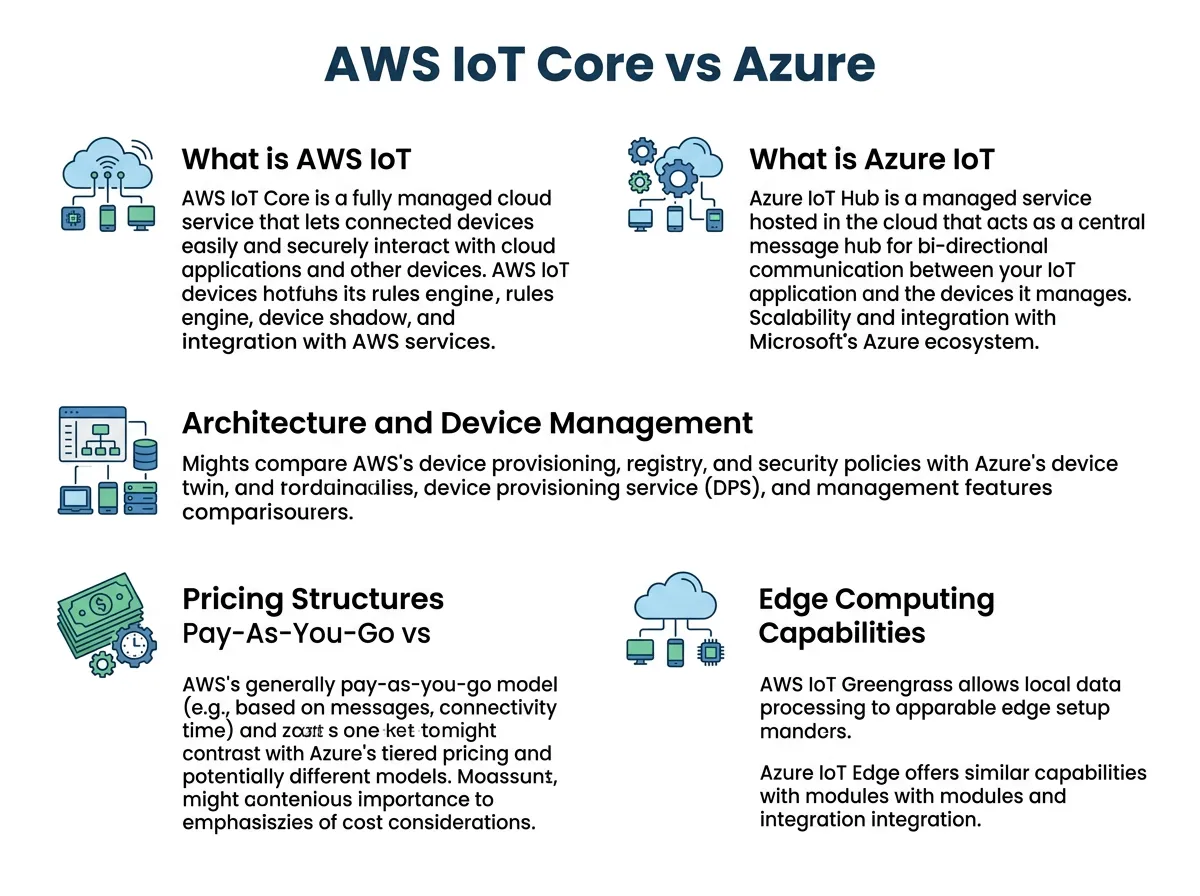
AWS IoT Core vs Azure IoT Hub: Which Is Better? — key points at a glance
Microsoft built this service to integrate smoothly with the rest of its enterprise stack. If your company already relies on Microsoft tools, this service feels like a natural extension of your daily workflow. It is highly structured and focuses on enterprise-level control.
Key Features of Azure IoT Hub
Azure IoT Hub excels in device management. It uses “Device Twins” which work similarly to AWS Device Shadows. It also supports multiple protocols like MQTT, AMQP, and HTTPS out of the box. Additionally, it offers a robust routing system. This system lets you send messages to various Azure services like Azure Storage, Azure Event Hubs, and Azure Service Bus.
Another strong feature is its device provisioning service. This service allows you to register millions of devices in a secure and scalable manner without human intervention.
Architecture and Device Management Compared
When we look closely at AWS IoT Core vs Azure IoT Hub: Which Is Better? for managing devices, we find two different philosophies. AWS focuses on flexibility and developer freedom. Azure leans toward structured, enterprise-ready templates.
Provisioning and Device Twins
Both platforms handle device provisioning very well. However, they use different terms. AWS has the “Device Registry” and “Device Shadows.” Azure uses “Device Identities” and “Device Twins.”
Azure’s Device Twins are highly praised by developers. They allow you to store device state metadata and synchronize conditions easily. If you look at this detailed comparison of Microsoft Azure IoT Hub vs AWS IoT Core, you can see how corporate users value Azure’s structured approach to managing large device fleets. On the other hand, AWS IoT Core offers incredible speed when routing messages through its Rules Engine. This makes AWS highly appealing for real-time data streaming projects.
Scalability for Big Projects
If you plan to scale up to millions of devices, both platforms can handle the load. However, the way they scale is slightly different. AWS scales dynamically. You do not have to worry about provisioning specific capacity beforehand. It grows automatically as your traffic grows.
Azure IoT Hub uses a concept of units. You purchase units of service. If you need more capacity, you add more units. For a deep look into how enterprise architects view this scaling challenge, check out this enterprise architect comparison for scalability. This resource highlights how unit management can affect large-scale deployments.
Pricing Structures: Pay-As-You-Go vs. Tiered Plans
When debating AWS IoT Core vs Azure IoT Hub: Which Is Better? for your business, pricing structures are key. Pricing is often the deciding factor for many businesses. This is where we see the biggest difference between the two platforms.
AWS IoT Core uses a pure pay-as-you-go model. You are billed based on the number of messages sent and received. You also pay for the specific rules triggered and the time your devices stay connected. This model is great for small projects or devices that send data infrequently. However, if your devices send messages every second, your bill can grow quickly.
Azure IoT Hub uses a tiered pricing model. You choose a tier (Free, Basic, or Standard) and purchase a specific number of units. Each unit allows a set number of messages per day. For example, a single Unit of the Standard B1 tier might allow 400,000 messages per day. If you exceed this limit, you must add another unit or pay for overages.
This means Azure offers highly predictable monthly costs. AWS offers highly precise costs that match your exact usage. If you want to see a real-world breakdown of these costs, you can read this guide on what 10,000 devices actually cost on both platforms. It shows how minor differences in architecture can lead to massive differences in your monthly bill.
Edge Computing Capabilities
The cloud is great, but sometimes you need to process data right on the physical device. This is known as edge computing. It reduces latency, saves bandwidth, and allows devices to work offline.
AWS offers AWS IoT Greengrass. This tool extends AWS to edge devices. It lets them act locally on the data they generate, while still using the cloud for management, analytics, and storage. With Greengrass, you can run AWS Lambda functions and Docker containers on your local hardware. This is perfect for industrial settings where internet connectivity might be spotty.
Azure offers Azure IoT Edge. Many developers consider Azure IoT Edge to be one of the best edge computing frameworks on the market. It allows you to deploy cloud workloads—such as artificial intelligence, Azure services, or custom logic—to run directly on your IoT edge devices. It features a highly modular architecture using Docker containers. This makes it very easy to manage and update remotely.
Making the Choice: AWS IoT Core vs Azure IoT Hub: Which Is Better?
Now we must answer the main question. AWS IoT Core vs Azure IoT Hub: Which Is Better?
The honest answer is that neither platform is universally “better.” The right choice depends on your specific needs, your existing setup, and your budget.
You should choose AWS IoT Core if:
- Your existing cloud infrastructure is already hosted on AWS, allowing you to easily link your devices to services like S3 or Lambda.
- You want a pure pay-as-you-go pricing model where you only pay for the exact resources you use.
- You prefer a highly flexible, rule-based message routing system that requires very little setup.
- Your devices send data infrequently, making Azure’s daily tiered pricing inefficient.
You should choose Azure IoT Hub if:
- Your company already uses Microsoft Azure and enterprise tools like Active Directory or Office 365.
- You need highly predictable monthly costs through tiered daily pricing plans.
- You want a highly mature, container-based edge computing solution with Azure IoT Edge.
- You require advanced, out-of-the-box device management and seamless bulk provisioning.
Conclusion
Both AWS IoT Core and Azure IoT Hub are industry-leading platforms. They can easily power everything from a smart home startup to a massive industrial factory. Ultimately, finding the answer to AWS IoT Core vs Azure IoT Hub: Which Is Better? depends heavily on your team’s existing skill set and your budget goals.
By looking closely at your current software stack, your pricing preferences, and your edge computing needs, you can easily choose the platform that will help your business thrive. Take the time to test both platforms with a small trial run. This hands-on experience will give you the confidence you need to make the final call.
Frequently Asked Questions
Which platform is cheaper, AWS IoT Core or Azure IoT Hub?
It depends on your messaging frequency. AWS IoT Core is usually cheaper for low-frequency devices because you only pay for the exact messages sent. Azure IoT Hub can be cheaper and more predictable for high-frequency devices due to its tiered daily pricing plans.
Can I use both AWS and Azure for my IoT project?
Yes, you can build a multi-cloud architecture. However, doing so adds complexity and may increase your overall costs, so most companies stick to one ecosystem.
What is the difference between AWS Device Shadows and Azure Device Twins?
Both serve the same purpose of storing and syncing device state. However, Azure Device Twins offer more structured sections for tags and desired properties, while AWS Device Shadows offer a simpler, JSON-based document model.
Which platform has better edge computing support?
While both are excellent, Azure IoT Edge is widely considered to have a slight edge. It features a highly mature, container-based module deployment system that makes running local AI and analytics very simple.
Do these platforms support the MQTT protocol?
Yes, both AWS IoT Core and Azure IoT Hub fully support the MQTT protocol, which is the industry standard for lightweight, low-bandwidth IoT communications.
How do these platforms handle security?
Both platforms offer industry-standard security. They support mutual TLS certificate authentication, token-based authorization, and fine-grained access control policies to keep your devices safe.
