

The best free IoT cloud service depends on your specific project needs. For absolute beginners, Adafruit IO is the top choice because it is incredibly easy to use. If you need powerful data analysis, ThingSpeak is the best option, while Blynk is unmatched for creating fast mobile dashboards.
Imagine you just built a smart plant waterer. You connected a moisture sensor to a small chip. It works on your desk. But now, you want to see the soil moisture levels while you are at work. You want to receive a text alert when your plant is dry. To do this, you need a way to send your data to the internet. This is where cloud services come in. They act as the brain for your smart gadgets.
For many makers, spending money on a monthly subscription is not an option. You might only want to test a simple idea. Or perhaps you just want to learn how coding works. As you start your search, you might ask yourself: What Is the Best Free IoT Cloud Service? Finding the right one can feel hard. There are many options out there, and each has different rules and limits.
In this guide, we will break down the top free platforms. We will look at what makes each one special. We will also talk about how to choose the right one for your specific build. By the end, you will know exactly where to send your data.
Key Takeaways
- Adafruit IO: Best overall for beginners who want simple setups and great community support.
- ThingSpeak: Ideal for students and researchers who need deep math tools and MATLAB integration.
- Blynk: The ultimate choice for building drag-and-drop mobile app control panels quickly.
- Ubidots STEM: Offers the most beautiful, clean dashboards for personal, non-commercial use.
- Watch the Limits: Free accounts always have limits on data storage, message rates, and active devices.
📑 Table of Contents
Why You Need an IoT Cloud Service
An IoT cloud service does more than just hold your data. It acts as a bridge. It takes the numbers from your sensors and turns them into things you can actually use. Without a cloud service, your smart device is just a lonely island.
Data Visualization
First, these platforms let you build dashboards. A dashboard is a web page with charts, gauges, and maps. Instead of looking at raw text, you can see a nice line graph of your home temperature. This makes it easy to spot trends over time.
Device Control
Second, the cloud lets you talk back to your device. You can click a virtual switch on your phone. The cloud sends a signal to your chip. Suddenly, your living room lamp turns on. This two-way communication is vital for any real smart home setup.
Top Free IoT Cloud Platforms Compared
Let us look at the best free options you can use today. Each of these has a free tier that is perfect for hobbyists.
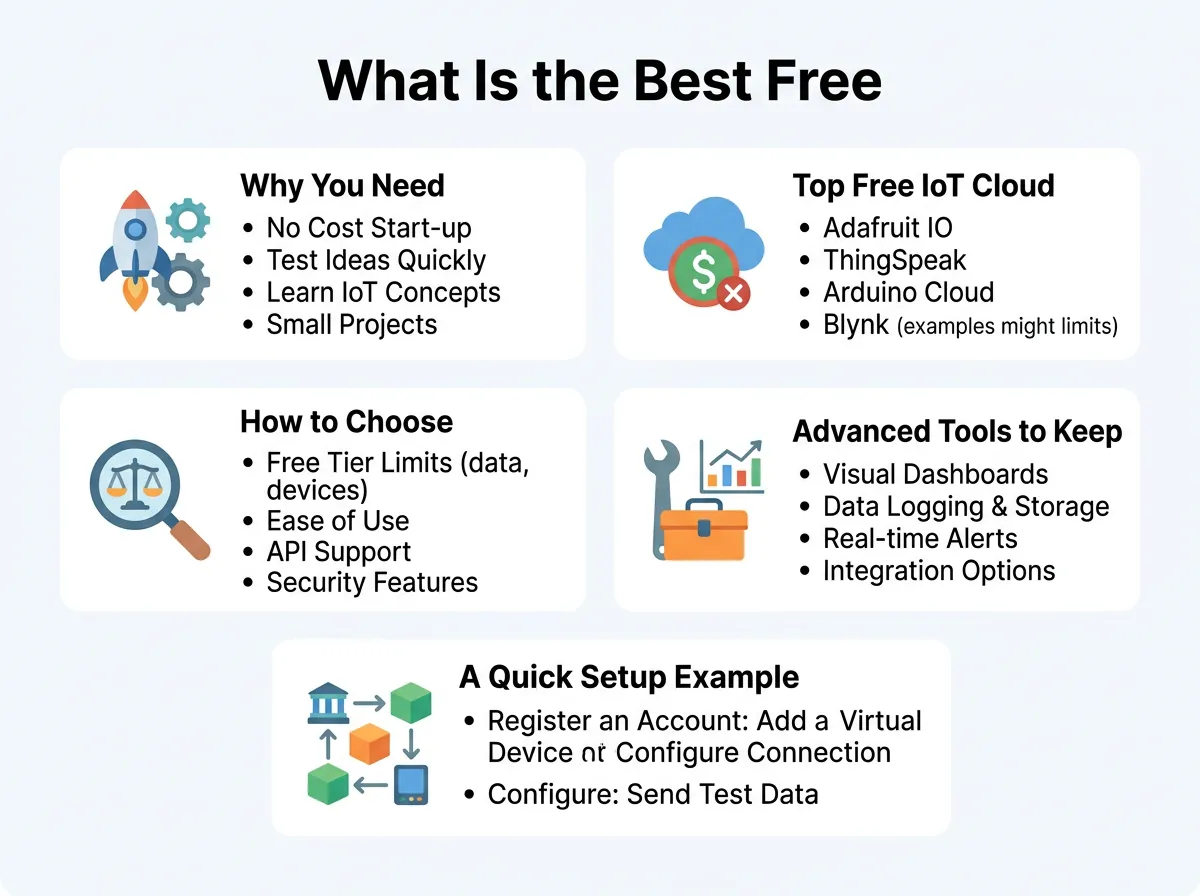
What Is the Best Free IoT Cloud Service? — key points at a glance
Adafruit IO: Best for Easy Setup
Adafruit IO is designed for beginners. The team at Adafruit wants to make learning electronics easy for everyone. Their cloud service reflects this goal. The layout is clean and simple to navigate.
With a free account, you can create up to ten feeds. A feed is just a stream of data, like temperature readings. You can send up to 30 data points every minute. This is more than enough for most basic projects. It also stores your data for 30 days. The best part is the massive community. If you get stuck, there are thousands of guides to help you out.
ThingSpeak: Best for Data Analysis
If you love math and charts, ThingSpeak is the platform for you. It is run by MathWorks, the creators of MATLAB. This means you can run complex math formulas on your data right in the cloud.
The free tier allows you to send up to three million messages per year. That is about 8,200 messages every day. The only catch is that you can only send data once every 15 seconds. If you need real-time updates, this might feel a bit slow. However, for weather stations or energy monitors, it is perfect. If you want to compare how these features rank against other big names, reading about the top 7 cloud platforms for IoT can help you see the bigger picture.
Blynk: Best for Mobile Apps
Do you want to control your project from a custom mobile app? Blynk is the absolute king of this. They provide a mobile app builder for iOS and Android. You do not need to know how to write mobile app code. You just drag and drop buttons, sliders, and graphs.
Blynk has changed its free plan over the years, but it still offers a great starting point. You get a few virtual pins and a basic dashboard. It connects very quickly to chips like the ESP32 or Arduino. It is the fastest way to get a working app on your phone.
Ubidots STEM: Best for Beautiful Dashboards
Ubidots offers a special tier called Ubidots STEM. This version is free for personal, non-commercial use. It is widely praised for having the most beautiful interface. The widgets look modern and professional.
With Ubidots STEM, you can connect up to three devices. You can set up ten variables. It supports SMS and email alerts, which is rare for a free service. If you want your project to look like a high-end commercial product, start here.
How to Choose Your Service
To figure out what is the best free IoT cloud service for your needs, you must check the limits. Every free service has them. Here are three things to keep in mind.
Message Rates
How often does your device need to send data? If you are tracking a fast-moving RC car, you need updates every second. In that case, ThingSpeak’s 15-second limit will not work. You would want to choose Adafruit IO or Blynk instead.
Data Retention
Do you need to see your data from six months ago? Free plans usually wipe your data after a few weeks. Ubidots STEM and Adafruit IO hold data for about a month. If you need long-term storage, you might need to download your data often or look at self-hosted setups.
Ease of Use
Some platforms require you to write complex code. Others have simple libraries that do the hard work for you. If you are new to coding, Adafruit IO is highly recommended. The code is clean and easy to read.
Advanced Tools to Keep in Mind
As you grow, you might want to try other tools. For example, if you want to update your device code through the air without plugging it into your computer, look into specialized platforms. You can use services like THiNX.cloud to manage your devices and push updates easily.
Additionally, if you want to explore how different networks and systems talk to each other, you can search through databases of supported IoT connection platforms. This helps when you start working with cellular IoT or advanced industrial protocols.
A Quick Setup Example
Let us see how easy it is to get started. We will use a basic ESP32 board and Adafruit IO as our example.
First, go to the Adafruit IO website. Create a free account. Next, click on “Keys” and copy your active username and key. Keep this secret! It is the password your chip uses to talk to the cloud.
Now, open your Arduino software. Install the Adafruit IO library. Paste your Wi-Fi details and your secret keys into the example code. Upload the code to your board. Within seconds, you will see your board connect. You can open your dashboard and watch a virtual light blink. It feels like magic, but it is just the power of the cloud!
Conclusion
So, what is the best free IoT cloud service for your next big idea? There is no single winner, but there is a best choice for your specific goal. If you want simplicity and great guides, go with Adafruit IO. If you want to analyze data with charts, choose ThingSpeak. If you want a cool mobile app to show your friends, pick Blynk. The best part is that they are all free, so you can try them all and see which one you like best!
Frequently Asked Questions
What are the limits of free IoT cloud services?
Free tiers usually limit how many devices you can connect and how fast you can send data. They also limit how long your historical data is stored, often keeping it for only 30 days. Some free plans may restrict commercial use as well.
Can I use a free IoT cloud for a commercial product?
Generally, no. Most free tiers, such as Ubidots STEM, are strictly for personal, educational, or hobbyist use. If you want to sell a product, you will need to upgrade to a paid plan or host your own server.
Do I need an internet connection to use these services?
Yes, your microchip or device must be connected to the internet via Wi-Fi, Ethernet, or cellular data to send information to the cloud. Without an active network connection, the data cannot leave your device.
Which free service is best for ESP32 and Arduino?
Adafruit IO and Blynk are both excellent for ESP32 and Arduino boards. They offer pre-made libraries that you can install with one click, making the coding process very simple for beginners.
Is my data secure on a free IoT cloud?
While these platforms use basic security keys to protect your feeds, free accounts do not always offer advanced encryption. Avoid sending highly sensitive or private data, such as home security passwords, over free public clouds.
Can I host my own free IoT cloud?
Yes, you can. Platforms like ThingsBoard and Node-RED have open-source versions that you can run for free on a local computer or a Raspberry Pi. This removes all data limits but requires more technical skill to set up.
