

The IBM Watson IoT Platform is a fully managed, cloud-hosted service designed to simplify the deployment of Internet of Things applications. It allows organizations to register devices, securely collect sensor data, and apply powerful real-time analytics and AI to drive smarter business decisions. By bridging the gap between physical hardware and digital intelligence, it helps industries optimize assets and automate operations seamlessly.
Imagine walking onto a busy factory floor. Dozens of machines are humming, conveyor belts are moving, and hundreds of tiny sensors are blinking in unison. These sensors collect temperatures, vibration speeds, and power levels every single second. But without a brain to process this massive wave of information, it is just digital noise. How do we turn this mountain of numbers into useful business choices?
This is where modern cloud systems step in to save the day. Today, we will explore a powerful tool that was built to solve this exact challenge. In this guide, we will dive deep into its structure, explore its top features, and look at real-world examples of how it is used to transform raw data into smart actions.
Key Takeaways
- Centralized Device Management: It offers a secure, unified console to register, monitor, and manage thousands of connected devices.
- Real-Time Data Analytics: Businesses can analyze live sensor data streams to identify patterns and trigger automated actions instantly.
- AI and Machine Learning: The platform leverages cognitive Watson APIs to detect anomalies and predict equipment failures before they happen.
- Lightweight Messaging: It relies on efficient protocols like MQTT to ensure stable, low-bandwidth communication for remote devices.
- Scalable Cloud Infrastructure: Built on IBM Cloud, the platform scales dynamically to support growing networks of smart devices.
📑 Table of Contents
What Is the IBM Watson IoT Platform?
At its core, this technology is a fully managed cloud service. It acts as a central hub for all your smart devices. Think of it as a giant, secure switchboard in the sky that links your physical hardware directly to the digital world. By using this service, companies can quickly build custom applications without hosting their own massive, expensive servers.
When people ask, “What Is the IBM Watson IoT Platform?” they are often looking at a tool that does three main things: connects, analyzes, and secures. It takes the hard work out of managing thousands of individual sensors. Instead of setting up custom code for every single device, you can manage them all from one central dashboard.
The Role of the Cloud in Modern IoT
Historically, companies had to run their own physical databases to store sensor data. This was expensive, slow, and hard to scale. This cloud platform removes that headache entirely. It scales up or down automatically as your business needs change. Whether you have five sensors or five million, the system handles the data flow without breaking a sweat.
Understanding the Architecture and How It Works
To truly understand this platform, we need to look under the hood. The system uses a clear, structured flow to process information. First, devices send data up to the cloud. Next, the platform organizes and validates this incoming data. Finally, it sends the parsed information to applications, dashboards, or analytical tools.
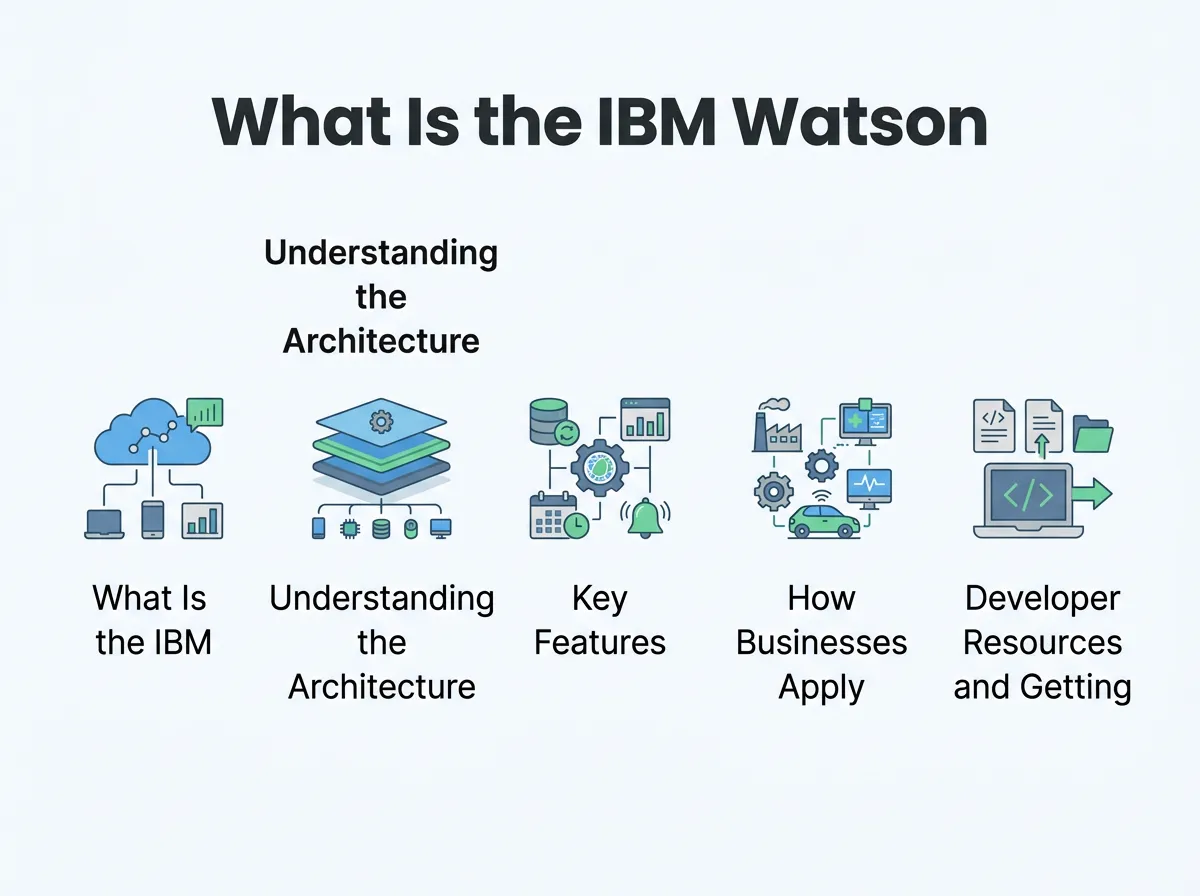
What Is the IBM Watson IoT Platform? — key points at a glance
Device Registration and Management
Before any device can talk to the cloud, it must be registered. This step is like giving your device a digital passport. The platform assigns a unique ID and security token to each sensor. This prevents unauthorized devices from sneaking into your network. You can easily register devices one by one or import thousands of them at once using built-in bulk tools.
Secure Connectivity and Messaging Protocols
Devices communicate with the platform using lightweight protocols. The most common protocol used here is MQTT, which stands for Message Queuing Telemetry Transport. MQTT is perfect for smart devices because it uses very little bandwidth and battery power. If your devices are in remote areas with weak cellular signals, MQTT ensures the messages still get through safely. The platform also supports standard HTTP traffic for traditional web-based integrations. You can find detailed resources on troubleshooting these connections at the IBM Watson IoT Support Portal, which assists developers with device communication issues.
Key Features of the Watson IoT Platform
Why do so many enterprises choose this platform over building their own custom systems? The answer lies in its rich set of built-in tools. Let us look at the core capabilities that set it apart from standard cloud databases. According to the official documentation detailing the IBM Watson IoT Platform features, the service offers an end-to-end framework for data ingestion, storage, and visualization.
Real-Time Data Visualization
Raw data is hard for humans to read quickly. A stream of numbers like “23.4, 102.1, 0.05” does not tell a clear story. The platform includes customizable dashboards that let you turn these numbers into live charts, dials, and maps. This lets your team monitor complex operations at a single glance.
Advanced Cognitive Analytics
This is where the Watson brand truly shines. Standard IoT systems can only tell you if a machine’s temperature is currently too high. Watson goes a step further. It uses cognitive APIs to learn what is “normal” for each specific machine. It can detect subtle anomalies that a human programmer might easily miss. Over time, it gets smarter, helping you predict failures before they happen.
Information Management and Storage
Not all data needs to be treated the exact same way. Some data is critical and needs immediate action, like an engine overheating. Other data is historical and can be stored away for later review. The platform lets you set up rules to route data automatically. You can send critical data to live dashboards and archive older data in cheap cloud storage.
How Businesses Apply the Watson IoT Platform in the Real World
It is easy to talk about technology in abstract terms. But how does it actually help businesses make money, save time, or keep workers safe? Many companies rely on IBM Internet of Things solutions to tackle complex, industrial-scale challenges every single day. Let us look at some practical, real-world examples of this technology in action.
Predictive Maintenance in Manufacturing
Imagine a car factory with hundreds of robotic arms. If one arm breaks unexpectedly, the whole assembly line stops. This costs the company thousands of dollars every minute. By using this platform, engineers can put vibration and temperature sensors on every robotic arm. The system monitors the vibrations in real-time. When it detects an unusual wiggle, it alerts the maintenance team. They can fix the arm during a scheduled break, preventing an expensive shutdown.
Smart Buildings and Facility Management
Large office buildings waste a lot of energy. Often, empty rooms are heated or cooled for no reason. By installing smart occupancy sensors, building managers can track which rooms are active. The platform processes this data and automatically adjusts the heating, ventilation, and air conditioning systems. This lowers utility bills and reduces the building’s carbon footprint.
Developer Resources and Getting Started
If you are a developer, you might be wondering how difficult it is to start building on this platform. The good news is that the environment is designed to be highly developer-friendly. You do not need to be an AI expert to start using these smart tools.
Connecting Your First Device
Getting started is straightforward. You can use a simple credit-card-sized computer, like a Raspberry Pi, to simulate a real industrial machine. By writing a short script, you can send simulated temperature data to the cloud in just a few minutes. If you want a hands-on guide, you can follow this structured IBM Watson IoT developer tutorial on GitHub to learn how to connect devices and analyze data step by step.
Leveraging SDKs and APIs
You do not have to write everything from scratch. The platform offers software development kits (SDKs) for many popular programming languages. Whether you write in Python, Node.js, Java, or C#, there is a helper tool ready for you. These SDKs handle the complex parts of security, encryption, and network retry logic automatically.
The Evolution and Future of Watson IoT
Technology moves fast. The way we think about the cloud and smart devices has changed over the last decade. Early IoT was just about collecting data. Today, it is about making that data actionable right at the edge of the network.
The Shift Toward Edge Computing
While sending all data to the cloud is powerful, it can sometimes be slow. For split-second decisions, like stopping a runaway machine, waiting for a cloud response takes too long. That is why modern systems support edge computing. This allows some of the AI models to run directly on local gateway devices, ensuring instant response times.
Lessons Learned from the Age of Cognitive Systems
The journey of cognitive computing has taught us many valuable lessons. We have learned that technology is most powerful when it works hand-in-hand with human expertise. To understand how these principles have shaped modern digital transformation, you can read about the inspirations from the age of IBM Watson IoT and how they continue to influence how we build smart systems today.
Conclusion
The world is becoming more connected every single day. From smartwatches on our wrists to massive wind turbines in the middle of the ocean, data is flowing everywhere. Managing this wave of information can feel overwhelming. However, tools like the IBM Watson IoT Platform make it highly manageable. By combining simple device management, secure connections, and advanced AI, it empowers businesses to work smarter, cut costs, and build a safer future. Whether you are a small startup or a global manufacturer, understanding this technology is a great step toward mastering the modern digital landscape.
Frequently Asked Questions
What Is the IBM Watson IoT Platform used for?
It is used to connect, manage, and analyze data from smart devices and sensors. Businesses use it to monitor equipment in real-time, predict maintenance needs, and automate industrial processes. It acts as a secure bridge between physical hardware and cloud-based applications.
What communication protocols does the platform support?
The platform primarily supports MQTT and HTTP protocols for device communication. MQTT is highly favored because of its lightweight nature, which is ideal for low-bandwidth environments. This ensures stable data transmission even from remote or mobile sensors.
Is the IBM Watson IoT Platform secure?
Yes, it is built with end-to-end security features. Every device must be registered and authenticated with unique tokens before it can connect. All data transmitted between the devices and the cloud is encrypted to prevent unauthorized access.
Does it require advanced AI skills to use?
No, you do not need a background in data science to get started. The platform offers built-in dashboards, templates, and pre-trained cognitive APIs. This allows developers and business analysts to easily leverage AI insights without writing complex algorithms.
Can it run on-premises or only in the cloud?
It is primarily offered as a fully managed cloud service on IBM Cloud. However, it also supports hybrid models and edge computing. This allows certain analytical workloads to run locally on gateway devices for faster response times.
How does the platform help with predictive maintenance?
The platform uses machine learning to establish a baseline of normal operation for physical assets. By monitoring continuous sensor feeds, it can detect minor changes in vibration or temperature. This allows businesses to repair equipment before a complete breakdown occurs.
