



The best Wi-Fi-based indoor positioning solutions for IoT utilize Fine Timing Measurement (FTM/RTT) and RSSI fingerprinting to deliver accurate tracking. These systems leverage existing network hardware to locate assets and personnel without expensive new cabling. By integrating Wi-Fi with Bluetooth or UWB, companies can achieve the ideal balance of cost, range, and precision.
Imagine walking into a massive hospital. You need to find a specific wheel chair right away. Or think of a giant warehouse with thousands of pallets. How do you find one single box in a sea of shelves? Outdoor GPS cannot help you here. The signals simply cannot get through the thick concrete walls and metal roofs. This is a common struggle for many modern businesses.
To solve this, companies use smart tracking inside their buildings. They connect smart tags to everyday items. But which technology should they use to connect them? Wi-Fi is already everywhere. This makes it a natural choice for tracking. In this guide, we will explore how this technology works. We will also help you choose the right tools for your business needs.
Key Takeaways
- Hardware Savings: Wi-Fi indoor positioning uses your current network routers to save on setup costs.
- Accuracy Levels: Simple RSSI methods offer basic tracking, while RTT and FTM provide precise, meter-level accuracy.
- Fingerprinting Power: Mapping signal patterns helps track items inside complex buildings with many walls.
- Hybrid Systems: Mixing Wi-Fi with Bluetooth or Ultra-Wideband gives you the best mix of range and precision.
- IoT Integration: Modern smart tags send real-time location data directly to cloud platforms for easy monitoring.
📑 Table of Contents
- Understanding Wi-Fi Indoor Positioning Technology
- The Top Wi-Fi Positioning Methods Explained
- What Are the Best Wi-Fi-Based Indoor Positioning Solutions for IoT?
- Comparing Wi-Fi to Other Indoor Tracking Technologies
- Real-World Use Cases for Wi-Fi IoT Tracking
- Best Practices for Implementing Wi-Fi IPS in Your IoT Network
- Conclusion
Understanding Wi-Fi Indoor Positioning Technology
Indoor tracking systems help us find assets, tools, and people inside large buildings. If you want to learn the basics first, check out this comprehensive indoor positioning guide. It explains the core ideas of how these systems map indoor spaces.
With Wi-Fi tracking, we use local signals instead of satellites. IoT devices listen to the signals from your local routers. Then, clever software calculates where those devices are. It is like having a tiny GPS system built just for your building.
The Role of IoT Devices in This Space
IoT devices can be small tags, badges, or smart sensors. You attach them to valuable items. These devices talk to your Wi-Fi access points. They send data about signal strength and timing. This lets managers track items on a live screen. To learn more about how Wi-Fi powers these setups, read about Wi-Fi capabilities in IoT systems. It shows how wireless tech keeps devices online and active.
The Top Wi-Fi Positioning Methods Explained
To find the answer to What Are the Best Wi-Fi-Based Indoor Positioning Solutions for IoT?, we must look at how they work. Not all Wi-Fi tracking is the same. There are three main methods used today.
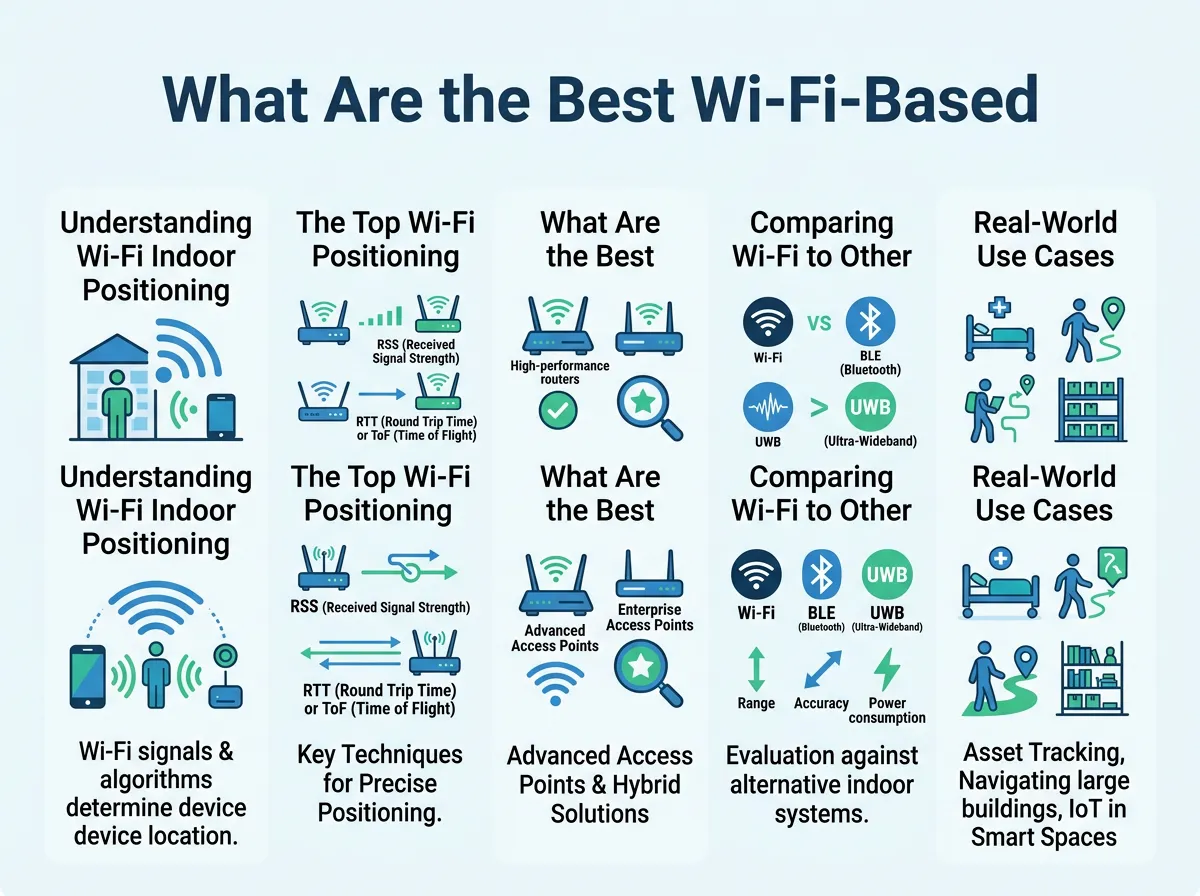
What Are the Best Wi-Fi-Based Indoor Positioning Solutions for IoT? — key points at a glance
RSSI (Received Signal Strength Indicator)
RSSI is the simplest method. It measures how strong a Wi-Fi signal is. If the signal is strong, the device is close. If the signal is weak, the device is far. This method is very cheap. You do not need special hardware. But it has a downside. Walls, doors, and moving people can block signals. This makes RSSI less accurate. It usually locates items within 5 to 10 meters.
Wi-Fi Fingerprinting
Fingerprinting is a two-step process. First, you map the building. You walk around and record signal strengths at different spots. This creates a signal map. Second, the system compares live signals to this map. If a device sees a certain signal pattern, the system knows where it is. This is highly accurate. But it takes time to set up. If you move a wall or a desk, you must map the building again.
RTT and FTM (Round Trip Time / Fine Timing Measurement)
RTT is the modern standard for high accuracy. It does not measure signal strength. Instead, it measures time. It calculates how long a signal takes to travel from a device to a router and back. Since signals travel at the speed of light, this time tells us the exact distance. This method is not affected by walls. It can give you accuracy within one meter. However, you need newer Wi-Fi routers that support this feature.
What Are the Best Wi-Fi-Based Indoor Positioning Solutions for IoT?
Now, let us look at the top commercial systems on the market. These platform choices are popular for businesses today.
Cisco Spaces
Cisco Spaces is a leading cloud platform. It turns your existing Cisco Wi-Fi network into a tracking engine. It is great for large offices, hospitals, and schools. It offers real-time tracking, safety alerts, and space analytics. You do not need to buy new hardware if you already use Cisco routers. This makes it very easy to set up.
Aruba Meridian
Aruba is another huge name in networking. Their Meridian platform combines Wi-Fi with Bluetooth. This hybrid approach gives you the best of both worlds. You get wide coverage from Wi-Fi and high accuracy from Bluetooth tags. It is perfect for visitor guiding and asset tracking.
Navigine
Navigine offers highly flexible software. It works with many hardware brands. They use advanced algorithms to combine Wi-Fi signals with sensor data from mobile phones. This is a great choice if you want a custom solution that fits your exact needs. It is highly scalable for large industries.
Mist Systems (Juniper Networks)
Mist uses artificial intelligence to improve tracking. They use virtual beacons and machine learning. This makes their system highly accurate without manual tuning. It is a smart choice for modern offices that want hands-off management.
Comparing Wi-Fi to Other Indoor Tracking Technologies
Wi-Fi is great, but it is not the only option. Let us compare it to other popular tools. To dive deeper, you can read this detailed comparison of UWB, Wi-Fi, and Bluetooth navigation methods.
Wi-Fi vs. Bluetooth Low Energy (BLE)
BLE is very popular for indoor tracking. BLE beacons are small, cheap, and run on batteries for years. However, BLE requires you to install new hardware all over your building. Wi-Fi can use the routers you already have. Wi-Fi also covers larger areas with fewer access points.
Wi-Fi vs. Ultra-Wideband (UWB)
UWB is the king of accuracy. It can locate an item within centimeters. But UWB is very expensive. It requires special tags and receivers. For most businesses, Wi-Fi-based indoor positioning solutions for IoT offer enough accuracy at a much lower cost.
Real-World Use Cases for Wi-Fi IoT Tracking
How do businesses use these systems? Let us look at some real examples.
Smart Hospitals
Hospitals have a lot of expensive equipment. Wheelchairs, beds, and pumps move around constantly. Staff waste time looking for them. With Wi-Fi tracking, nurses find tools instantly. This saves lives and reduces stress.
Warehouses and Logistics
Warehouses are massive. Tracking pallets is a big job. Wi-Fi tags on pallets tell the system exactly where they are. This speeds up shipping. It also stops items from getting lost on high shelves.
Large Retail Stores
Big stores use Wi-Fi to track shopping carts. They can see where shoppers spend the most time. This helps stores place items in better spots to boost sales. It also helps manage staff placement during busy hours.
Best Practices for Implementing Wi-Fi IPS in Your IoT Network
Setting up a tracking system takes planning. Here are some quick tips to help you succeed.
Plan Your Access Point Placement
For good tracking, a device should see at least three Wi-Fi routers at once. This is called trilateration. Place your routers in a grid. Avoid putting them all in a single straight line. This improves calculation accuracy.
Choose the Right IoT Tags
Ensure your IoT tags have good battery life. Wi-Fi tags can use a lot of power. Look for tags that support power-saving modes. They should only send signals when they move. This saves a lot of battery life over time.
Test Your Environment
Do not just set it and forget it. Test the system during busy hours. People and moving machinery can affect Wi-Fi signals. Regular testing helps you find and fix weak spots quickly.
Conclusion
Finding the right system does not have to be hard. When asking What Are the Best Wi-Fi-Based Indoor Positioning Solutions for IoT?, look at your existing setup first. If you have good Wi-Fi routers, a software-based solution might be best. It saves you money and setup time.
For high accuracy, look into RTT-capable hardware. If you need a mix of low cost and high precision, go for a hybrid system that mixes Wi-Fi and Bluetooth. With the right choice, you will never lose track of your valuable assets again.
Frequently Asked Questions
What is Wi-Fi indoor positioning?
Wi-Fi indoor positioning is a technology that uses local Wi-Fi signals to find the location of devices inside a building. It acts like an indoor GPS by using signal strength or signal timing to calculate exact positions. This helps businesses track assets, tools, and people in real time.
How accurate is Wi-Fi tracking for IoT?
The accuracy of Wi-Fi tracking depends on the method you use. Simple signal strength methods (RSSI) are accurate within 5 to 10 meters. Advanced timing methods (RTT) can locate items within 1 to 2 meters.
Do I need to buy new routers for Wi-Fi positioning?
No, you often do not need new routers if you use basic signal strength tracking. However, if you want high-accuracy tracking using Round Trip Time (RTT), you will need modern routers that support the latest wireless standards.
Is Wi-Fi tracking better than Bluetooth tracking?
Wi-Fi tracking is great because it uses your existing network routers, saving you money on hardware. Bluetooth is better for tracking small, low-power tags over shorter distances. Many businesses combine both for the best results.
How does Wi-Fi fingerprinting work?
Wi-Fi fingerprinting works by mapping the signal strengths of a building beforehand. The system records the unique signal patterns at different spots to create a database. When a device is active, the system compares its live signal to the database to find its location.
Can Wi-Fi tracking work offline?
No, Wi-Fi tracking requires an active local network connection. The IoT devices must be able to communicate with local access points or routers to send and receive signal data for location calculations.
