


IoT indoor asset tracking works by attaching smart, wireless tags to physical items. These tags send signals to fixed receivers inside a building, which then forward location data to a central cloud platform. This allows managers to view the real-time position of tools, inventory, and equipment on a digital screen.
Imagine you run a large hospital. A patient needs an emergency heart monitor, but the nearest machine is missing. It is not stolen; it is simply sitting in an empty hallway on the third floor. Your team spends twenty precious minutes running up and down stairs just to find it. In high-stakes environments, these lost minutes are painful, stressful, and highly expensive. This is exactly where modern smart technology steps in to save the day.
GPS is fantastic for guiding us on open roads, but it falls short the moment we step inside a building. Thick concrete walls, metal beams, and ceilings easily block satellite signals. To solve this problem, businesses rely on specialized local networks to monitor their inventory and tools. If you have ever wondered, “How Does IoT Indoor Asset Tracking Work?” you are in the right place. Let us break down the simple science behind this technology, look at the hardware that makes it happen, and show how it keeps businesses running smoothly.
Key Takeaways
- Hardware Setup: Smart tags and stationary anchors work together to detect locations inside buildings.
- Signal Transmission: Devices use technologies like Bluetooth, Ultra-Wideband, and Wi-Fi to send data.
- Software Map: Cloud platforms translate raw signal coordinates into a live, interactive map of the facility.
- Time Savings: Tracking eliminates manual search times, allowing teams to focus on productive tasks.
- Cost Reduction: Companies prevent theft and avoid buying duplicate equipment by knowing exactly what they own and where it is.
📑 Table of Contents
The Three Pillars of Indoor Tracking
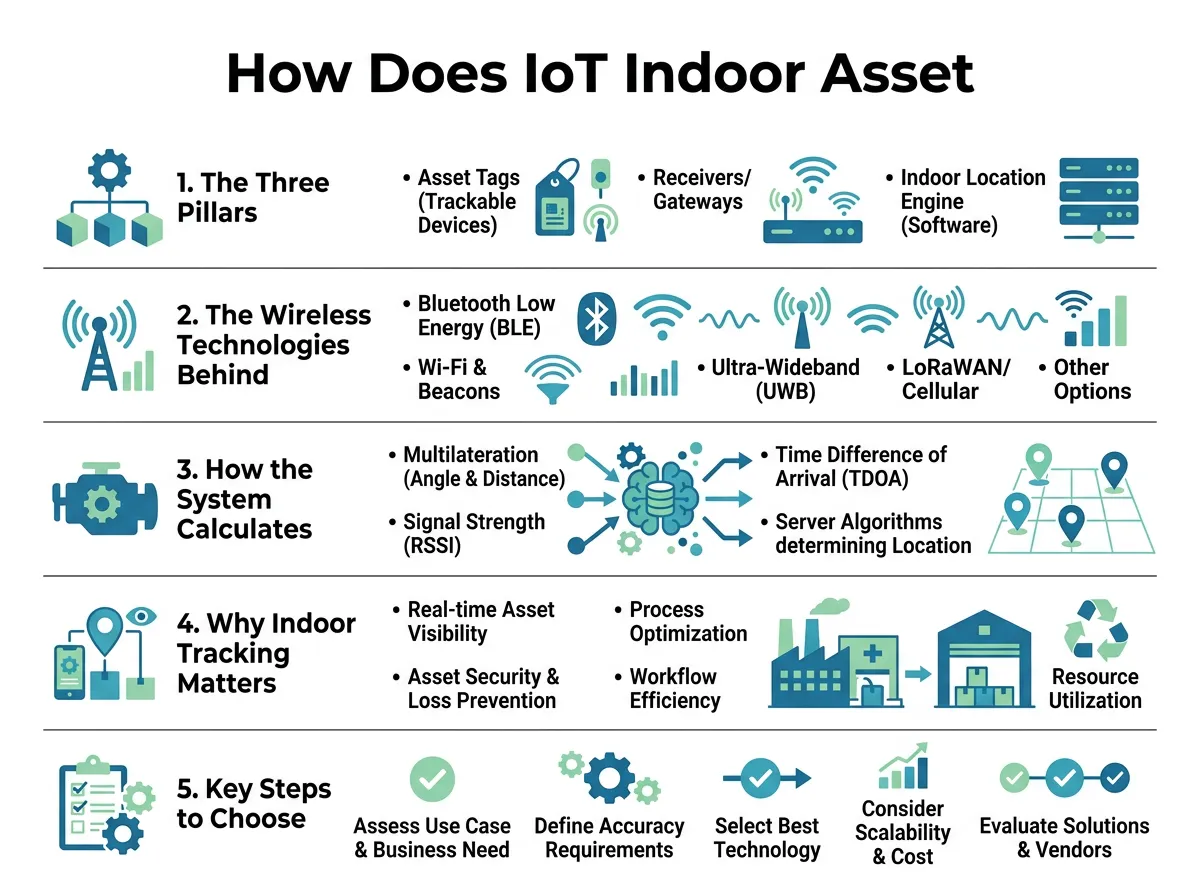
An indoor tracking system is like a three-part team. Each part has a specific job. If one part is missing, the whole system stops working. To understand how these pieces fit together, we must look at the physical tags, the stationary readers, and the central software platform.
1. Smart IoT Tags
The process starts with smart tags. These are small, battery-powered devices that you attach directly to the items you want to monitor. They can be placed on medical pumps, heavy warehouse tools, or even wooden pallets. These tags do not just sit there silently. They constantly broadcast unique wireless signals into the surrounding air, acting like tiny lighthouse beacons.
2. Stationary Anchors and Receivers
Since the tags are always moving, we need stationary devices to listen for their signals. These devices are called anchors, beacons, or gateways. Technicians mount them permanently on walls and ceilings throughout a building. When an asset tag moves near an anchor, the anchor hears the signal, measures its strength, and instantly sends this information to the internet.
3. The Cloud Software
The cloud software is the brain of the operation. It receives raw data from all the anchors in the facility. The software uses smart algorithms to calculate the exact distance between the moving tags and the fixed anchors. Within seconds, it translates these numbers into a dot on a digital map, allowing managers to see their assets on any phone, tablet, or computer screen.
The Wireless Technologies Behind the Signals
Not all indoor tracking systems are built the same way. Different businesses have different needs. Some need to find tools down to the exact centimeter, while others just need to know which room a pallet is in. Several wireless options power these systems.
How Does IoT Indoor Asset Tracking Work? — key points at a glance
Bluetooth Low Energy (BLE)
BLE is one of the most popular choices for indoor tracking today. It is highly energy-efficient, meaning tag batteries can last for several years without needing a charge. BLE tags are also small and affordable. They work by sending signals to nearby Bluetooth receivers, giving you a location accuracy of within a few meters.
Ultra-Wideband (UWB)
If you need extreme precision, UWB is the gold standard. It sends quick radio pulses across a wide frequency spectrum. This allows the system to calculate location down to a few centimeters. It is perfect for tracking high-value items, moving robotic parts, or tools on a fast-moving assembly line. However, UWB hardware is more expensive and requires more power than BLE.
Wi-Fi and RFID
Many facilities already have strong Wi-Fi networks in place. You can use this existing network to track assets, which saves money on initial installation. However, Wi-Fi tags can be bulky and drain batteries quickly. Radio Frequency Identification (RFID) is another classic choice. Passive RFID tags do not use batteries at all. They only send a signal when they pass close to a powerful reader, making them ideal for tracking items through doorways.
How the System Calculates Location
How does the cloud software turn raw radio waves into a precise location on a map? It relies on simple geometric math. The software uses two main methods to figure out where your items are hiding.
The first method is proximity. This is the simplest approach. If a tag is close to a specific anchor, the system assumes the asset is in that general area. It is like saying, “The keys are near the television.” The second method is trilateration. Here, the tag sends a signal to three or more anchors at the exact same time. By measuring the signal strength or the time it takes for the wave to travel, the software draws intersecting circles to pinpoint the exact location of the item. To learn more about how systems choose these tracking methods, you can read about the differences between time-based vs proximity-based asset tracking to see which fits your business workflow best.
Why Indoor Tracking Matters in Real-Life Industries
This technology is not just for tech enthusiasts; it solves real, everyday business headaches. Let us look at how different industries put these smart systems to work.
Smart Hospitals
Hospitals are busy, chaotic places. Nurses spend hours looking for wheelchairs, IV pumps, and specialized beds. By using indoor tracking, hospital staff can find life-saving equipment in seconds. It also helps track the temperature of sensitive medicine fridges, alerting staff if a door is left open.
Manufacturing and Facility Management
On a large factory floor, misplaced tools cause expensive production delays. Implementing these setups helps managers keep an eye on expensive calibration tools. To explore the wider benefits of this technology in commercial buildings, you can read about how IoT facility management works to see how connected sensors improve daily building operations.
Logistics and Warehousing
Warehouses are packed with thousands of boxes and pallets. Knowing where every item sits makes shipping much faster. Workers do not waste time wandering down the wrong aisles. Using dedicated IoT asset tracking systems for logistics ensures that goods flow smoothly from arrival docks directly to delivery trucks without getting lost in the shuffle.
Key Steps to Choose Your Tracking Setup
If you are ready to set up an indoor tracking system, you must plan carefully. Do not just buy the most expensive option on the market. Take a moment to ask yourself a few simple questions.
- What is my target accuracy? Decide if you need to know the exact shelf an item sits on, or if knowing the general room is enough.
- What is my budget? Remember to count the cost of tag batteries, reader installations, and software subscription fees.
- How difficult is the environment? Metal shelves and thick concrete walls block radio waves, so you might need more anchors to get a clear signal.
Conclusion
So, how does IoT indoor asset tracking work? At its core, it is about keeping things connected. By using small, smart tags, local wireless receivers, and clever cloud software, businesses can eliminate the headaches of lost equipment. This smart technology turns invisible radio signals into clear, actionable data. It saves time, reduces stress, and saves companies thousands of dollars. As these sensors get smaller, cheaper, and smarter, we will see them in almost every building we enter, making lost items a thing of the past.
Frequently Asked Questions
What is the difference between GPS and indoor tracking?
GPS relies on satellite signals that cannot pass through thick building walls and ceilings. Indoor tracking uses local wireless signals like Bluetooth or Wi-Fi to locate objects inside a facility.
How long do the batteries in IoT tracking tags last?
Battery life depends heavily on the wireless technology you choose. Bluetooth Low Energy (BLE) tags can easily last between three to five years, while high-precision Ultra-Wideband (UWB) tags may need a battery change every few months.
Is indoor asset tracking expensive to install?
The cost varies based on the size of your building and the level of accuracy you need. Using existing Wi-Fi networks is highly cost-effective, while installing high-precision UWB anchors requires a larger initial investment.
Can thick walls block indoor tracking signals?
Yes, heavy physical materials like concrete, steel, and brick can weaken or block radio signals. Designing your system with extra anchors helps route signals around these obstacles.
Are indoor tracking tags safe to use around medical equipment?
Yes, modern Bluetooth and RFID tags operate on low-power frequencies that are completely safe for sensitive environments. They are widely used in hospitals without causing interference with medical devices.
Do I need to track everything in my facility?
No, most businesses only track high-value equipment, shared tools, or items that move frequently. You can easily start by tracking a few critical assets and scale the system up later.
