


The best eUICC SIM for IoT applications is one that offers multi-carrier coverage, robust remote provisioning, and no carrier lock-in. To find the right fit, you must choose a provider that aligns with your specific deployment scale, geographical needs, and budget. Partnering with a reliable vendor ensures your devices stay connected globally without physical SIM swaps.
Imagine you are launching a fleet of smart cargo trackers. Your goal is to ship them to five different countries. At first, everything seems perfect. But as soon as the trackers cross the border, they go offline. Why? Because the network provider in the next country does not support your SIM card. Now, you have to recall hundreds of devices or send a team to swap the physical SIM cards. That is a logistical nightmare and a massive waste of money.
This is where eUICC steps in to save the day. It is the ultimate tool for modern business connectivity. But with so many options on the market, how do you find the right one? What Is the Best eUICC SIM for IoT Applications? In this guide, we will break down what makes an eUICC SIM stand out. We will also help you choose the perfect match for your unique project.
Key Takeaways
- No Carrier Lock-in: eUICC technology lets you switch network operators over the air without changing physical cards.
- Global Coverage: The ideal SIM connects to multiple local networks automatically to prevent coverage gaps.
- Future-Proof Fleet: Remote provisioning makes it easy to update carrier profiles as your business grows.
- Form Factors Matter: Choose the right physical size, like MFF2 chip SIMs for harsh environments or standard plastic cards for easy swaps.
- Security First: Top eUICC providers offer advanced encryption and private APNs to protect your sensitive IoT data.
📑 Table of Contents
Understanding eUICC and Why It Matters
To find the best option, we must first understand what this technology is. Many people get confused by the jargon. You might hear terms like eSIM, eUICC, and physical SIM used interchangeably. However, they are not quite the same thing.
The Difference Between eSIM and eUICC
An eSIM is the physical chip soldered onto a device’s circuit board. On the other hand, eUICC is the software that runs on that chip. It is the magic engine that lets you change network profiles over the air. You can learn more about this by understanding the difference between eSIM and eUICC. In short, eUICC gives you the power to swap carriers without ever touching the device.
Why Standard SIMs Fail in IoT
Standard SIM cards are locked to a single network operator. If that network goes down, your device goes dark. If you move your device to a new country, you might face high roaming fees. Replacing a physical SIM card in thousands of utility meters or smart cars is almost impossible. It costs too much time and money. eUICC solves this by letting you push new profiles to the device remotely.
Key Features of the Best eUICC SIMs
Not all eUICC solutions are built the same way. The best options on the market share a few vital features. Here is what you should look for when shopping around.
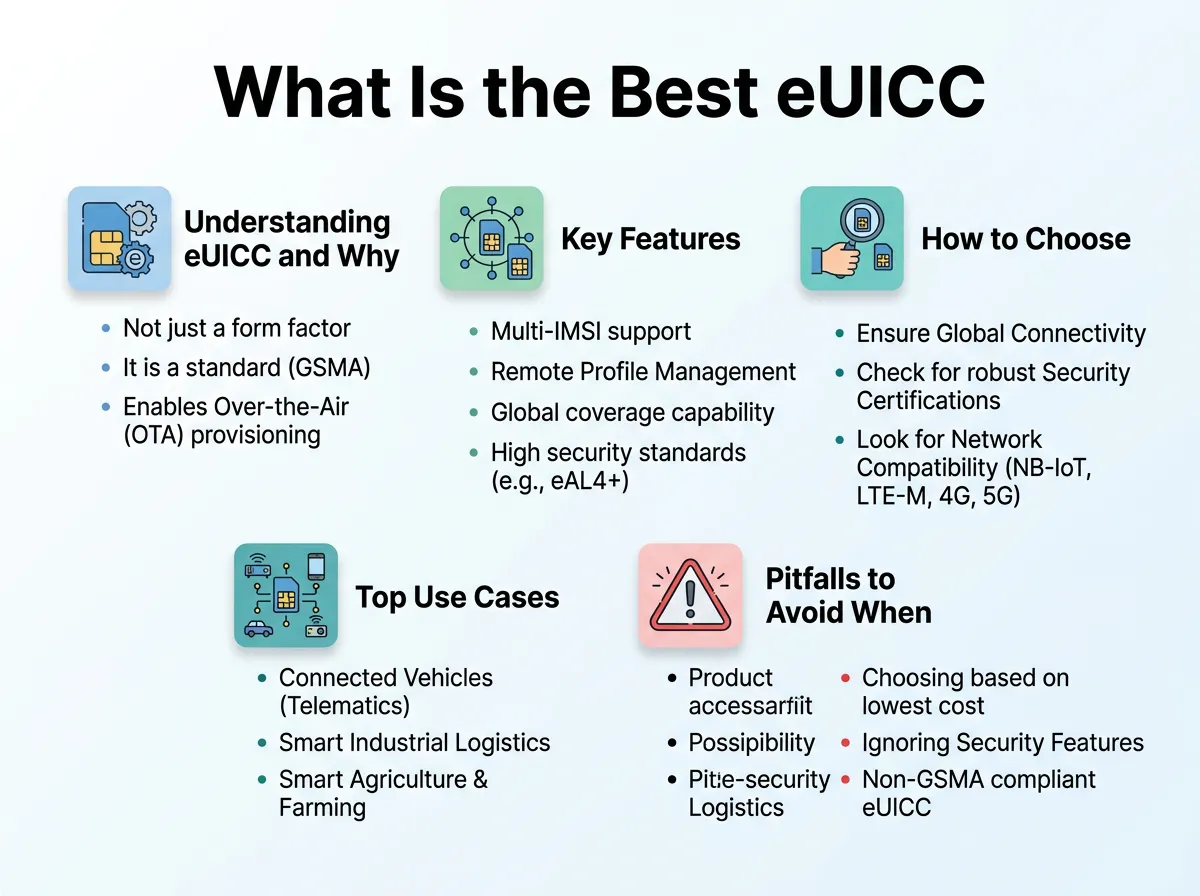
What Is the Best eUICC SIM for IoT Applications? — key points at a glance
Robust Remote Provisioning (OTA)
Over-the-air (OTA) provisioning is the core of eUICC. The best SIMs let you send updates, switch carriers, and fix bugs remotely. This process must be fast and secure. It should work even when the connection is weak. If the OTA process is too slow, your devices might lose connection during an update.
Multi-IMSI and Multi-Profile Capabilities
A great eUICC SIM does not rely on just one carrier profile. It should support multiple International Mobile Subscriber Identities (IMSIs). This allows the SIM to fall back on another network if the primary carrier fails. This feature keeps your devices connected in remote areas or deep inside buildings.
Ruggedized Form Factors
IoT devices operate in some harsh places. They can be placed in hot deserts, wet fields, or vibrating factory floors. The best eUICC SIMs come in rugged forms. The MFF2 chip is highly recommended. It is soldered directly to the device board. This makes it resistant to dust, water, and rough vibrations.
How to Choose the Best eUICC SIM for Your Project
Every IoT project is unique. A smart water meter in a basement has different needs than a drone flying in the sky. Therefore, there is no single “best” SIM for everyone. You need to focus on choosing the right SIM technology for your specific deployment goals.
Evaluate Network Coverage and Redundancy
Where will your devices live? If they travel across borders, you need a SIM with global roaming agreements. Look for providers that offer steering-free roaming. This means the SIM will always connect to the strongest network nearby, rather than forcing a connection to a preferred but weaker network.
Analyze the Management Platform
You need an easy way to manage all your SIMs. The best providers offer a clean, simple dashboard. This platform should let you monitor data usage, activate new SIMs, and switch carrier profiles with a few clicks. If the platform is too complex, your team will spend hours trying to fix basic issues.
Look at the Total Cost of Ownership
Do not just look at the upfront cost of the SIM card. Consider the long-term fees. Check the cost of sending OTA updates. Some providers charge high fees every time you change a carrier profile. The best providers offer clear, flat-rate pricing structures that help you plan your budget.
Top Use Cases for eUICC SIMs
Let us look at how businesses use these smart SIM cards in the real world. These examples show how eUICC makes life easier for different industries.
Asset Tracking and Logistics
Cargo containers travel by ship, train, and truck. They cross many borders. With an eUICC SIM, the tracker stays online during the entire journey. It switches to local networks in each country. This keeps roaming costs low and ensures you never lose sight of your goods.
Smart Utilities and Energy
Smart gas and water meters are built to last for ten years or more. They are often placed in hard-to-reach places like underground basements. Sending a technician to change a SIM card is not an option. eUICC allows utility companies to update network settings remotely, saving millions of dollars over the product’s lifespan.
Automotive and Connected Vehicles
Car manufacturers ship vehicles all over the world. They cannot put different physical SIMs in cars destined for different countries. Instead, they solder an eUICC chip into the car during assembly. Once the car arrives at its final destination, the system downloads the local carrier profile over the air.
Pitfalls to Avoid When Selecting a Provider
As you search for a provider, keep your eyes open for red flags. Some deals look great on paper but cause major headaches later.
Hidden Roaming Fees
Some providers offer cheap SIM cards but charge high fees for global data. Always read the fine print. Make sure you understand the cost of data in every country where your devices will operate.
Lack of Local Bootstrap Profiles
A bootstrap profile is the initial connection used to download other profiles. If your bootstrap profile has poor coverage, your device cannot download its primary profile. Ensure your provider offers a reliable, global bootstrap profile.
Proprietary Lock-ins
Some vendors sell what they call “eSIMs” but lock you into their own network ecosystem. Real eUICC should give you the freedom to move to any carrier. To protect your business from high costs and vendor lock-in, it is smart to seek out open eSIM solutions for business that guarantee true flexibility.
Conclusion
So, what is the best eUICC SIM for your IoT application? The answer is simple. The best SIM is the one that gives you complete control over your connectivity. It should offer reliable remote provisioning, strong global coverage, and a simple management platform. It must also match the physical needs of your devices, whether they are in a quiet office or a harsh industrial site.
By choosing an open, flexible eUICC solution, you protect your business from future network changes. You save money on physical maintenance and ensure your devices stay online. Take the time to evaluate your network needs, test your devices in real-world scenarios, and select a partner that can scale alongside your business.
Frequently Asked Questions
What is the main benefit of an eUICC SIM?
The main benefit is remote provisioning, which lets you switch network operators over the air without changing physical SIM cards. This saves you from expensive physical swaps and protects your fleet from carrier lock-in.
Can I use eUICC SIMs globally?
Yes, eUICC SIMs are perfect for global deployments because they can hold multiple carrier profiles. When your device crosses a border, it can download or switch to a local network profile to keep roaming costs low.
What is the difference between eSIM and eUICC?
An eSIM is the actual physical hardware chip that is soldered onto a device’s circuit board. In contrast, eUICC is the software architecture that allows that chip to store and switch between multiple network profiles.
What physical sizes do eUICC SIMs come in?
They come in all standard sizes, including 2FF (mini), 3FF (micro), and 4FF (nano) plastic cards. They are also available as MFF2 chips, which are soldered directly into devices for maximum durability.
Do eUICC SIMs cost more than traditional SIM cards?
The upfront cost of an eUICC SIM may be slightly higher than a traditional SIM card. However, they drastically reduce long-term operational costs by eliminating physical SIM swaps and expensive roaming fees.
How do I change carriers on an eUICC SIM?
You can change carriers remotely using an over-the-air (OTA) update through your provider’s connectivity management platform. The platform sends a command to the device to download and activate the new network profile.
