

A 2G IoT SIM card is a specialized cellular card designed to connect smart machines and sensors to 2G cellular networks. These cards help devices send tiny bits of data like location or temperature over long distances at a very low cost. While newer networks exist, these budget-friendly SIMs remain highly popular for global tracking and simple remote monitoring.
Imagine you run a logistics company. You have hundreds of cargo boxes moving across the country. You do not need to stream high-definition movies to these boxes. You do not need fast web browsing. You only need to know where they are. You want to see their location on a map once every hour.
How do you do this without spending too much money? How do you keep the tracking devices alive for months without charging them? Perhaps you are wondering if a 2G IoT SIM card is still the right tool for the job. The secret lies in simple, reliable technology that has worked for years.
In this guide, we will explore a small but powerful tool. We will explain how it connects your devices to the internet. You will learn about its benefits, where it works best, and how it can save your business money. Let us dive in and see how this classic technology still helps the modern world.
Key Takeaways
- Low Cost: 2G networks offer incredibly cheap hardware and data plans for businesses.
- Excellent Battery Life: Devices using these SIM cards consume very little power, lasting for years.
- Global Coverage: Many regions worldwide still maintain highly stable 2G coverage.
- Simple Data Needs: Perfect for sending tiny text-based messages rather than heavy files.
- Sunset Planning: Businesses must track local carrier updates as some countries phase out 2G networks.
📑 Table of Contents
Understanding the Basics of 2G IoT SIM Cards
What exactly is a 2G IoT SIM card? In simple terms, it is a tiny plastic chip. You slide it into a smart device or machine. It lets that machine talk to other machines over a second-generation (2G) cellular network.
What Makes It Different from a Phone SIM?
The SIM card in your smartphone is made for people. It lets you make phone calls, send texts, and watch videos. It needs a lot of data and speed. It is also quite expensive to run. Your phone is hungry for bandwidth all day long.
A specialized 2G IoT SIM card is different. It is made for machines. It only sends tiny packets of data. For example, it might send a sensor reading or a GPS coordinate. Because it does not do heavy work, it uses very little power and costs much less.
Why Do We Still Use 2G?
You might think 2G is too old. After all, we now have 5G. But old does not mean useless. The 2G network is incredibly stable. It reaches deep into rural areas where newer signals struggle. It is the perfect backbone for simple, reliable machine tasks that do not need high speeds.
How Does a 2G IoT SIM Card Work?
When using a 2G IoT SIM card, the chip works much like the one in your phone, but it follows a simpler path. When you turn on your smart device, the chip searches for a 2G signal. Once it connects, it acts as a secure key. It proves to the network that your device is allowed to send data.
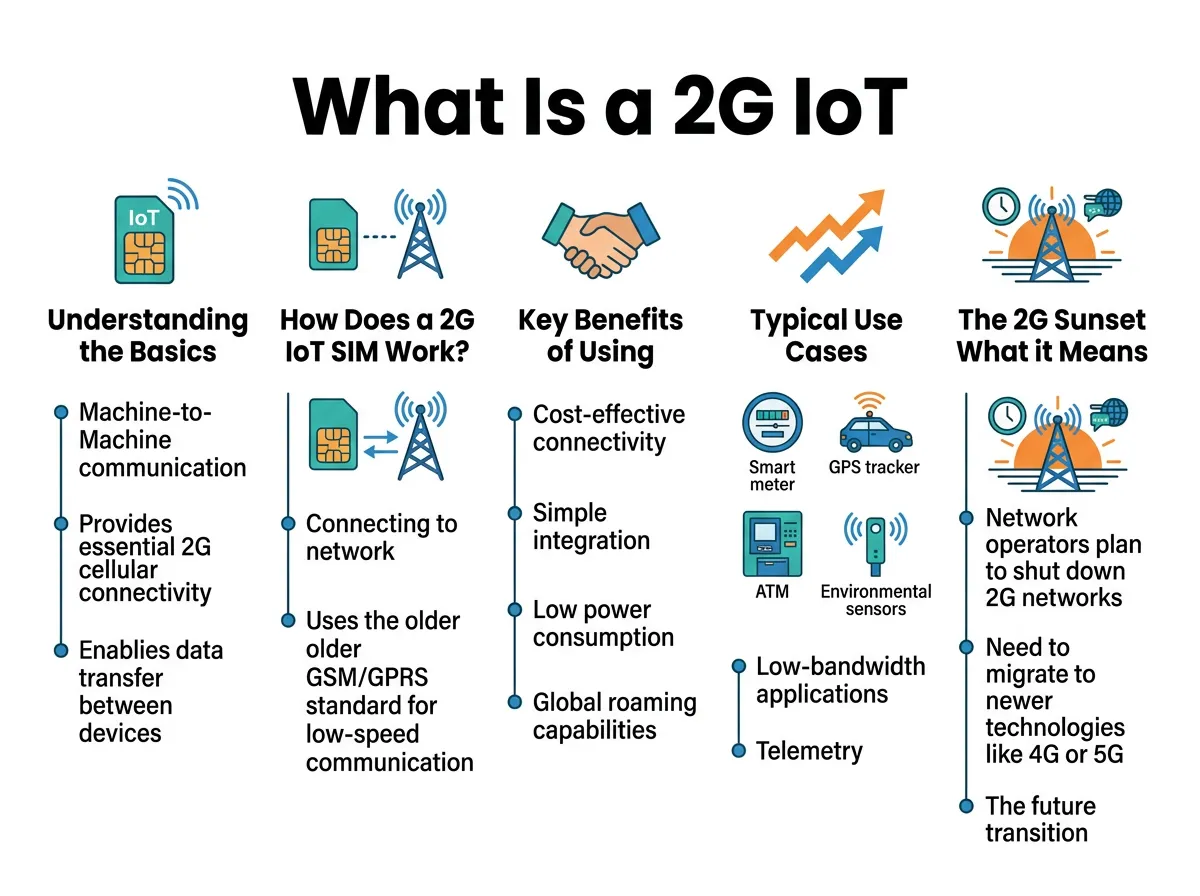
What Is a 2G IoT SIM Card? — key points at a glance
Machine-to-Machine Communication
This process is called machine-to-machine (M2M) communication. The device gathers data, like the temperature of a fridge. The card helps package this data. Then, the card sends it over the airwaves to a cloud server. From there, you can see the data on your computer screen instantly.
Global Roaming and Multi-Network Support
Many smart devices travel across borders. A delivery truck might drive from one country to another. This is where a multi-network SIM card becomes very useful. It allows your device to connect to different network carriers without swapping physical chips. It simply finds the strongest 2G signal nearby and hops onto it, ensuring you never lose connection.
Key Benefits of Using 2G for IoT Devices
Why do businesses still choose this older technology? Let us look at the main reasons why this system remains a top choice for many modern projects.
Unmatched Battery Life
Newer cellular networks require a lot of power. They search for fast signals constantly, which drains batteries fast. 2G is much simpler. A device using this technology can go to sleep when it is not sending data. When it wakes up, it connects quickly and uses very little energy. This means your device batteries can last for years instead of days.
Low Hardware and Data Costs
Building a 5G device is expensive. The modems and chips cost a lot of money. On the other hand, 2G hardware is cheap. It has been mass-produced for decades. Also, because your devices only send tiny text-based messages, your monthly data plans are extremely cheap. This makes it highly scalable.
Small and Tough Form Factors
IoT devices come in all shapes and sizes. Sometimes, you need a chip that can survive shaking cars or hot engines. According to a comprehensive guide on IoT SIM cards, these chips come in various shapes. You can get standard plastic cards or soldered chips. Soldered chips are welded directly onto the device board, making them tough and weather-resistant.
Typical Use Cases and Real-World Examples
Where do we actually see these chips in action? Let us look at some everyday examples where simple connectivity wins.
Asset Tracking and Logistics
Think of shipping companies tracking wooden pallets. They do not need high-speed video. They only need to know if the pallet is in Chicago or New York. This cheap, reliable technology is perfect here. It provides tracking across long distances without draining the tracker’s battery.
Smart Agriculture
Farmers use sensors to measure soil moisture. These sensors sit in deep mud in the middle of giant fields. They only send a few numbers once a day. This setup keeps these sensors connected for years on a single small battery, saving the farmer from constant field trips.
Smart Utility Meters
Water and gas meters do not need massive bandwidth. They just need to tell the utility company how much gas you used this month. A simple card inside the meter sends this number automatically. This saves the utility company from sending a worker to read the meter in person.
The 2G Sunset: What You Need to Know
While this system is great, we must talk about the future. Many phone companies are turning off their 2G networks. This process is called the “2G sunset.” They do this to clear up space for faster 4G and 5G networks.
Regional Shutdowns
The 2G sunset is happening at different speeds around the world. In places like the United States and Australia, most 2G networks are already gone. However, in parts of Europe, Africa, and Latin America, 2G is still very active. It will remain online in those regions for many years to come.
Planning for the Future
If you are starting a new project, you must check local network maps. If you deploy devices in a country that still supports 2G, it is a great, low-cost choice. If you are deploying in a place where 2G is gone, you should look at newer low-power alternatives like LTE-M or NB-IoT.
Tips for Choosing the Right SIM Card
If you decide to use this technology, how do you make the right choice? Here are some simple tips to keep in mind.
Check the Coverage Area
Make sure the countries you want to deploy in still have active 2G networks. Talk to your SIM provider about their coverage map before you make a purchase.
Choose a Flexible Plan
Look for a provider that offers pooled data. This means all your devices share a single bucket of data. If one device uses slightly more data, another device can balance it out. This keeps your costs predictable and low.
Look for Quality Support
IoT projects can be tricky. Choose a SIM provider that offers great customer support. You want a team that can help you troubleshoot connection issues quickly so your business never stops moving.
Conclusion
The world of connected devices is vast. While high-speed 5G gets all the attention, the humble 2G IoT SIM card still plays a massive role. It offers a low-cost, low-power, and highly reliable way to connect simple devices globally. By understanding how it works and where it is supported, you can make smart choices for your business and keep your devices connected easily.
Frequently Asked Questions
Is 2G still available for IoT?
Yes, 2G is still available in many parts of the world, including Europe, Africa, and Latin America. However, many network operators in the US and Australia have shut down their 2G services. It is important to check regional network maps before deploying your devices.
What is the difference between a 2G IoT SIM card and a 4G IoT SIM card?
A 2G IoT SIM card connects to older, slower networks that are ideal for small data transmissions like text or coordinates. A 4G IoT SIM card connects to faster networks, which allows you to send larger files like images or video. The 2G option is generally cheaper and uses less power.
Can I use a regular mobile 2G SIM card for IoT?
While it is physically possible, it is not recommended for business use. Regular consumer SIM cards lack features like global roaming, pooled data plans, and long-term network management tools. An IoT-specific card is designed to handle tough conditions and keep costs predictable.
How long does a 2G IoT SIM card battery last?
The SIM card itself does not use much battery, but it helps the device run very efficiently. Because 2G hardware is simple, a device using this card can easily last for five to ten years on a single charge. This depends on how often the device wakes up to send data.
What will happen when 2G is completely shut down?
When the 2G network in your area is turned off, your 2G device will lose its connection. To prevent this, you will need to upgrade your hardware to support newer standards like LTE-M or NB-IoT. Most modern IoT providers offer seamless pathways to transition your devices.
Are 2G IoT SIM cards secure?
Yes, these cards use secure, encrypted cellular tunnels to send your data. They are much safer than public Wi-Fi networks because they connect directly to cellular towers. This makes them a trusted choice for sending sensitive business information.
