


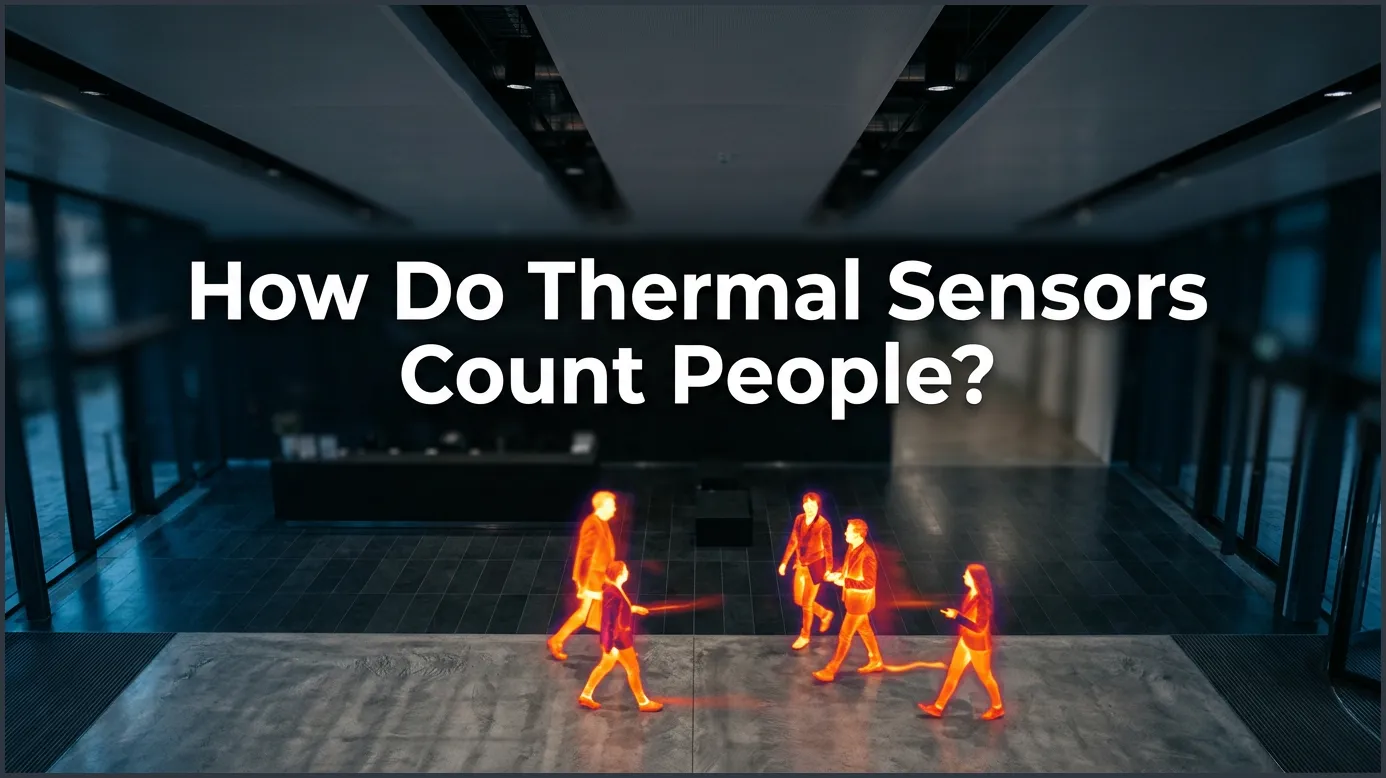
Thermal sensors count people by detecting body heat instead of capturing visual images. They sense the infrared energy naturally emitted by human bodies and translate those heat patterns into highly accurate data counts. This technology allows smart buildings to track foot traffic while keeping everyone’s personal identity completely private.
Imagine walking into a busy department store. The automatic doors slide open, and you step inside. You do not see any security cameras pointing directly at your face. Yet, the store managers still know exactly how many visitors are walking through the aisles. They know which sections are crowded and which areas are quiet. How do they gather this helpful information without making you feel like you are under a microscope?
The secret lies in the ceiling. Small, quiet devices sit above the doorways. They do not watch you. Instead, they feel you. These devices are thermal sensors. Many business owners and facility managers ask: how do thermal sensors count people? It sounds like science fiction, but the reality is simple, elegant, and highly effective.
In this article, we will break down the technology behind these heat-seeking counters. We will look at how they work, why they are great for personal privacy, and how they compare to traditional cameras. By the end, you will understand how these tiny devices help shape the smart buildings of tomorrow.
Key Takeaways
- Heat Detection: Sensors read the invisible infrared heat emitted by human bodies to detect presence.
- Privacy First: They do not capture faces or identifiable details, making them fully compliant with strict privacy laws.
- Total Darkness Utility: Because they rely on heat rather than light, they work perfectly in pitch-black environments.
- Smart Filtering: Advanced algorithms ignore non-human heat sources like pets, heating vents, and warm sunlight.
- Real-Time Insights: Businesses use this live data to manage crowds, clean offices, and save energy on heating and cooling.
📑 Table of Contents
What is the Science Behind Thermal Imaging?
To understand how these devices work, we must first look at basic physics. Everything in our world emits some level of heat. Your desk, your chair, and your smartphone all radiate thermal energy. Humans are warm-blooded creatures. Our bodies naturally produce a steady amount of heat. This heat escapes our skin in the form of invisible light called infrared radiation.
Understanding Infrared Radiation
The human eye can only see a small band of light. We cannot see infrared light because its wavelength is too long. However, thermal sensor technology is designed to detect this exact type of light. When you walk under a thermal sensor, the device sees you as a moving shape of warmth. It does not see your clothes, your hair color, or your face. It only sees your unique heat signature against a cooler background.
The Grid of Heat Pixels
Inside the sensor is a special lens that focuses infrared light onto a grid. This grid is made of tiny heat-sensitive pixels. When warm energy hits these pixels, they generate small electrical signals. The sensor’s internal computer reads these signals. It creates a low-resolution map of the area. On this map, cold things look blue or black, while warm objects like humans look bright red, orange, or yellow.
How Do Thermal Sensors Count People? The Core Process
We know that the sensor can see heat. But how does it translate a warm blob into a precise tally mark? The transition from heat detection to data collection involves a few simple, smart steps.
How Do Thermal Sensors Count People? — key points at a glance
If you want to know how do thermal sensors count people, you have to look at how the device processes movement. The sensor does not just look for warmth. It looks for warmth that moves like a human. Here is the step-by-step process of how this works:
1. Creating a Baseline Temperature
When a sensor is first turned on, it scans the empty room. It notes the temperature of the floor, the walls, and the furniture. This becomes the baseline background. Anything that matches this baseline is ignored.
2. Detecting the Heat Signature
When a person walks into the sensor’s field of view, their body heat disrupts the baseline. The sensor instantly spots a warm shape that is different from the floor. This shape is usually around 98.6 degrees Fahrenheit (37 degrees Celsius), which stands out clearly in a typical room.
3. Defining a Human Target
Sensors are programmed with smart rules. A hot cup of coffee is warm, but it is too small to be a person. A dog is warm, but it moves differently and has a different shape. The sensor’s software uses size, shape, and speed thresholds to confirm that the heat source is indeed a human being.
4. Crossing the Virtual Line
To count a person, the system uses virtual lines. Installers draw these invisible lines in the sensor’s software. When the warm human shape crosses this line, the system counts them. If they walk in, the counter goes up by one. If they walk out, the counter goes down by one. This is one of the most reliable people counting technologies available today.
Why Thermal Sensors are Great for Privacy
In our modern world, privacy is a major concern. Many people do not want to be recorded by standard video cameras. They worry about where their video footage might end up. This is where thermal counters shine.
Anonymous Data Collection
Thermal sensors provide complete anonymity. They do not capture facial features, eye color, or skin tone. They cannot read the text on your phone or see what brand of shoes you are wearing. To the sensor, everyone is just a warm, anonymous shape. This makes privacy-first thermal sensor people counting an excellent choice for sensitive areas like bathrooms, hospitals, and corporate offices.
Compliance with Privacy Laws
Because these sensors do not gather any personally identifiable information, they easily comply with strict global privacy laws. Rules like the General Data Protection Regulation (GDPR) in Europe limit how businesses can use video cameras. Thermal sensors completely bypass these issues. Businesses can track visitor numbers without worrying about legal headaches or customer complaints.
Thermal Sensors vs. Standard Cameras
Why would a business choose a thermal sensor over a standard security camera? Let us compare the two options across a few key areas.
Performance in Low Light
Standard cameras need good lighting to work. If a room is dark, a standard camera cannot see anything. It might miss people entirely. Thermal sensors do not care about light. They work in pitch-black rooms, bright sunlight, and shadows. As long as there is a temperature difference between the person and the room, the sensor works perfectly.
Data Accuracy
Standard cameras can get confused by shadows. They can also make mistakes when people wear dark clothing that blends into the background. Thermal sensors are highly accurate. Shadows have no heat, so the sensor ignores them. No matter what color clothes you wear, your body still emits the same amount of heat.
Where are Thermal People Counters Used?
Now that we have answered the question, how do thermal sensors count people, let us look at where they are used in everyday life. These devices are incredibly versatile.
Smart Offices and Workspace Management
Many modern offices do not have assigned desks. Employees work from empty spaces. Facilities managers use thermal sensors to see which desks and meeting rooms are busy. If a room is empty for hours, the building can automatically turn off the lights and air conditioning to save money.
Retail Stores and Shopping Malls
Retailers want to know how many customers visit their stores. This help is called conversion rate analysis. If 1,000 people enter a store but only 10 buy something, the store owner knows they need to change their sales approach. Thermal sensors provide the accurate foot traffic data needed for these calculations.
Public Transportation
Train stations and airports use thermal sensors to monitor crowd sizes. If a platform becomes too crowded, the system warns security staff. This keeps travelers safe and helps trains run on time.
Common Challenges and Best Practices
While thermal sensors are highly reliable, they are not magic. Installers must follow a few best practices to get the best results.
Avoid Placing Near Direct Heat Sources
Sensors should not be mounted directly above radiators, heating vents, or drafty doorways. Sudden blasts of hot or cold air can confuse the sensor’s pixels. It is best to place them in neutral areas with steady air temperatures.
Mounting Height Matters
For the most accurate count, sensors should be mounted directly overhead. This is called a top-down view. If a sensor is mounted at an angle, one person might block the heat signature of the person standing behind them. Mounting the sensor straight down ensures everyone is seen clearly.
Conclusion
So, how do thermal sensors count people? They do it by turning invisible heat into useful, anonymous data. By sensing our natural body warmth, these devices help businesses track foot traffic, manage building energy, and keep crowds safe. Best of all, they do all of this without ever invading your personal privacy. As our buildings become smarter and our need for privacy grows, thermal sensors will continue to play a quiet, warm role in our daily lives.
Frequently Asked Questions
How accurate are thermal people counters?
Thermal people counters are highly accurate, often reaching rates between 95% and 98%. Their accuracy remains high because they are not affected by shadows, changing light conditions, or the color of a person’s clothing.
Can thermal sensors see through walls?
No, thermal sensors cannot see through solid walls. They can only detect the infrared heat emitted by objects that are directly within their clear line of sight.
Do thermal sensors work in outdoor environments?
Yes, thermal sensors can work outdoors, but they require weather-resistant housing. Extremely hot outdoor temperatures that match human body heat can sometimes reduce their accuracy.
Do thermal sensors record video of my face?
No, thermal sensors do not record video or capture facial features. They only register low-resolution heat shapes, ensuring your personal identity remains fully private.
Can a thermal sensor distinguish between a human and a pet?
Yes, modern thermal sensors use smart algorithms that analyze the size, shape, and speed of a heat source. This allows them to easily tell the difference between a human and a dog or cat.
Do thermal sensors emit harmful radiation?
No, thermal sensors do not emit any radiation at all. They are entirely passive devices that only read the heat energy that is already naturally radiating from your body.
