

AWS IoT Core is a cloud-based gateway that connects smart devices to Amazon Web Services, while AWS IoT Greengrass brings cloud capabilities directly onto local devices so they can run offline. AWS IoT Core acts as the central hub in the cloud, whereas Greengrass acts as the local edge runtime for immediate processing.
Imagine you are building a smart farm. You have soil sensors all over your fields. They measure moisture and check the temperature. How do you get that valuable data to your phone or your database? You need a reliable cloud platform to tie everything together. Amazon Web Services (AWS) is a very popular choice for this job. But as soon as you start planning, you will face a big question. Should you use AWS IoT Core or AWS IoT Greengrass?
These two services sound very similar. They both help you manage smart devices. Yet, they serve very different needs in your setup. If you choose the wrong one, you might end up with high costs or a system that stops working when the internet drops. In this guide, we will look closely at both tools. We will find out which one fits your project best as we explore AWS IoT Core vs Greengrass: What Is the Difference? in plain, simple terms.
Key Takeaways
- Core Location: AWS IoT Core lives in the cloud, while AWS IoT Greengrass runs on your local physical hardware.
- Internet Needs: IoT Core requires a constant internet connection to work, whereas Greengrass can operate offline for long periods.
- Hardware Specs: IoT Core works with very cheap, low-power microchips, but Greengrass needs more powerful devices like a Raspberry Pi or industrial PC.
- Data Processing: Greengrass processes data locally at the “edge” to reduce latency, while IoT Core processes data once it reaches the cloud.
- Perfect Harmony: These two services are not competitors; they work best when used together in a hybrid setup.
📑 Table of Contents
- Understanding AWS IoT Core: Your Gateway to the Cloud
- Exploring AWS IoT Greengrass: Bringing the Cloud to the Edge
- AWS IoT Core vs Greengrass: What Is the Difference?
- Real-World Use Cases: When to Choose Which?
- How They Work Together: The Hybrid Approach
- Practical Tips for Your IoT Journey
- Conclusion
Understanding AWS IoT Core: Your Gateway to the Cloud
AWS IoT Core is a fully managed cloud service. Think of it as a giant, highly secure post office in the sky. Your smart devices send messages to this post office. AWS IoT Core reads these messages and routes them to other AWS tools, like databases or notification systems. It makes it easy for billions of devices to talk to the cloud at the same time.
How AWS IoT Core Connects Devices
Your devices talk to AWS IoT Core using lightweight network protocols. The most common protocol is MQTT. This protocol is very fast and uses very little power. Your device sends a small packet of data, and IoT Core accepts it securely. You do not need to run or manage your own servers. AWS handles all the hard work for you behind the scenes.
Key Features of AWS IoT Core
First, it has a Device Gateway. This is the secure entry point for all your incoming data. Second, it has a Message Broker. This tool acts like a traffic cop to send your data to the right place. Third, it has a Device Shadow. This is a very handy feature. It keeps a virtual copy of your device in the cloud. Even if your physical device goes offline, you can still read its last known state or set future tasks.
Exploring AWS IoT Greengrass: Bringing the Cloud to the Edge
Sometimes, the cloud is just too far away. What if you are running a cargo ship in the middle of the ocean? What if your equipment is deep inside a mine? The internet might fail, or it might be very slow. This is where AWS IoT Greengrass comes in. It brings the power of the AWS cloud directly onto your local physical hardware.
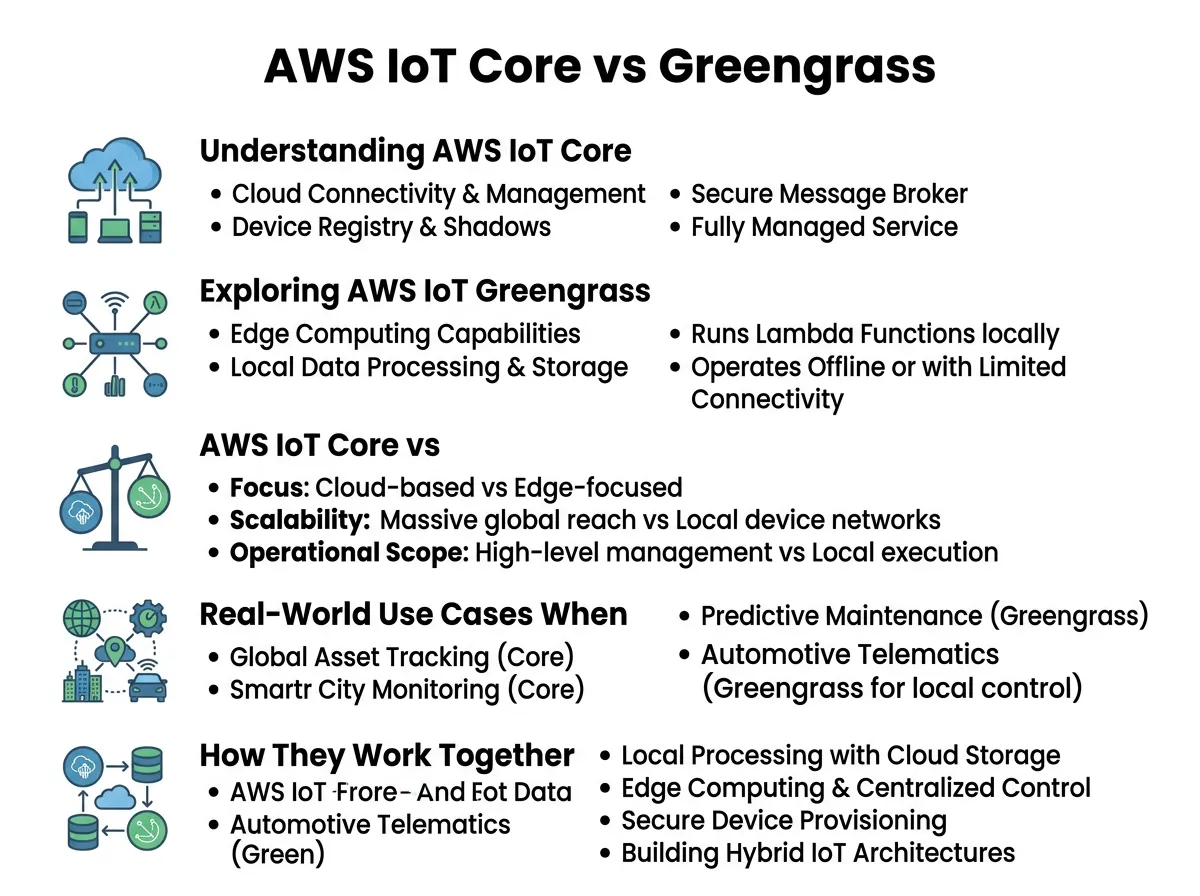
AWS IoT Core vs Greengrass: What Is the Difference? — key points at a glance
Why Edge Computing Matters
Edge computing means processing data close to where it is created. Instead of sending raw data to the cloud, you process it on-site. This saves a lot of internet bandwidth. It also cuts down on latency. If an industrial machine is about to overheat, you cannot wait for a cloud response. You need to turn it off in milliseconds. Greengrass lets you make these decisions locally. You can read more about these design patterns on the official AWS IoT Greengrass architectural patterns blog.
Key Features of AWS IoT Greengrass
Greengrass is software that you install on your own local device. It lets you run local code, like AWS Lambda functions or Docker containers. It can store data locally when the internet is down. Once the connection comes back, it syncs everything with the cloud automatically. It also allows local devices to talk to each other directly without needing to go to the web.
AWS IoT Core vs Greengrass: What Is the Difference?
Now, let us compare these two tools head-to-head. They are not rivals. Instead, they are two sides of the same coin. Still, they have distinct roles in your tech stack. To see how developers rate their everyday usability, you can also compare AWS IoT Core and Greengrass software specs online.
Cloud vs. Local Execution
AWS IoT Core runs strictly in the cloud. Your physical device just sends messages to it. It does not run any AWS software on your actual hardware. On the other hand, AWS IoT Greengrass is an “edge” runtime. It actually runs on your physical device. It turns your local hardware into a mini-cloud that can think on its own.
Internet Dependence and Offline Operation
This is the most critical difference. AWS IoT Core requires a constant web connection. If your internet connection breaks, your device cannot talk to IoT Core, and data flow stops. AWS IoT Greengrass does not need a constant connection. It can work offline for days or even weeks. It collects data, runs local logic, and saves it safely. When it finds a Wi-Fi or cellular signal, it sends the saved data up to the cloud.
Hardware Requirements and Costs
AWS IoT Core is very light on your device. Your hardware only needs enough power to send a simple network message. It can run on a tiny, cheap microchip. Greengrass is much heavier. It needs a real operating system like Linux or Windows. Your device must have a decent processor and enough RAM to run the Greengrass software. This means Greengrass hardware will cost you more upfront.
Real-World Use Cases: When to Choose Which?
Let us look at some simple stories. These will help you see how to use these tools in real life.
Best Scenarios for AWS IoT Core
Imagine you sell smart light bulbs for homes. These bulbs are always near a reliable home Wi-Fi network. They only need to do simple tasks, like turning on or changing color. They do not need to do complex math. For this project, AWS IoT Core is perfect. It is very cheap, easy to set up, and you do not need expensive chips inside the bulbs.
Best Scenarios for AWS IoT Greengrass
Now, imagine a big factory with fast robotic arms. If one arm gets stuck, the others must stop instantly to prevent a crash. You cannot wait for a cloud signal. Also, factories have a lot of metal and noise that can disrupt wireless signals. Here, you install Greengrass on a local control box. It manages the robots locally and safely. If the internet fails, the factory keeps running. This is a classic case where a control engineer would use edge computing. You can check out this AWS guide for control engineers to see how these setups work on the factory floor.
How They Work Together: The Hybrid Approach
Many people think they must choose only one of these services. This is a mistake. In fact, most advanced systems use both of them together. They work as a team to give you the best of both worlds.
Designing a Complete IoT Architecture
In a hybrid setup, your local sensors talk to your local Greengrass device. The Greengrass device processes the data and filters out the noise. For example, if a temperature sensor sends the same reading 1,000 times, Greengrass ignores the duplicates. It only keeps the changes. Then, Greengrass sends this clean, valuable data up to AWS IoT Core. This hybrid setup saves you a lot of money because you pay less for cloud storage and internet bandwidth.
Practical Tips for Your IoT Journey
Starting an IoT project can feel hard, but it does not have to be. Here are some simple tips to keep you on the right path.
- Start Small: If you are new to this, start with AWS IoT Core. It is very easy to set up, and you can connect a simple device in just a few minutes.
- Watch Your Costs: AWS IoT Core charges you by the number of messages. If your device sends a message every single second, your bill can grow fast. Try to group your data before sending it.
- Choose the Right Hardware: Do not buy expensive edge computers if your device only needs to send basic logs. Save Greengrass for when you truly need local logic, machine learning, or offline support.
- Keep Security in Mind: Both tools offer great security features. They use strong encryption and digital certificates. Always keep your security keys safe on your physical devices.
Conclusion
We have covered a lot today. AWS IoT Core is your bridge to the cloud. It is great for simple, connected devices that have a reliable internet connection. AWS IoT Greengrass is your local powerhouse. It is built for local action, high speed, and offline smarts. By knowing the difference, you can build smarter, cheaper, and faster systems. Choose the right tool for your specific needs, and enjoy building your next great project!
Frequently Asked Questions
Can AWS IoT Greengrass run without AWS IoT Core?
No, Greengrass still relies on AWS IoT Core for its initial setup, deployment, and cloud sync. It needs IoT Core to receive its configurations and send long-term data. They are designed to work together.
What kind of hardware does AWS IoT Greengrass need?
Greengrass needs a device that can run a full operating system like Linux or Windows. It is commonly installed on devices like a Raspberry Pi, industrial PCs, or smart gateways. It requires more RAM and CPU than a basic microchip.
Is AWS IoT Core cheaper than AWS IoT Greengrass?
Yes, the cloud costs for AWS IoT Core are very low for basic use because you only pay per message. However, Greengrass can save you money on bandwidth and cloud storage by filtering data locally. The right choice depends on how much data you send.
Can I run machine learning models on AWS IoT Greengrass?
Yes, this is one of its best features. Greengrass can run machine learning models locally on the edge device. This allows your device to make smart decisions instantly without needing a cloud connection.
Does AWS IoT Core support offline devices?
AWS IoT Core itself does not keep offline devices running locally. However, it uses a Device Shadow to store the last known state of an offline device in the cloud. For true local offline operation, you need AWS IoT Greengrass.
Can I use both AWS IoT Core and Greengrass in the same system?
Absolutely, and this is the best practice for many large systems. You can use Greengrass to handle local tasks and filter data at the edge. Then, Greengrass sends the refined data to AWS IoT Core in the cloud.
