

Finding the right connection for your smart devices can be tough. The best IoT SIM card in the USA depends on your needs, but multi-carrier roaming providers like Hologram, EMnify, and Soracom offer the most reliable coverage by connecting to AT&T, T-Mobile, and Verizon on a single card. For single-network projects with high data needs, direct plans from T-Mobile or AT&T are excellent choices.
Imagine you make a smart pet tracker. The collar tracks a dog as it runs around. If the dog runs into a forest, the signal might drop. If the signal drops, the owner cannot find their pet. This is a big problem for any smart device creator. You need a network connection that stays strong everywhere. You might ask yourself: What Is the Best IoT SIM Card in the USA? Let us explore the top options. We will make it easy to choose the right card for your project.
The world of connected devices is growing fast. We use smart sensors in farms, cities, and homes. All these devices need a way to send data. Standard phone plans do not work well here. You need a card built just for the Internet of Things (IoT). Let us dive into the details to help you find the best fit.
Key Takeaways
- Multi-Network SIMs are Best: They switch networks automatically to keep devices online.
- Avoid Consumer SIMs: Standard phone SIM cards lack the tools needed for smart devices.
- Data Pooling Saves Money: Sharing data among all devices prevents high extra fees.
- eSIMs Offer Safety: Soldered eSIM chips are great for outdoor and moving hardware.
- Test Before You Buy: Always try a few starter SIM cards in real-world spots first.
📑 Table of Contents
Why Standard SIM Cards Fail for IoT Devices
You might think about buying a cheap phone SIM card. It is simple to buy at a local store. But this is usually a bad idea for smart hardware. Phone SIM cards are made for human users who stay in populated areas.
The Multi-Carrier Problem
Smart devices often move around. They go inside thick concrete buildings. They travel to quiet rural roads. A standard SIM card only connects to one carrier. If you buy a T-Mobile SIM, it only uses T-Mobile towers. If you go to a spot with no T-Mobile service, your device dies. IoT SIM cards are different. They can connect to multiple networks. If one network is weak, they swap to another one.
Data Pooling and Management
When people ask us, what is the best IoT SIM card in the USA, we always tell them to look at data plans first. Standard plans give you one limit per line. If one device goes wild and uses too much data, you get a huge bill. IoT SIMs use a trick called data pooling. All your cards share one big pot of data. If one device uses a lot, and another uses none, it balances out. You also get a web dashboard. This tool lets you turn cards on or off from your computer.
The Top Contenders: Who Makes the Best IoT SIM Card in the USA?
There is no single card that is perfect for every single job. The best choice depends on what your device does. Let us look at the three main types of providers in the United States.
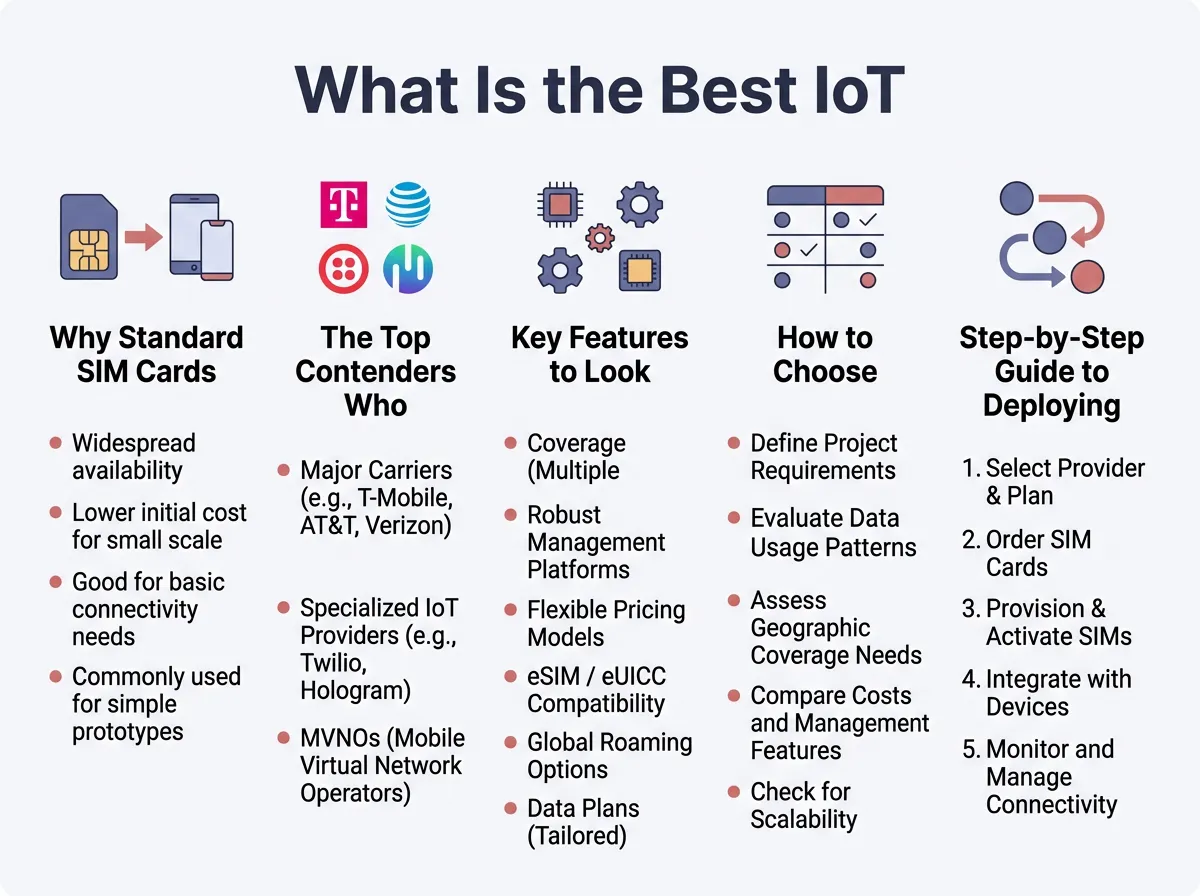
What Is the Best IoT SIM Card in the USA? — key points at a glance
1. Multi-Network MVNOs
An MVNO is a company that does not own cell towers. Instead, they buy space on big networks. They sell SIM cards that can use many networks. This makes them highly reliable.
- Hologram: Hologram is a top choice for many builders. Their SIM card can connect to AT&T, T-Mobile, and Verizon. It switches automatically. This is a great answer when searching for what is the best IoT SIM card in the USA for tracking assets.
- EMnify: EMnify offers great cloud tools. They let you connect your data directly to secure cloud systems. Their service is very reliable and has great security.
- Soracom: Soracom is perfect if you want to scale up fast. They offer great prices and very smart tools for software developers.
2. Major US Carriers
You can also buy directly from the big three networks in the USA. These are AT&T, Verizon, and T-Mobile. They have their own IoT departments.
- T-Mobile IoT: T-Mobile is known for fast 5G speeds. They offer great prices if you need to send a lot of data, like for video cameras.
- AT&T IoT: AT&T has very strong coverage for cars and transport. They work with many large fleet companies.
- Verizon IoT: Verizon has the best coverage in rural areas. If your devices are on farms or remote fields, Verizon is often the top choice.
3. Developer-Friendly Providers
If you are just starting, you do not want to sign a big contract. You want to buy one or two cards to play with. Twilio Super SIM and Particle are great for this. You can buy them online with no minimum order. Their setup is fast, and their online guides are very simple to read.
Key Features to Look For in an IoT SIM
When you shop for a card, you will see a lot of technical terms. Let us break them down into simple language.
Network Steering
Some cheap SIM cards are lazy. They stay on a weak network even when a stronger one is right next to them. You want a card with smart steering. This means the card always hunts for the best signal. It keeps your device fast and online.
Form Factors: Plastic vs. eSIM
SIM cards come in different shapes. You can get standard plastic cards in three sizes: standard, micro, and nano. But you can also get an eSIM. This is a tiny chip soldered directly onto your device’s circuit board. It cannot fall out. This is perfect for devices that shake, like bikes or industrial machines.
Security and Latency
Hackers love to attack smart devices. A good IoT SIM offers private APNs. This acts like a private tunnel for your data. It keeps your info safe from the public web. Also, check where the servers are. If you are in the USA, but your provider routes data through Europe, it will be slow. This delay is called latency. Always choose a provider with servers close to your devices.
How to Choose the Right Plan for Your Use Case
To find what is the best IoT SIM card in the USA for your business, you must look at how much data you need. Different projects have different needs.
Low-Data Projects
If you have a smart water meter, it only sends a few numbers once a day. You do not need high-speed 5G. You should look for LTE-M or NB-IoT networks. These are special slow networks. They use very little power. Your device battery can last for ten years on these plans. The data cost is very low, often under one dollar a month.
High-Data Projects
If you have a live dashcam in a delivery truck, you need regular LTE or 5G. You will need gigabytes of data. For this, look at direct plans from T-Mobile or AT&T. Their high-speed networks are built for big files.
Step-by-Step Guide to Deploying Your First IoT SIM
Ready to start? Follow these simple steps to keep your project on track.
First, buy a small testing kit. Do not buy one thousand cards on day one. Most providers sell developer kits with two or three SIMs.
Second, test your device in bad spots. Take it to a basement or a park. See if it stays online. Check how fast it connects when you turn it on.
Third, look at the management software. Is the website easy to use? Can you see your data usage clearly? If the software is confusing, you will have a hard time when you scale up.
Fourth, check the support team. If your devices go offline in the middle of the night, can you get quick help? Good support is worth every penny.
Conclusion
In the end, deciding what is the best IoT SIM card in the USA comes down to your data needs and physical location. If you want the most reliable connection that never drops, choose a multi-carrier option like Hologram or EMnify. If you need massive speed for video streaming, go with T-Mobile or Verizon. Always start small, test your devices in the real world, and choose a plan that can grow with your business. With the right SIM card, your smart devices will stay connected, safe, and ready to work.
Frequently Asked Questions
What is the difference between an IoT SIM and a regular SIM?
A regular SIM card connects to only one network and is made for phones. An IoT SIM card can connect to multiple networks, offers pooled data plans, and has a dashboard to manage many devices at once.
Can I use an IoT SIM card in my smartphone?
No, most IoT SIM cards are not made for phones. They do not support standard voice calls or normal text messaging, and carriers may block them if used in a phone.
What does multi-carrier roaming mean?
Multi-carrier roaming means your SIM card can connect to different networks like AT&T, T-Mobile, and Verizon. It will automatically switch to the strongest signal in the area.
What is an eSIM for IoT?
An eSIM is a tiny chip soldered directly onto your device’s board. It cannot be removed, which makes it very safe and great for outdoor or moving devices like tracking systems.
How much does an IoT SIM card plan cost?
For low-data devices like smart meters, plans can cost less than one dollar per month. For high-data devices like video cameras, plans can cost ten dollars or more depending on usage.
Do IoT SIM cards work in rural areas?
Yes, especially if you use a multi-network SIM card. It can search for any active tower nearby, whether it belongs to AT&T, T-Mobile, or Verizon, to keep your device online.
