

Choosing the right IoT cloud platform is crucial for connecting and managing your smart devices securely. The top industry leaders include AWS IoT Core, Microsoft Azure IoT Hub, and Google Cloud, which offer unmatched scalability, security, and integration features. By selecting the solution that fits your budget and technical needs, you can easily turn raw sensor data into valuable business insights.
Imagine you are building a brand-new smart home product. You have designed the hardware. The mobile app looks beautiful. But as you prepare to launch, a big question hits you. How will all these devices talk to each other safely? How will you handle millions of messages every second? This is where cloud platforms save the day.
It is easy to feel lost with so many tech giants and niche players in the market. In this guide, we will break down the top choices, explore their unique strengths, and help you find the perfect match. You will learn about their features, security, and how to pick the right one for your goals.
Key Takeaways
- Big Three Dominance: AWS, Microsoft Azure, and Google Cloud remain the undisputed leaders in the IoT cloud space.
- Scalability Matters: The best solutions grow with your business, allowing you to add thousands of smart devices without downtime.
- Security First: Top platforms offer robust end-to-end encryption, device authentication, and secure access controls.
- Edge Computing Integration: Modern IoT cloud setups rely heavily on edge computing to process data closer to the physical device.
- Cost Structure Variety: Pricing models vary from pay-as-you-go to tier-based systems, requiring careful planning before commitment.
- Niche Alternatives Exist: Beyond the tech giants, specialized platforms offer tailored solutions for specific industries like manufacturing and healthcare.
📑 Table of Contents
What Are the Best IoT Cloud Solutions for Beginners?
What Do These Platforms Actually Do?
Think of an IoT cloud platform as the brain of your smart network. Your physical devices are like hands and eyes. They collect data from the real world. However, they cannot do much with that data on their own. The cloud platform acts as a central hub. It receives the data, processes it, and tells the devices what to do next. According to market insights from IoT Analytics, the demand for these cloud systems is growing rapidly as businesses seek smarter ways to manage their hardware.
Key Components of a Great Cloud Solution
A great platform offers more than just a place to store data. It needs to provide device management, security, and data analytics. Device management lets you update software on thousands of machines at once. Security tools keep hackers away from your smart grid. Analytics tools turn messy raw numbers into clear, readable charts.
The Big Three: Heavyweights of the IoT Cloud
AWS IoT Core: The Market Pioneer
Amazon Web Services (AWS) is a massive name in the cloud world. Their IoT offering, AWS IoT Core, is incredibly popular. It lets you connect billions of devices and route trillions of messages without managing any servers. It supports open protocols like MQTT and HTTP. This makes it highly flexible. If you want to build custom applications on top of your hardware, looking into AWS IoT cloud platform solutions can give you a major head start. It integrates perfectly with other Amazon tools, like Alexa and AWS Lambda.
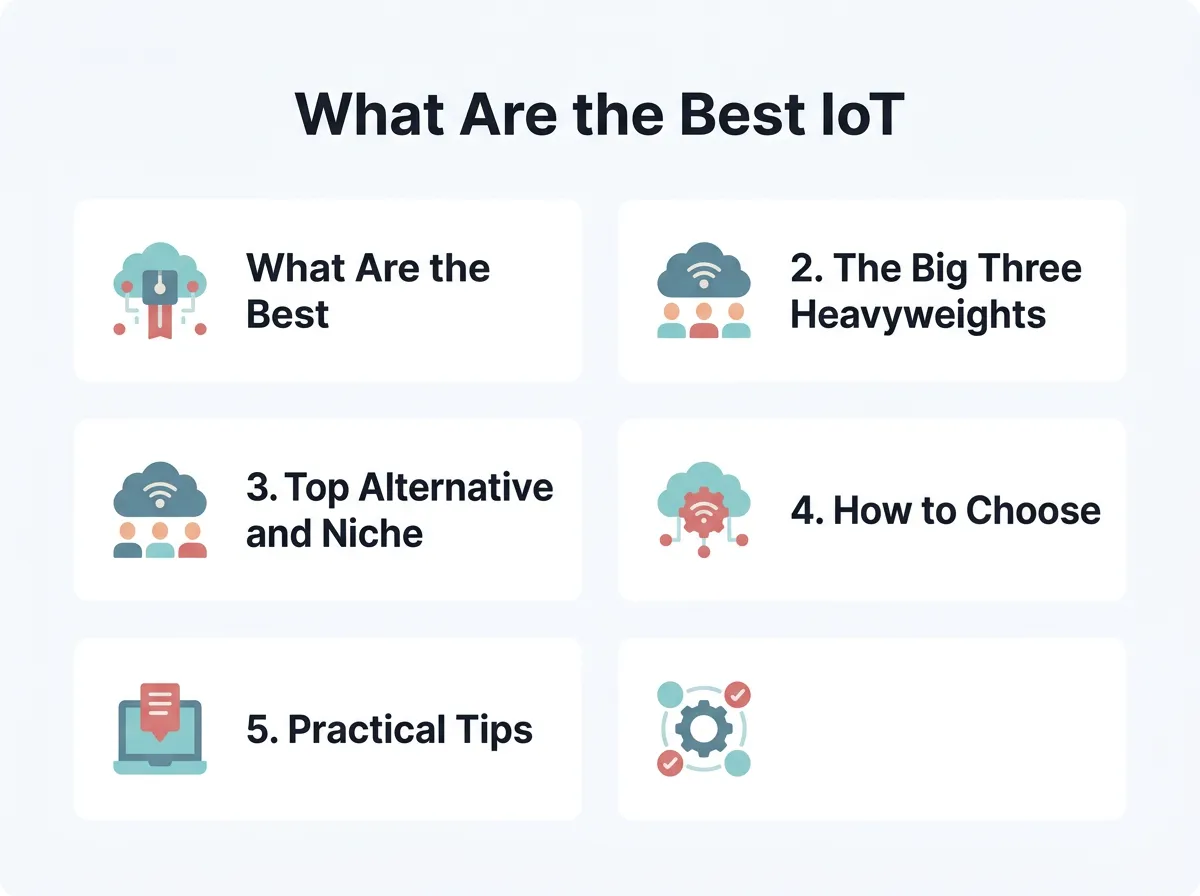
What Are the Best IoT Cloud Solutions? — key points at a glance
Microsoft Azure IoT Hub: The Enterprise Favorite
If your business already uses Microsoft tools, Azure IoT Hub is a natural fit. It is known for its world-class security and excellent enterprise integration. Azure makes it easy to build a digital twin. This is a virtual model of your physical device. You can test changes on the digital twin before pushing them to the real machine. Azure also shines when it comes to hybrid cloud setups.
Google Cloud IoT: The Data and Analytics Champion
Google Cloud is famous for its speed and intelligence. While they have shifted some of their direct device management services to partner networks, Google Cloud remains the gold standard for data processing. If your IoT project relies heavily on machine learning and artificial intelligence, Google is hard to beat. You can feed your sensor data directly into BigQuery to spot trends in real time.
Top Alternative and Niche IoT Platforms
Salesforce IoT: Customer-Centric Connectivity
Not every IoT project is about industrial machines. Sometimes, you want to improve customer service. Salesforce IoT connects your smart products directly to your customer relationship management (CRM) software. For example, if a smart washing machine detects an error code, it can automatically open a support ticket. It can even schedule a repair technician before the customer realizes there is a problem.
Oracle IoT: Built for Enterprise Operations
Oracle focuses heavily on supply chain and manufacturing. Their IoT applications are ready to use right out of the box. You do not have to write endless lines of code to get started. It helps logistics companies track shipments in real time, monitor cargo temperatures, and prevent equipment breakdowns.
How to Choose the Best Solution for Your Business
Assess Your Device Compatibility
Before signing any contracts, make sure your physical hardware can talk to the cloud. Some cheap microcontrollers only support basic protocols. When looking at what are the best IoT cloud solutions, check their developer documentation. Ensure they support your specific hardware and programming languages. To dive deeper into this decision process, check out this guide on choosing the best IoT cloud platform for your engineering team.
Look at the Total Cost of Ownership
Cloud pricing can be tricky. Most platforms charge based on the number of messages sent or the amount of data stored. A small project with ten sensors might cost pennies. But if those sensors start sending data every millisecond, your bill will skyrocket. Estimate your data usage early to avoid surprise charges at the end of the month.
Prioritize Security and Compliance
Smart devices are common targets for hackers. A single weak point can compromise your entire business network. Ensure your chosen platform offers end-to-end encryption. It should also have a clear way to rotate security certificates on your devices automatically. This keeps your user data safe and builds customer trust.
Practical Tips for a Smooth Migration
Start with a Small Pilot Project
Do not try to connect your entire factory on day one. Start with a small pilot project. Connect five or ten devices first. Learn how the data flows, test the security rules, and see how your team handles the new dashboard. Once you feel confident, you can scale up.
Plan Your Data Storage Needs Early
Do you need to keep every single sensor reading forever? Probably not. Storing hot data (data you need to access quickly) is expensive. Storing cold data (old data for archives) is cheap. Set up rules to move older data to cheap archive storage automatically after a few weeks. This simple step can save you thousands of dollars over time.
Conclusion
Finding the right partner for your smart network does not have to be overwhelming. When asking yourself what are the best IoT cloud solutions, remember to focus on your specific business goals. If you need massive scale and endless customization, AWS is a fantastic choice. For corporate environments, Azure offers unmatched stability. If you want to harness the power of artificial intelligence, Google Cloud is a top contender. Start small, budget carefully, and keep security at the center of everything you do. Your smart network will be up and running in no time!
Frequently Asked Questions
What is an IoT cloud platform?
An IoT cloud platform is a centralized service that helps smart devices connect, communicate, and exchange data securely over the internet. It handles device management, security, and data storage so you do not have to build server infrastructure from scratch. These platforms also offer analytics tools to help you make sense of your sensor data.
Which IoT cloud solution is the easiest for beginners?
AWS IoT Core and Microsoft Azure IoT Hub are both excellent for beginners because they offer extensive documentation, free tiers, and pre-built templates. These platforms also have massive global communities, making it easy to find tutorials and troubleshooting help online. Starting with their guided quick-start projects is highly recommended.
How do I secure my IoT devices in the cloud?
You can secure your devices by using strong, unique authentication certificates and enabling end-to-end encryption for all transmitted data. It is also important to regularly update your device firmware and use a cloud platform that supports role-based access control. Never use default passwords or unencrypted protocols.
What is the difference between AWS IoT and Google Cloud IoT?
AWS IoT focuses heavily on device connection, management, and integration with a massive ecosystem of cloud services. Google Cloud, on the other hand, excels in advanced data analytics, artificial intelligence, and machine learning tools. Many developers choose Google Cloud when their primary goal is processing massive amounts of data quickly.
Can I build my own IoT cloud solution?
Yes, you can build your own IoT cloud solution using open-source tools, but it is highly complex and expensive to maintain. Commercial cloud platforms already have built-in security, scalability, and device management features that would take years to develop yourself. For most businesses, using an established cloud provider is much more cost-effective.
How does edge computing relate to the IoT cloud?
Edge computing processes data directly on the local physical device or router instead of sending all raw data to the cloud. This reduces latency, saves internet bandwidth, and allows devices to function even when offline. The best IoT cloud solutions integrate edge computing to manage data processing efficiently.
