


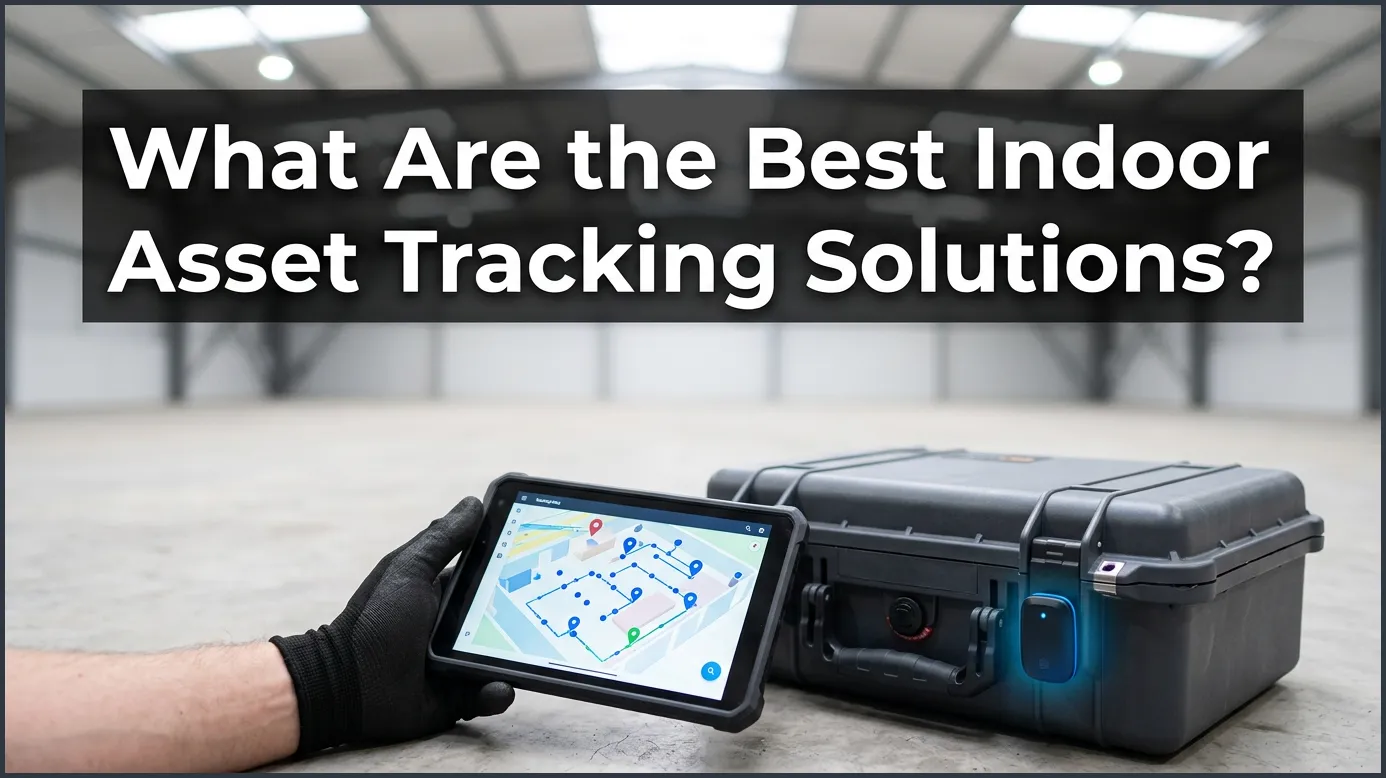
Finding the right technology to track your gear inside a facility can be a challenge. The best indoor asset tracking solutions use Bluetooth Low Energy (BLE) for low cost, Ultra-Wideband (UWB) for high precision, or Wi-Fi for using your existing network setup. Choosing the right system depends on your budget, accuracy needs, and environment.
Imagine walking onto a busy hospital floor or a massive warehouse. You need a specific medical cart or a specialized tool right away to finish your job. But nobody seems to know where it is. Employees wander the halls, checking room after room, wasting valuable time and getting frustrated. If this scenario sounds familiar, you are not alone. Many businesses face this exact problem every day, losing money and productivity to misplaced gear.
Fortunately, modern technology offers a smart way to solve this issue. Over the last few years, indoor tracking systems have evolved from luxury tools into essential business equipment. In this article, we will explore the top options on the market. We will break down how they work, look at real-world examples, and give you tips to choose the perfect fit for your needs.
Key Takeaways
- BLE is highly popular: It is the most cost-effective option and is very easy to set up.
- UWB offers extreme accuracy: Choose this technology if you need centimeter-level precision for high-value items.
- Wi-Fi saves hardware costs: It allows you to use your existing infrastructure, though it uses more battery power.
- RFID is perfect for bulk scanning: It is best for high-volume inventory checks at specific entry and exit points.
- Software matters as much as hardware: Look for a system with live maps, geofencing, and easy integrations.
📑 Table of Contents
Understanding Indoor Asset Tracking Technologies
Why do we need special tools for indoor tracking in the first place? Global Positioning System (GPS) technology is fantastic for outdoor navigation, but its signals struggle to pass through thick walls, steel beams, and concrete roofs. Because of this, businesses use different wireless technologies to locate items inside. Let us look at the most common options available today.
Bluetooth Low Energy (BLE)
BLE is currently the most popular choice for indoor tracking. It works by placing small, battery-powered tags or beacons on your assets. These beacons send out signals that nearby receivers pick up. Many companies choose BLE because the tags are inexpensive and can last for years on a single battery. You can learn more about how these options compare by reading about the best indoor asset tracking technologies available today.
Ultra-Wideband (UWB)
If you need extreme accuracy, UWB is the premier choice. While BLE can tell you if an item is in a specific room, UWB can pinpoint its location down to a few centimeters. It uses high-frequency radio waves to measure the exact distance between tags and anchors. It is perfect for tracking fast-moving items, safety gear, or high-value tools in crowded spaces where every inch matters.
Wi-Fi Positioning
Did you know you can use your existing office network to track assets? Wi-Fi tracking uses your current wireless access points to estimate where a device is located. This is a great option if you already have a strong Wi-Fi network and do not want to install new hardware on your walls. However, it is usually less accurate than BLE and UWB, and it tends to drain device batteries much faster.
Specialized Indoor Tracking Solutions
Beyond the standard wireless options, there are other specialized systems designed for specific jobs.
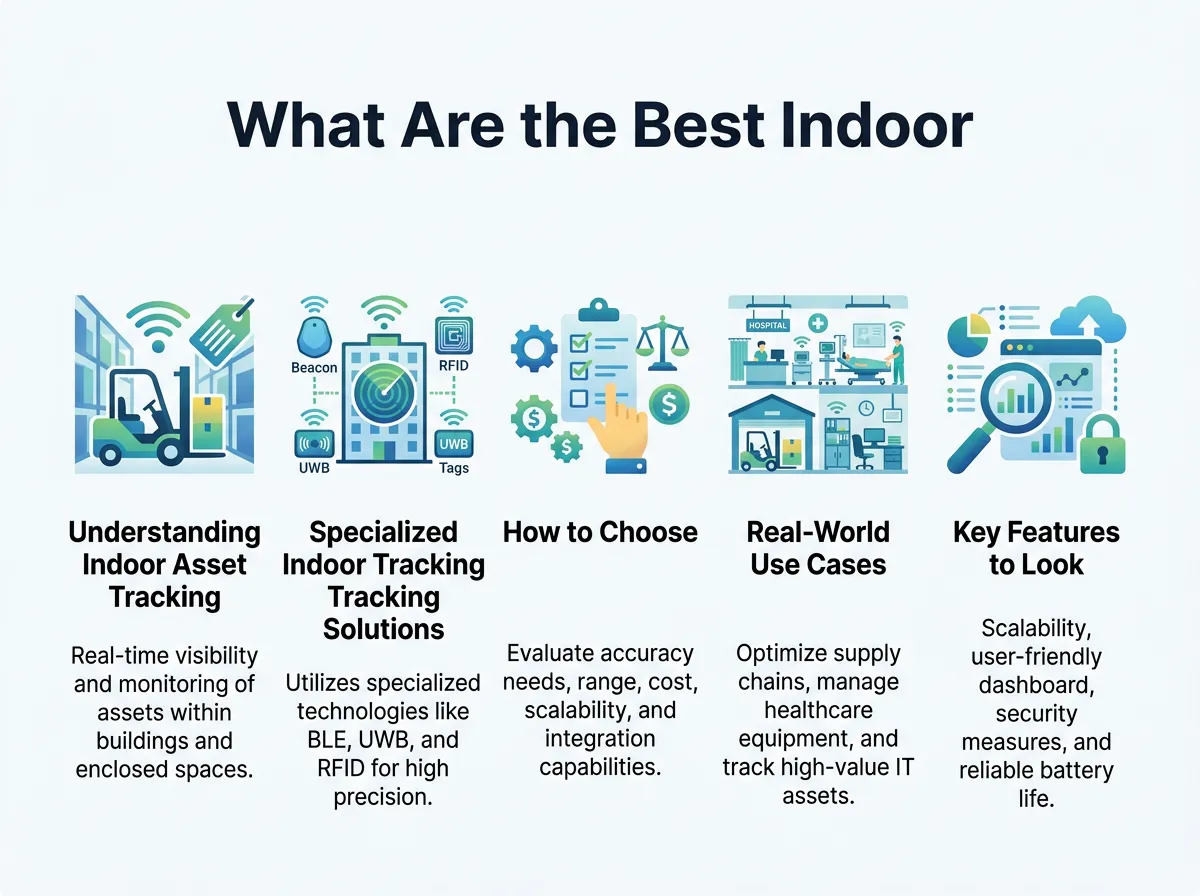
What Are the Best Indoor Asset Tracking Solutions? — key points at a glance
RFID (Radio Frequency Identification)
RFID has been a trusted tool for inventory management for decades. It uses passive tags, which do not need batteries, or active tags. When a tag passes near an RFID reader, the system logs its location. This is highly effective for retail inventory or tracking shipments as they move through specific doorways. However, it does not offer continuous, live tracking as the asset moves around a room.
Chirp Spread Spectrum (CSS)
CSS is another technology used in heavy industrial environments. It provides long-range coverage and handles radio interference very well. It is often used in shipyards, mines, or large factories where metal walls block other signals. It is highly robust but can be more complex to set up than standard Bluetooth systems.
How to Choose the Best Solution for Your Business
Finding the right fit depends on your unique business needs. There is no single system that works perfectly for everyone. Instead, you must balance several factors to make the right choice.
First, consider accuracy. Do you need to know which room an item is in, or do you need to know the exact shelf? For room-level accuracy, BLE is fantastic. For centimeter accuracy, go with UWB. Second, think about installation and upkeep. Some systems require you to mount many sensors on your walls, which can take time and money. Other systems are simple and plug-and-play. Many organizations find that using robust commercial asset tracking systems helps simplify this setup process.
Third, look at the total cost. Consider both the starting price and the long-term maintenance. Remember to factor in battery replacement costs for your tags over the next five years. To help you narrow down your search, ask yourself these quick questions:
- What is the size of the area we need to cover?
- How many assets do we need to track?
- Do we have a team to maintain the hardware, or do we need a managed service?
- Are there environmental challenges, like lots of metal walls or high temperatures?
Real-World Use Cases of Indoor Tracking
Let us look at how these systems work in daily life across different industries.
Healthcare and Hospitals
Hospitals are fast-paced environments where every second counts. Nurses use tracking systems to find ventilators, wheelchairs, and infusion pumps instantly. This saves hours of search time and ensures patients get care faster. It also helps hospital management know when equipment is sitting idle so they do not buy unnecessary extras.
Manufacturing and Warehousing
In a busy warehouse, forklift operators can waste hours looking for specific pallets. By using real-time location systems (RTLS), managers can view a live map of all inventory and equipment. This streamlines the assembly line, prevents costly delays, and keeps workers safe by preventing collisions.
Corporate Offices and IT Departments
Some companies use tracking tags to monitor shared laptops, high-end AV equipment, or important physical documents. This prevents theft, improves accountability, and ensures tools are always where they belong when a team member needs them.
Key Features to Look For in a Tracking Platform
Hardware is only half of the equation. You also need software to make sense of the data. When shopping for a tracking platform, look for these key features:
- Live Map Views: A user-friendly dashboard should show you where your assets are on a digital floor plan in real-time.
- Geofencing: This feature lets you draw virtual boundaries. If an asset leaves a designated area, you get an instant email or text alert.
- Battery Life Monitoring: The software should warn you when a tag’s battery is running low so you can replace it before the tag goes offline.
- Easy Integration: Ensure the tracking software can connect with your existing ERP, maintenance, or warehouse management tools.
Many modern teams use real-time indoor positioning platforms to manage these tasks in one place, combining hardware and software into a single, simple dashboard.
Future Trends in Indoor Positioning
The world of indoor tracking is evolving quickly. In the coming years, we will see even smarter systems. We are starting to see hybrid tags that combine BLE, GPS, and cellular tracking. This allows a single tag to track an item smoothly as it moves from an indoor factory, onto a delivery truck outside, and into a retail store across the country.
Artificial intelligence is also playing a major role. AI can analyze movement patterns to predict when a machine needs maintenance or to optimize the layout of a warehouse floor based on traffic. This will make businesses even more efficient and safe.
Conclusion
Finding the best indoor tracking solution does not have to be overwhelming. By understanding your budget, accuracy needs, and infrastructure, you can choose a system that saves you time and money. Whether you pick BLE for its affordability or UWB for its high precision, the right platform will help you take control of your operations and keep your business running smoothly. Start by testing a small pilot program to see what works best for your team!
Frequently Asked Questions
What is the most accurate indoor tracking technology?
Ultra-Wideband (UWB) is the most accurate technology, offering precision down to a few centimeters. It is ideal for high-value assets and situations where exact location is critical. However, it is generally more expensive to set up than other technologies.
Can I use GPS for indoor asset tracking?
No, standard GPS signals are usually too weak to penetrate building walls and roofs. Indoor tracking solutions rely on local wireless networks like BLE, UWB, or Wi-Fi to locate assets inside a facility.
How long do indoor tracking tag batteries last?
Battery life depends on the technology and how often the tag sends updates. BLE tags can last anywhere from 2 to 5 years, while active RFID and UWB tags may need battery replacements more frequently depending on usage.
What is the difference between active and passive RFID?
Active RFID tags have their own battery and transmit signals continuously over long distances. Passive RFID tags do not have a battery; they are powered by the radio energy sent from an RFID reader when they pass close by.
Do indoor asset tracking solutions require a lot of maintenance?
Most modern systems require very little maintenance once installed. The main tasks include occasionally replacing tag batteries and updating the software platform to ensure security and performance.
Can BLE signals pass through walls?
Yes, BLE signals can pass through standard walls, but thick concrete, brick, or metal walls can weaken the signal. System installers place receivers strategically to ensure complete coverage regardless of building materials.
