


The Global M2M Association (GMA) simplifies international IoT deployment through its key operator members—including Deutsche Telekom, Orange, Telecom Italia, Telia Company, and SoftBank. These industry giants offer extensive NB-IoT and LTE-M roaming across Europe and Asia, allowing businesses to connect low-power devices seamlessly across multiple borders. By leveraging joint roaming agreements, GMA members ensure your smart devices stay online without the hassle of managing multiple local SIM cards.
Imagine launching a smart fleet of shipping containers. They need to travel from a port in Germany to the busy streets of Tokyo. Along the way, your sensors must track temperature, humidity, and location in real-time. If your connection drops when crossing a border, your data disappears. This is why global IoT roaming is so important for businesses today.
To solve this puzzle, major telecom companies teamed up. They formed a powerful alliance known as the Global M2M Association (GMA). In this guide, we will explore which Global M2M Association Members Support NB-IoT and LTE-M Roaming in Asia and Europe. We will look at how they keep your devices connected across oceans and continents.
We will also break down the differences between these technologies. You will learn how simple roaming agreements save you time, money, and stress. Let us dive into the world of seamless global IoT connectivity!
Key Takeaways
- Seamless Cross-Border Connectivity: GMA members like Deutsche Telekom, Orange, and Telia provide massive NB-IoT and LTE-M roaming footprints across Europe and Asia.
- Low-Power WAN Benefits: Cellular LPWAN technologies offer long battery life and deep indoor penetration, making them perfect for smart tracking.
- Simplified Contracts: Working with a single GMA member allows businesses to deploy IoT devices globally under one unified contract.
- Broad European Coverage: Orange and Deutsche Telekom lead the charge in Europe, offering robust national and international roaming.
- Growing Asian Footprint: SoftBank is expanding regional LPWAN roaming options, linking key Asian markets to European networks.
- Future-Proof Operations: Multi-network agreements ensure devices automatically switch to the best available cellular signal.
📑 Table of Contents
What is the Global M2M Association (GMA)?
The Global M2M Association is a group of leading mobile operators. They work together to deliver joint machine-to-machine (M2M) and IoT services. The main members include Deutsche Telekom, Orange, Telecom Italia (TIM), Telia Company, SoftBank, and Bell Canada. These companies are giants in their respective regions.
The Power of Joint Cooperation
Instead of dealing with six different carriers, the GMA offers a unified approach. They share network resources and technologies. This means your devices get high-quality service wherever they travel. They can use local networks without needing a new physical SIM card. This is a game-changer for logistics companies.
A Focus on Low-Power Networks
In recent years, the GMA has focused heavily on low-power wide-area networks (LPWAN). Specifically, they focus on NB-IoT and LTE-M. These technologies are built for devices that do not need to send much data but need to run on battery power for years. The GMA ensures these technologies work across borders.
Deciding Between NB-IoT and LTE-M for Global Roaming
Before looking at specific members, it helps to understand the two main technologies. NB-IoT and LTE-M serve different purposes. Choosing the right one depends on your business goals.
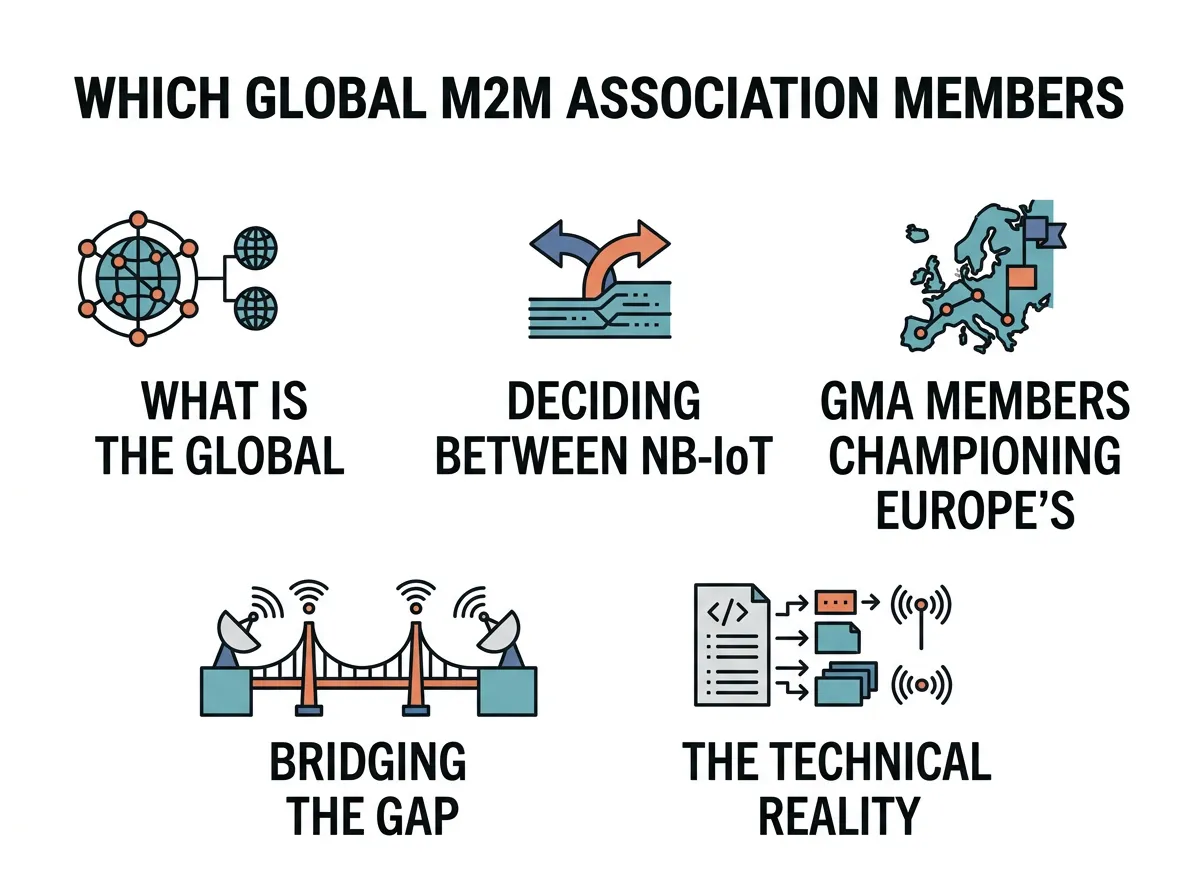
Which Global M2M Association Members Support NB-IoT and LTE-M Roaming in Asia and Europe? — key points at a glance
NB-IoT (Narrowband IoT)
NB-IoT is great for static devices. It is perfect for smart water meters, trash bin sensors, and agricultural monitors. It has deep indoor penetration. This means it can send signals from underground basements. However, it does not handle moving objects very well. It also has very low data speeds.
LTE-M (Long Term Evolution for Machines)
LTE-M is built for mobility. It supports seamless handover between cell towers. This makes it perfect for tracking trucks, shipments, and pets. It also supports voice features and has higher data speeds than NB-IoT. To understand how these technologies work in the real world, you can read more about the current LPWAN roaming status and deployments across various continents.
Why Roaming Matters for Low-Power Networks
In the past, roaming on cellular networks was designed for smartphones. It used a lot of battery power. Today, mobile operators have optimized their networks. They now support power-saving features like eDRX and PSM while roaming. This keeps your device batteries alive for up to ten years.
GMA Members Championing Europe’s LPWAN Footprint
Europe is a leader in LPWAN deployment. The GMA members in this region have built massive networks. They have also signed extensive roaming agreements with each other.
Deutsche Telekom
Deutsche Telekom has an impressive footprint. They offer extensive NB-IoT and LTE-M networks across Germany and many other European countries. They have signed roaming agreements with dozens of operators. This allows your devices to cross borders from Germany to Poland or Spain without losing connection.
Orange
Orange is another heavy hitter in Europe. They have built an incredibly strong LTE-M network in France, Spain, and Belgium. Their roaming agreements extend deep into other European nations, giving businesses reliable access. You can view global LTE-M coverage options to see how these networks link up. Orange also supports NB-IoT roaming in several key markets.
Telia Company and Telecom Italia (TIM)
Telia covers the Nordic and Baltic regions. They are pioneers in smart city and agricultural IoT. Meanwhile, Telecom Italia (TIM) provides stellar coverage in Southern Europe. Together, these operators cover almost every corner of the European continent. They allow seamless transitions as your goods travel from North to South.
Bridging the Gap to Asia with SoftBank
Moving your operations to Asia requires a reliable partner. In the GMA, SoftBank is the key player for this region. SoftBank operates a premium network in Japan.
Connecting Europe and Asia
SoftBank works closely with European GMA members. They have set up strong roaming corridors. This means a device built and tested in Europe can be shipped to Japan. It will connect to SoftBank’s network immediately upon arrival. There is no need for manual configuration or local testing.
The Asian LPWAN Landscape
While SoftBank covers Japan, other partners extend this coverage. They use roaming agreements to reach South Korea, Taiwan, and Singapore. This massive web of networks makes global logistics much easier to manage. It reduces the risk of lost shipments in busy Asian ports.
The Technical Reality of LPWAN Roaming
Roaming is not always automatic. It requires specific hardware and software configurations. You must plan ahead to ensure success.
Hardware Compatibility
Your devices must support the correct frequency bands. Europe uses different bands than Asia. Ensure your hardware has a multi-band modem. This allows the device to switch frequencies depending on its location. Also, keep your firmware updated to support global power-saving states.
For detailed technical setups, check out the technical roaming guidelines for mobile IoT networks. This helps developers configure their modems correctly for international travel.
Multi-IMSI and eSIM Roaming
Many GMA members use advanced eSIM technology. This lets you change carrier profiles over the air. It provides a safety net if a roaming agreement changes in the future. To see a detailed breakdown of how coverage works for various regions, refer to the detailed IoT coverage specifications.
How to Choose the Right GMA Partner for Your Project
Choosing the right partner depends on your specific needs. Here are a few tips to help you make the right choice.
Look at Your Main Deployment Hub
If most of your devices start their journey in Europe, partnering with Orange or Deutsche Telekom is smart. If your main hub is in Asia, SoftBank is your best entry point. They can guide you through local regulations and customs.
Check the Battery Requirements
Make sure your chosen operator supports power-saving features in their roaming agreements. Not all networks support PSM (Power Saving Mode) while roaming. If battery life is your top priority, double-check this technical detail with your provider before signing a contract.
Conclusion
Global M2M Association members provide a fantastic bridge between Europe and Asia. By combining their networks, they make complex global rollouts simple. Whether you choose Deutsche Telekom, Orange, Telia, or SoftBank, you get access to a massive footprint. This ensures your NB-IoT and LTE-M devices stay connected, no matter where they travel. Plan your hardware carefully, choose the right partner, and watch your global IoT project thrive!
Frequently Asked Questions
Which GMA members offer the best LPWAN coverage in Europe?
Deutsche Telekom and Orange offer the most extensive LPWAN coverage in Europe. They have built robust domestic networks and established deep roaming agreements across the continent. Telia also provides excellent coverage in the Nordic and Baltic regions.
Does SoftBank support LTE-M roaming for European devices?
Yes, SoftBank supports LTE-M roaming for devices coming from Europe. Thanks to agreements with GMA partners, European-configured devices can connect to SoftBank’s network in Japan. This is highly useful for global asset tracking.
Can my NB-IoT device roam between Europe and Asia automatically?
Yes, but your device hardware must support the correct regional frequency bands. You should also ensure your connectivity provider has active NB-IoT roaming agreements in both regions. Checking these details beforehand avoids connectivity issues.
What is the benefit of using GMA members over standard roaming?
GMA members offer pre-tested, high-quality roaming agreements with optimized technical support. This reduces setup times and ensures features like power-saving modes work across borders. It also allows you to manage everything under a single contract.
Do GMA roaming agreements support power-saving features?
Yes, many GMA roaming agreements support power-saving features like PSM and eDRX. However, support can vary depending on the local visited network. It is always best to verify support with your primary carrier before deployment.
How do I manage eSIMs across different GMA networks?
You can manage eSIMs through a unified connectivity management platform provided by your chosen GMA member. This platform allows you to download new profiles and monitor device status globally over the air. It simplifies operations significantly.
