

T-Mobile IoT plans are specialized cellular data packages designed to connect smart devices, sensors, and machines to the internet. These plans leverage T-Mobile’s national 4G LTE and 5G networks to provide reliable, low-cost connectivity for businesses of all sizes. By offering flexible data tiers and robust management tools, they make it easy to scale smart technology deployments seamlessly.
Imagine a world where your trash cans tell the city when they are full. Or picture a shipping container that alerts you the moment its internal temperature gets too warm. This is not science fiction. It is the reality of the Internet of Things (IoT). Today, millions of smart devices communicate with each other every second. They track assets, monitor health, and automate factories.
But to make this magic happen, these smart devices need a reliable way to talk to the internet. Standard cell phone plans are too expensive and power-hungry for a simple sensor. That is where specialized cellular data packages come into play. When you first start looking into connecting your business devices, you might ask yourself: What Are T-Mobile IoT Plans?
In this guide, we will break down everything you need to know about these plans. We will explore how they work, the networks they use, and how they can help your business grow. Let us dive in and demystify cellular IoT connectivity.
Key Takeaways
- Purpose-Built Connectivity: Unlike standard phone plans, these plans are specifically tailored for machine-to-machine (M2M) communication.
- Network Diversity: They utilize NB-IoT, LTE-M, and ultra-fast 5G networks to match different device requirements.
- Cost Efficiency: Flexible, low-data packages prevent businesses from paying for unused gigabytes.
- Centralized Management: Users gain access to dedicated control portals to monitor and manage all active SIM cards in real time.
- Scalability: The plans support quick scaling, making them ideal for startups and massive enterprises alike.
📑 Table of Contents
The Basics of IoT Connectivity
To understand what these plans are, we must first look at how smart devices communicate. Most of us are used to smartphones that stream high-definition video. Those phones require massive amounts of data. IoT devices, however, are very different. Many of them only need to send tiny packets of information once or twice a day.
For example, a smart water meter might only send a single text-like reading every 24 hours. Using a standard consumer data plan for this would be a waste of money. It would also drain the device battery in a matter of days. Specialized IoT plans solve this problem by offering micro-data packages and using power-saving network technologies.
Why Wi-Fi Isn’t Always Enough
You might wonder why businesses do not just use Wi-Fi. While Wi-Fi is great for homes and offices, it has major limits. It has a short range, and it can easily drop its connection. If the power goes out, your Wi-Fi goes down too. Cellular IoT offers a secure, always-on connection that works almost anywhere, even in remote fields or moving trucks.
Exploring the Network Technologies
To fully understand What Are T-Mobile IoT Plans, it helps to look at the network technologies behind them. T-Mobile does not just offer one type of connection. They offer a mix of advanced network technologies to fit different device needs.
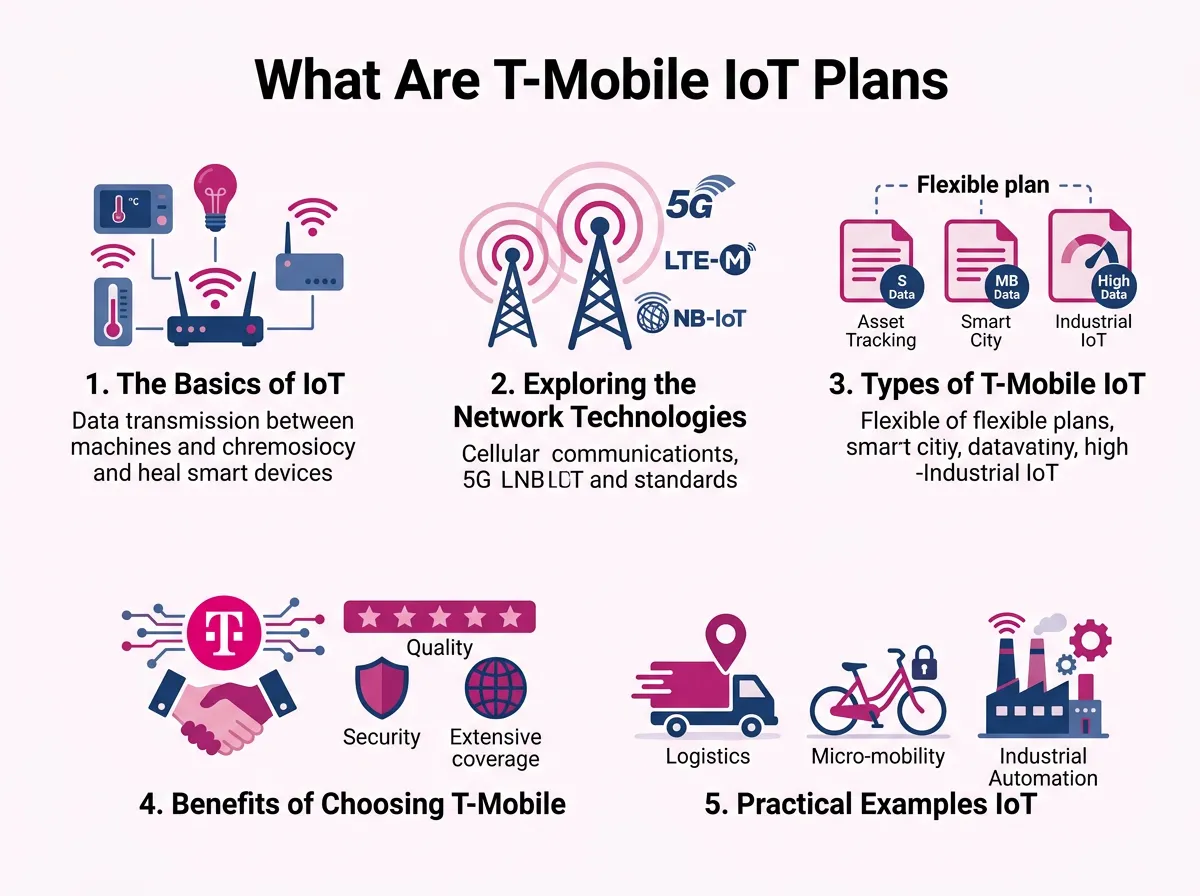
What Are T-Mobile IoT Plans? — key points at a glance
Narrowband IoT (NB-IoT)
NB-IoT is a specialized network built for simple devices. It is designed for low-power, low-data applications. It can penetrate deep underground and through thick concrete walls. This makes it perfect for utility meters, soil sensors, and smart city infrastructure. It also uses very little battery power, allowing some devices to last for up to ten years on a single charge.
LTE-M (Long-Term Evolution for Machines)
LTE-M is another low-power network, but it has more bandwidth than NB-IoT. It supports voice features and can handle moving objects much better. If you need to track a delivery truck across the country, LTE-M is often the best choice. It balances low power consumption with reliable, mobile data transfers.
High-Speed 4G LTE and 5G IoT
Some smart devices actually do need a lot of data. Think of security cameras streaming live video or self-driving cars navigating city streets. For these high-demand tasks, T-Mobile provides access to their nationwide 4G LTE and ultra-fast 5G networks. This ensures low latency and high speeds for critical real-time data.
Types of T-Mobile IoT Plans and Pricing
So, What Are T-Mobile IoT Plans doing differently in the pricing department? The biggest difference is flexibility. T-Mobile offers flexible pricing structures that scale with your business. Instead of a one-size-fits-all plan, you can choose a package that matches your exact data needs.
Micro-Data Plans
These plans are designed for devices that only send small updates. They often offer data pools as small as 100 Kilobytes to a few Megabytes per month. Because the data usage is so low, these plans are incredibly cheap. They allow businesses to connect thousands of sensors without breaking the bank.
High-Bandwidth Plans
If you are running digital signs, retail kiosks, or mobile hotspots, you will need a high-bandwidth plan. These plans offer multiple Gigabytes of data. They ensure your heavy-use devices always stay online and run smoothly.
Shared Data Pools
One of the best features of these plans is data pooling. Instead of buying a strict limit for each individual SIM card, you can pool your data together. If you have 100 devices and each gets 10 Megabytes, you have a total pool of 1,000 Megabytes. If one device uses a bit more data and another uses less, they balance each other out. This prevents unexpected overage fees.
Benefits of Choosing T-Mobile for IoT
If you are asking What Are T-Mobile IoT Plans and how they benefit your daily operations, the answer lies in their sheer scale. T-Mobile is a major player in the wireless space, and they bring significant advantages to the table.
By leveraging the comprehensive T-Mobile IoT solutions portfolio, businesses can access a massive, nationwide network. This means your devices will stay connected whether they are in a busy downtown area or a rural farmland.
The Control Center Portal
Managing five smart devices is easy. Managing five thousand is a different story. T-Mobile provides businesses with a central online dashboard. From this portal, you can activate new SIM cards, monitor data usage, and set up alerts. If a device starts using too much data, you can pause its connection instantly with the click of a button.
Security You Can Trust
Sending sensitive business data over public networks can be risky. T-Mobile builds advanced security features directly into their IoT services. They offer private networks, virtual private networks (VPNs), and secure data routing. This keeps your business information safe from hackers and unauthorized access.
Practical Examples: IoT in Action
To truly appreciate What Are T-Mobile IoT Plans, let us look at some real-world examples of how businesses use them every day.
Smart Agriculture
Farmers place sensors in their soil to measure moisture, temperature, and nutrient levels. These sensors use low-cost NB-IoT plans to send updates to the farmer’s phone. This helps the farmer save water and grow healthier crops without ever having to step foot in the field.
Asset Tracking
Logistics companies place small trackers on high-value cargo. These trackers monitor the location and condition of the goods in real time. Because the trackers travel across different states, they rely on T-Mobile’s nationwide network to stay connected constantly.
Smart Retail
Modern vending machines and retail kiosks do more than just hold snacks. They track inventory, process credit card payments, and display digital ads. A medium-bandwidth plan keeps these machines online, secure, and ready to make a sale.
How to Choose the Right Plan
When deciding What Are T-Mobile IoT Plans that fit your operations, you should consider three key elements. Planning ahead will save you money and prevent future technical headaches.
- Assess Your Data Needs: Determine exactly how much data your devices will send. Do not buy a high-bandwidth plan if a micro-data plan will do the trick.
- Check the Hardware: Make sure you choose compatible IoT devices that can connect to T-Mobile’s specific network frequencies.
- Consider the Location: Ensure the areas where you deploy your devices have strong T-Mobile network coverage, especially if you plan to use low-power NB-IoT networks.
Conclusion
Connecting the physical world to the digital space is no longer a luxury. It is a vital step for modern businesses. Whether you want to track a fleet of trucks, monitor agricultural fields, or run smart vending machines, cellular connectivity is the key to your success.
Now that you can explain What Are T-Mobile IoT Plans to your team, it is time to take action. Evaluate your smart devices, estimate your data needs, and choose a plan that helps your business grow. With the right network partner, the possibilities for your business are virtually limitless.
Frequently Asked Questions
What Are T-Mobile IoT Plans?
T-Mobile IoT plans are specialized wireless data packages designed to connect smart machines and sensors to the internet. They use T-Mobile’s nationwide 4G and 5G networks to offer low-cost, reliable, and secure data transmission. These plans are tailored specifically for business and industrial use rather than personal cell phones.
Can I use a standard phone SIM card in an IoT device?
While a standard SIM card might physically fit, it is not recommended for IoT devices. Standard phone plans are expensive and optimized for voice and high-speed streaming, which wastes money on simple sensors. IoT plans offer much cheaper, low-data options and grant access to dedicated device management tools.
What is the difference between NB-IoT and LTE-M?
NB-IoT is a highly energy-efficient network designed for stationary, low-data devices like smart meters that need deep signal penetration. LTE-M offers slightly higher data speeds and better support for moving assets, making it ideal for tracking shipments or vehicles. T-Mobile supports both technologies to give businesses maximum flexibility.
How do I manage hundreds of T-Mobile IoT SIM cards?
T-Mobile provides businesses with a centralized online management portal often called the Control Center. This platform allows you to activate, monitor, and suspend SIM cards remotely in real time. You can also set up automatic data usage alerts to prevent unexpected overage charges on your bill.
Do T-Mobile IoT plans support 5G connectivity?
Yes, T-Mobile offers high-bandwidth IoT plans that utilize their nationwide 5G network. These plans are designed for data-heavy applications that require ultra-low latency, such as security cameras or robotics. For simpler devices, low-power 4G LTE options are also available.
Can I pool data across multiple IoT devices?
Yes, T-Mobile offers shared data pools for business IoT accounts. Instead of buying individual data limits for each sensor, your total data allowance is shared across all active SIM cards. This helps balance out devices that use slightly more data with those that use less, saving you money.
