


Outdoor people counting sensors often lose accuracy due to unpredictable environmental factors like changing weather, poor lighting, and harsh shadows. Additionally, crowded group behaviors and improper sensor placement can easily trigger false readings or missed counts. Understanding these key challenges is essential for choosing and maintaining the right sensor technology for your public space.
Imagine standing in a beautiful, sunny park. You see families walking down the trails, runners pacing themselves, and friends chatting on benches. To keep this park clean, safe, and well-funded, the city installs smart sensors. These devices count how many visitors arrive each day. But when the city staff look at the weekly report, the numbers look very strange. They show thousands of visitors at midnight during a freezing snowstorm. Why does this happen?
If you manage a public park, a busy downtown street, or an outdoor shopping center, accurate foot traffic data is your lifeblood. It helps you schedule cleaning crews, plan budget requests, and organize community events. Yet, tracking people outdoors is much harder than tracking them inside a quiet office. There are many hidden challenges that can easily disrupt your data systems.
To fix these issues, you must ask: What Causes Inaccuracies in Outdoor People Counting Sensors? In this article, we will explore the major environmental, behavioral, and technical factors that mess with your visitor data. We will also share simple, practical tips to help you get the most accurate counts possible.
Key Takeaways
- Weather Interference: Heavy rain, thick snow, and wind-blown tree branches block views and trigger false counts.
- Lighting Struggles: Sunrise, sunset, and nighttime darkness confuse standard camera-based sensors.
- Group Occlusion: People walking close together or side-by-side often get counted as a single person.
- Mounting Height Matters: Placing sensors too high or too low, or at the wrong tilt angle, heavily reduces data accuracy.
- Technology Matters: Upgrading to advanced systems like radar or LiDAR helps bypass environmental errors.
📑 Table of Contents
1. Extreme Weather and Changing Seasons
When studying What Causes Inaccuracies in Outdoor People Counting Sensors, we have to start with mother nature. Indoor sensors enjoy a cozy, stable climate. Outdoor sensors, however, must brave the elements every single day. Heavy rain, thick snow, and dense fog can block a sensor’s line of sight. This makes it very hard for the device to see or detect passing visitors.
The Rain and Snow Dilemma
Water droplets on a camera lens can blur the image completely. For optical sensors, this blur makes humans look like big, fuzzy blobs. The software might ignore them entirely. Heavy snow can also pile up on top of the sensor housing. If snow hangs over the lens, the sensor is essentially blinded until the snow melts or someone cleans it.
Wind and Moving Foliage
Wind does not directly affect a sensor, but it moves everything else around it. Think about tree branches, leaves, and hanging banners. When a strong gust of wind blows, these objects wave back and forth. Basic motion sensors might mistake a swaying branch for a walking human. This leads to a massive number of false-positive counts.
2. Lighting and Shadow Interference
Lighting changes constantly throughout the day. In the morning, you have bright, direct sunlight. By noon, the sun is directly overhead. In the evening, the light slowly fades into total darkness. These constant shifts create huge challenges for visual counting devices.
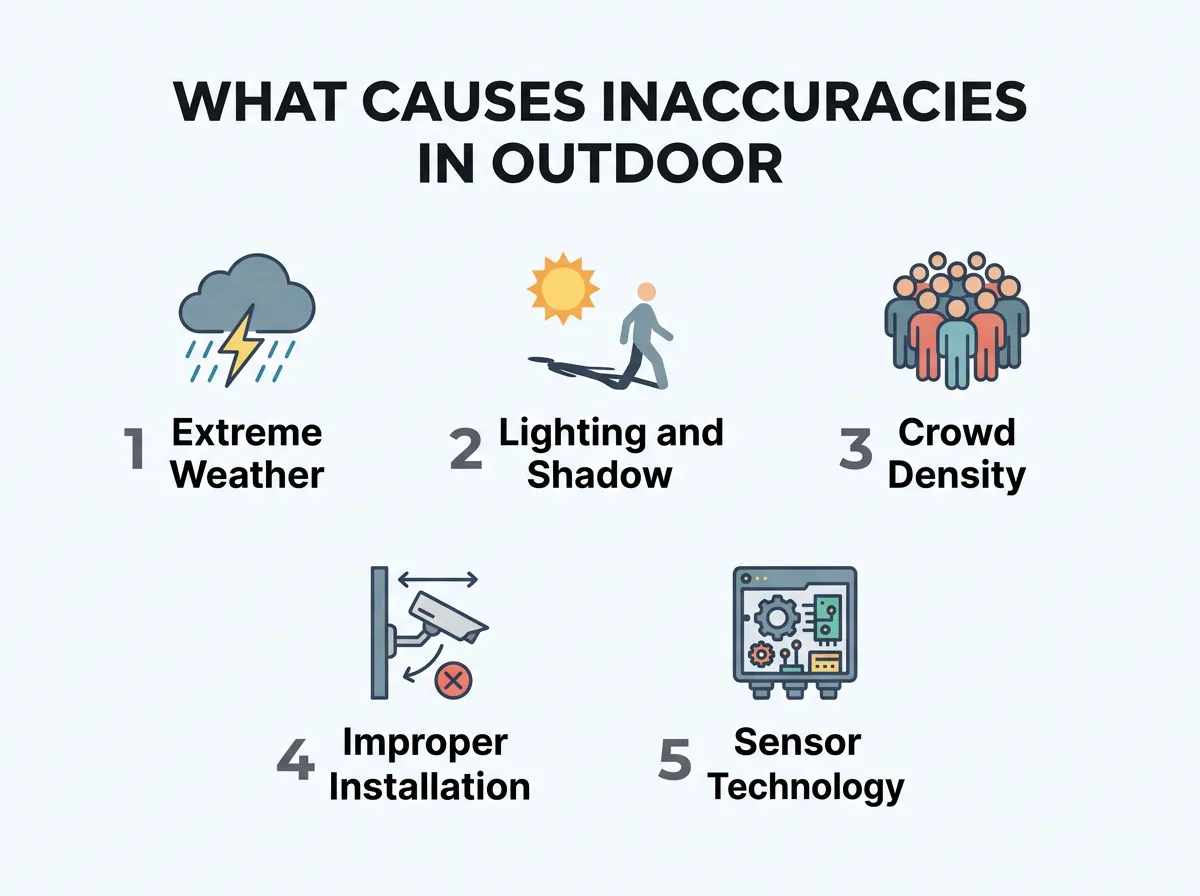
What Causes Inaccuracies in Outdoor People Counting Sensors? — key points at a glance
The Shift from Day to Night
Standard optical cameras need visible light to see. When the sun goes down, their counting accuracy drops quickly. Some sensors try to switch to night-vision mode, but this transition can cause gaps in your data. Luckily, modern systems show us how to count people accurately even when it is completely dark, but cheaper or older sensors still struggle when the sun sets.
How Harsh Shadows Trick the Lens
Long shadows are a major enemy of outdoor people counters. During sunrise and sunset, the low sun stretches human shadows across the ground. A camera-based sensor might look at a person and their long shadow and count them as two separate people. Alternatively, it might get confused by the fast-moving dark shapes and fail to count anyone at all.
3. Crowd Density and Group Dynamics
If you want to understand What Causes Inaccuracies in Outdoor People Counting Sensors, you must look at how groups of humans move. People rarely walk in neat, single-file lines. They walk in pairs, hold hands, push strollers, and gather in large crowds. This natural human behavior can easily trick even the smartest sensors.
The Occlusion Problem
Occlusion is a fancy word for when one object blocks another. Imagine a family of four walking closely together. If your sensor is mounted on a side wall, the parent closest to the wall might completely block the sensor’s view of the other three family members. As a result, the sensor counts only one person instead of four. This is especially true when tracking public space occupancy during busy community festivals or weekend street markets. According to academic studies on sensor errors, body occlusion remains one of the hardest issues to solve in crowded environments.
Side-by-Side Walking Patterns
When people walk side-by-side, older infrared beam counters cannot tell them apart. These sensors work by sending an invisible beam of light across a path. When someone walks through, they break the beam, and the sensor registers a count. If two friends walk through the beam at the exact same moment, the beam only breaks once. The system only counts one visitor, cutting your actual foot traffic data in half.
4. Improper Installation and Sensor Height
Sometimes, the sensor hardware is perfect, but the installation is flawed. Setting up an outdoor counter requires precise planning. If the physical placement is off by even a few inches, your data quality will suffer.
Incorrect Angles and Tilt
Sensors need a clear, direct view of the target zone. If a sensor is tilted too far down, its field of view becomes too small, and it might miss fast-moving runners. If it is tilted too far up, it might capture background activity, like cars driving on a nearby street. This background noise causes major data spikes.
Mounting Height Mistakes
Mounting a sensor too low makes it easy for vandals to damage or block it. It also increases the risk of occlusion. On the other hand, mounting it too high makes people look very small. The sensor’s software might mistake a child or a shorter adult for a dog or a small package. Finding the perfect “sweet spot” height is critical for clean data.
5. Sensor Technology and Hardware Limitations
Not all sensors are built the same way. The technology inside your device determines how well it handles outdoor challenges. Choosing the wrong type of hardware for your specific environment is a very common mistake.
Infrared vs. Optical Cameras
Infrared sensors are cheap and easy to install, but they are highly sensitive to temperature changes. On a very hot day, the pavement can warm up to match human body temperature. When this happens, thermal infrared sensors cannot tell the difference between a person and the hot ground. Optical cameras offer better detail, but they demand high processing power and are highly sensitive to rain and glare.
Radar and LiDAR Alternatives
To bypass these common errors, many modern facilities are switching to advanced radar people counting systems. Radar and LiDAR technologies do not rely on visible light or thermal heat. Instead, they bounce radio waves or laser beams off objects to measure distance and shape. This makes them highly accurate in absolute darkness, heavy rain, and dense fog.
How to Improve Your Outdoor Counting Accuracy
Now that you know the main causes of sensor errors, how do you fix them? Here are a few actionable tips to help you clean up your data:
- Choose the right tech: Avoid using basic infrared beams in wide, open outdoor spaces. Use top-down optical cameras, radar, or LiDAR instead.
- Mount sensors overhead: Whenever possible, install your sensors directly above the walkway. A top-down view drastically reduces the occlusion of people walking side-by-side.
- Perform regular maintenance: Clean your sensor lenses at least once a month. Wipe away spider webs, dust, water spots, and bird droppings.
- Define clear counting zones: Use your sensor software to draw digital boundaries. Tell the system to ignore background areas like busy roads or swaying tree branches.
- Calibrate seasonally: Test your sensor counts manually a few times a year. Your system may need different settings for bright summer sun versus dark, snowy winter days.
Conclusion
Outdoor people counting is a vital tool for managing parks, streets, and public plazas. However, nature and human behavior will always try to disrupt your data. Knowing What Causes Inaccuracies in Outdoor People Counting Sensors is the first step to cleaner data. By choosing the right technology, mounting it overhead, and keeping up with regular maintenance, you can beat the elements. You will get reliable, highly accurate foot traffic data that you can truly trust.
Frequently Asked Questions
Can rain completely stop a people counter from working?
Rain rarely stops a sensor from turning on, but heavy downpours can severely blur optical camera lenses. This blur makes it difficult for the software to identify human shapes, leading to missed counts. Using protective hoods or switching to radar-based sensors can solve this issue.
Why do shadows cause double-counting in outdoor sensors?
When the sun is low, it casts long, dark shadows on the ground. Some optical camera sensors cannot distinguish between the actual person and their shadow, causing the software to count them as two separate moving objects.
What is the best mounting position for an outdoor people counter?
The best position is directly overhead, pointing straight down at the walkway. This top-down angle reduces the chance of people blocking each other and prevents errors caused by long shadows.
How does temperature affect infrared people counters?
Passive infrared sensors detect human body heat. On extremely hot summer days, the ground temperature can rise to match body heat, making it very difficult for the sensor to detect a passing person.
Are radar-based people counters better than camera-based ones?
Yes, radar-based counters are generally better for outdoor spaces. They do not rely on light or heat, meaning they perform perfectly in complete darkness, heavy rain, thick fog, and bright sunshine.
How often should I calibrate my outdoor counting sensors?
You should calibrate your outdoor sensors at least twice a year, ideally during the seasonal transitions between summer and winter. This helps the sensors adjust to changes in foliage, lighting, and weather patterns.
