


Multi-carrier eSIM deployments in IoT often fail due to complex remote profile switching, hardware incompatibilities, and network steering issues. When smart devices cannot switch profiles smoothly or lack clear backup rules, they lose connection entirely. Successful rollouts require careful configuration of profile rules and deep real-world testing before launch.
Imagine you just launched a fleet of smart cargo trackers. They look sleek, the software is perfect, and in your local office, they connect instantly. You feel proud of your team. Then, your fleet crosses the border. Suddenly, half of your trackers go dark. They are lost in a digital desert, and you cannot reach them.
This is the nightmare of many IoT project managers. We are told that eSIMs are the ultimate cure for cellular connectivity pain. They let you swap carriers over the air. They promise global coverage with a single chip. But in the real world, things are rarely that simple. Many multi-carrier eSIM projects fail. If you want to know what causes multi-carrier eSIM deployment failures in IoT, you have to look at the hidden gaps between hardware, software, and carrier networks.
In this guide, we will unpack the top reasons why these deployments fail. We will look at hardware bugs, network fights, and testing gaps. Most importantly, we will show you how to protect your project.
Key Takeaways
- Subscription Complexity: Swapping operator profiles over the air can trigger software bugs and freeze devices if the network signal drops.
- Hardware Lock-in: Cheap cellular modules often lack the memory or commands needed to support complex eSIM switching.
- Steering Roadblocks: Carrier networks often force devices onto preferred partners, blocking backup profiles from activating.
- Testing Gaps: Lab testing fails to simulate real-world roaming challenges, leading to failures in the field.
- Battery Drain: Endless network searching and profile switching can quickly drain a device’s battery.
- Fallback Logic: Devices must have smart local rules to recover when their primary network goes offline.
📑 Table of Contents
1. The Friction of Profile Switching
The main benefit of an eSIM is the profile. This is a digital package that tells the device how to connect to a specific network. In theory, you can swap this profile anytime. In practice, this process is prone to bugs.
The Hidden Bugs in Remote Provisioning
Remote SIM Provisioning (RSP) is the engine behind eSIMs. It downloads new profiles over the air. But this engine needs a stable connection to work. If a device has a weak signal, the download can stop halfway. This leaves the eSIM in a broken state. It has no working profile, and it cannot connect to the internet to try again. Understanding the basics with a handy eSIM for IoT guide can save hours of pain when designing these switching rules.
Profile Lock-In and Ownership
Many users think they own their eSIMs. However, the software on the chip is often owned by the carrier who sold it to you. If you want to switch to a new carrier, the old carrier must cooperate. If they do not release the chip, the switch can fail. This legal and technical friction ruins many deployments before they even start.
2. Hardware and Cellular Module Incompatibilities
An eSIM is not just a digital file. It is a physical chip soldered onto a circuit board. This chip must talk to the device’s main processor and cellular module. If they do not speak the same language, the system fails.
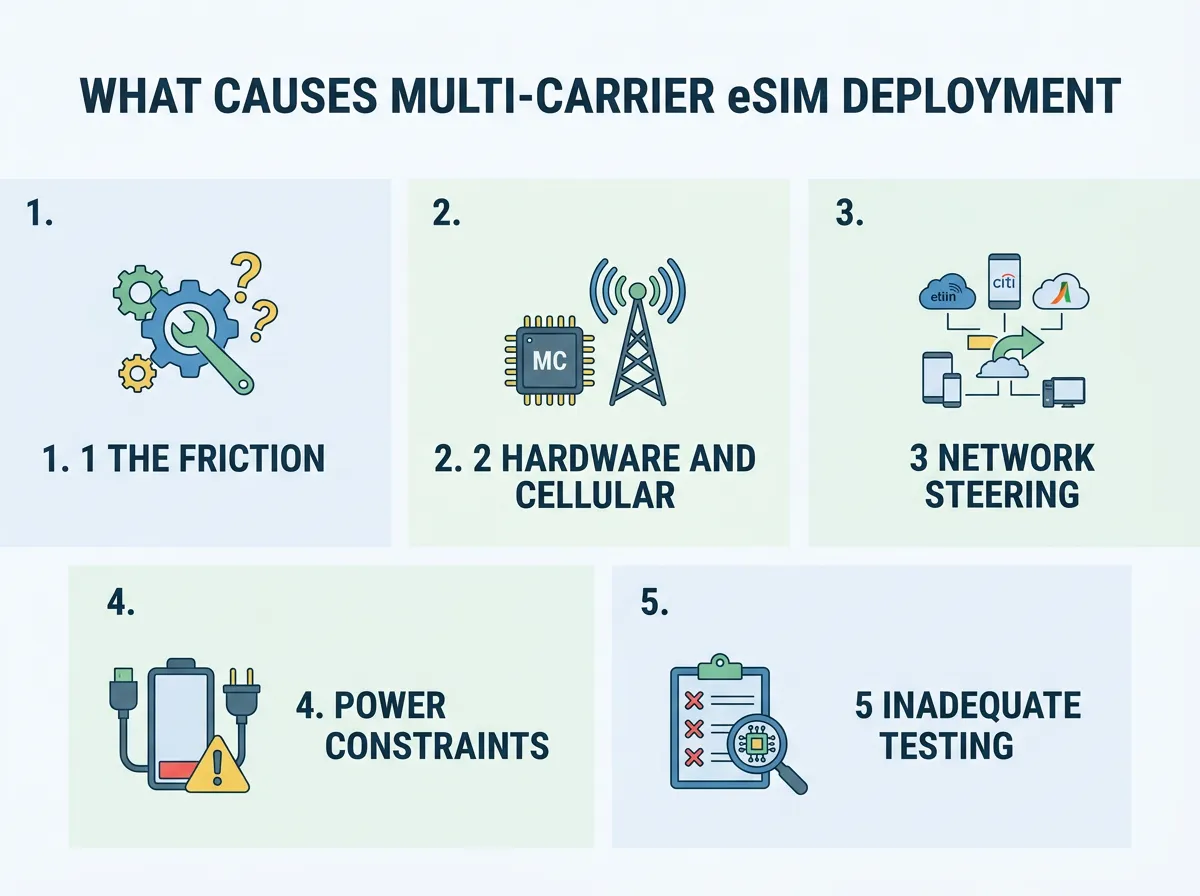
What Causes Multi-Carrier eSIM Deployment Failures in IoT? — key points at a glance
Module Memory Limitations
Cheap IoT modules have very little memory. eSIM profiles are surprisingly large. They contain security keys, network lists, and complex carrier rules. Sometimes, a new profile is too big for the module’s memory. When this happens, the module crashes. The device might reboot over and over. This is a common answer when asking what causes multi-carrier eSIM deployment failures in IoT.
Proprietary AT Commands
Cellular modules use AT commands to talk to the SIM. Sadly, there is no single standard for these commands. One module might use a command that another module does not know. If your eSIM software sends the wrong command, the module will ignore it. The profile switch will fail, and the device will remain offline.
3. Network Steering and Roaming Barriers
When a device travels, it must choose a network. This choice seems simple, but it is a silent battlefield. Carriers want to control which network your device uses to protect their margins.
The Battle Between Home and Guest Networks
Carriers use “steering of roaming” to save money. They prefer to put your device on their partner networks. They will block other networks, even if those networks have a stronger signal. This is why you must understand the difference between steered vs non-steered roaming in IoT. In a steered setup, the network might reject your device. If your device cannot switch to a backup, it gets stuck with no service.
Local Regulations and Permanent Roaming
Many countries do not allow permanent roaming. Brazil, Turkey, and China are very strict about this. If your eSIM stays on a roaming profile for too long, the local carrier will block it. If your eSIM cannot download a local profile in time, your device dies. This makes global rollouts very hard. You must plan for local profiles from day one.
4. Power Constraints and Battery Drain
Many IoT devices run on small batteries. They are built to last for years without a charge. However, multi-carrier eSIMs can be very power-hungry.
The High Energy Cost of Searching
When an eSIM loses its primary network, it searches for a new one. This search uses a lot of battery. It scans different bands and frequencies. It tries to talk to different cell towers. If it has to switch to a backup profile, it must boot up a new software stack. If this process fails, the device might search forever. This can drain a five-year battery in a single week.
Inefficient Timeout Settings
Many devices are programmed with bad timeout rules. They might wait only ten seconds for a network to respond. Cellular networks can take minutes to authenticate a new roaming device. If the device gives up too fast, it will try another profile. It enters a loop of endless searching. This loop kills both the battery and the connection. To prevent this, developers must write smart failover rules. This is crucial for building redundant IoT networks with multi-carrier failover.
5. Inadequate Testing and Edge Cases
It is easy to test a device in a cozy office. It is much harder to test it in the real world. Many failures happen because of lazy testing habits.
Lab Testing vs. Real-World Driving
In a lab, network signals are perfect. The cell towers are close, and roaming is simulated. But the real world is messy. Devices go under bridges, into metal shipping containers, and deep underground. If you only test in a lab, you will miss these edge cases. You will not see how your device behaves when the signal drops to zero.
How Devices Choose Carriers
How does a device decide when to give up on a network? This logic is hard to write. If the rules are too loose, the device switches profiles too often. If they are too tight, it stays on a dead network. You should learn more about how a multi-carrier IoT device chooses a carrier automatically. Without proper logic, the device can get stuck in a network “black hole.”
How to Ensure Your eSIM Deployment Succeeds
Do not let these challenges scare you. You can build a reliable eSIM deployment. Here are some simple, practical steps to protect your project:
- Choose the Right Hardware: Work with module makers who have certified their hardware with major eSIM vendors.
- Set Long Timeouts: Give your device at least three to five minutes to find and connect to a network before trying a backup profile.
- Test in the Field: Ship a few test units to your target locations. Let them run for weeks. Watch how they switch profiles in real-world conditions.
- Use Non-Steered eSIMs: Choose eSIMs that let the device connect to the strongest signal, rather than the cheapest partner network.
- Have an Offline Fallback: Write software that lets the device operate offline if the cellular connection fails completely.
Conclusion
Multi-carrier eSIMs are a powerful tool for the internet of things. They offer freedom and flexibility. But they are not a plug-and-play magic trick. They are a complex system of software, hardware, and radio signals. By understanding the common pitfalls, you can avoid deployment failures. Plan your testing early, choose your hardware carefully, and keep your software logic smart. With the right prep, your smart devices will stay connected no matter where they travel.
Frequently Asked Questions
What causes multi-carrier eSIM deployment failures in IoT?
Failures are usually caused by hardware incompatibilities, strict carrier steering rules, and weak cellular signals during remote profile downloads. If a device has poor logic or limited memory, it cannot process profile updates correctly. This leads to dropped connections and bricked devices.
Why do IoT devices get stuck when switching eSIM profiles?
Devices get stuck because profile switching requires a reliable cellular signal to complete the handshake with the remote server. If the signal drops mid-transfer, the eSIM is left without a valid active profile. Without an active profile, the device cannot reconnect to the internet to retry the download.
What is network steering, and how does it hurt eSIMs?
Network steering is when a carrier forces your device onto their preferred partner networks to save money. This can prevent your device from connecting to a stronger, non-partner network. If the preferred network has no coverage in your area, your device will lose connection entirely.
How does battery life affect eSIM profile switching?
Searching for networks and downloading new profiles uses a lot of processing power and radio energy. If a device switches profiles too often due to poor network coverage, it will drain its battery rapidly. This is why smart timeout rules are essential for battery-powered IoT devices.
Can cheap cellular modules work with multi-carrier eSIMs?
Some cheap modules struggle with eSIMs because they have limited memory and lack support for specific AT commands. Before buying, you must verify that your module is fully certified to work with your chosen eSIM vendor. Otherwise, the module may crash when loading complex profiles.
How can I prevent eSIM failures in my IoT project?
You can prevent failures by testing your devices in real-world roaming conditions rather than just inside a lab. Additionally, use non-steered eSIMs, set long connection timeouts, and write robust fallback code so your device can work offline when networks fail.
