

AWS IoT is the clear winner for native, fully integrated cloud device management, especially since Google officially retired its native Google Cloud IoT Core service. While Google Cloud still powers robust IoT architectures through partner-led integrations and its powerful Pub/Sub messaging system, AWS provides an unmatched suite of ready-to-use, native IoT tools. Your choice depends on whether you prefer a complete native ecosystem (AWS) or a modular, partner-driven setup (Google Cloud).
Imagine waking up to find that your smart home devices cannot connect to the internet. Or picture a factory manager tracking thousands of moving parts, only to have the data system lag. Building an Internet of Things (IoT) network is exciting, but it is also highly complex. You need a solid cloud backbone to manage your devices, route your data, and keep everything secure.
This brings us to a major industry debate: AWS IoT vs Google IoT: Which Is Better? Both Amazon and Google are cloud giants, but they handle IoT very differently. Choosing the right platform can save you time, money, and future headaches.
In this guide, we will break down how these two ecosystems compare. We will look at device connection, edge computing, data analytics, and security. We will also look at a major structural change in Google’s setup that might surprise you. By the end, you will know exactly which platform fits your smart project.
Key Takeaways
- Native Services: AWS offers a fully native, highly secure, and deeply integrated suite of IoT tools.
- Google’s Shift: Google officially retired its native IoT Core service, shifting to a partner-led model.
- Data Streaming: For high-volume data streaming, Google Cloud Pub/Sub remains an industry leader.
- Edge Computing: AWS IoT Greengrass provides excellent edge computing capabilities for local devices.
- Analytics & AI: Google is best for projects that already rely heavily on BigQuery and Google AI tools.
- Device Management: Setting up and managing devices is much simpler out-of-the-box with AWS IoT.
📑 Table of Contents
The Modern Landscape of Cloud IoT
An IoT platform acts as a bridge. It connects physical hardware to the digital cloud. It helps you send commands to devices and pull data back for analysis. To get started, it is helpful to read a comprehensive IoT cloud guide to understand how these systems link devices together.
For years, AWS and Google Cloud went head-to-head with native tools. However, the market shifted recently. Amazon kept building its native features, while Google changed its business model. This change is the most important factor to consider today.
How AWS Built a Complete Native Suite
Amazon Web Services (AWS) took an all-in-one approach. They built a massive suite of native IoT tools. These tools cover everything from the hardware level to the analytics dashboard. If you use AWS, you do not need to look outside their ecosystem. Everything is built to work together smoothly under one roof.
Google’s Shift to Partner-First Solutions
Google Cloud took a different path. In August 2023, Google officially retired its native service, Google Cloud IoT Core. Instead of building every tool themselves, Google now relies on a partner-first model. They work with trusted third-party companies to handle device connection. If you want to use Google Cloud, you will need to look at alternative configurations for Google Cloud IoT to see how partners bridge the gap.
Core Device Management and Architecture
Device management is all about control. You need to register new devices, update their software, and check their health. Let us see how AWS and Google compare in this area.
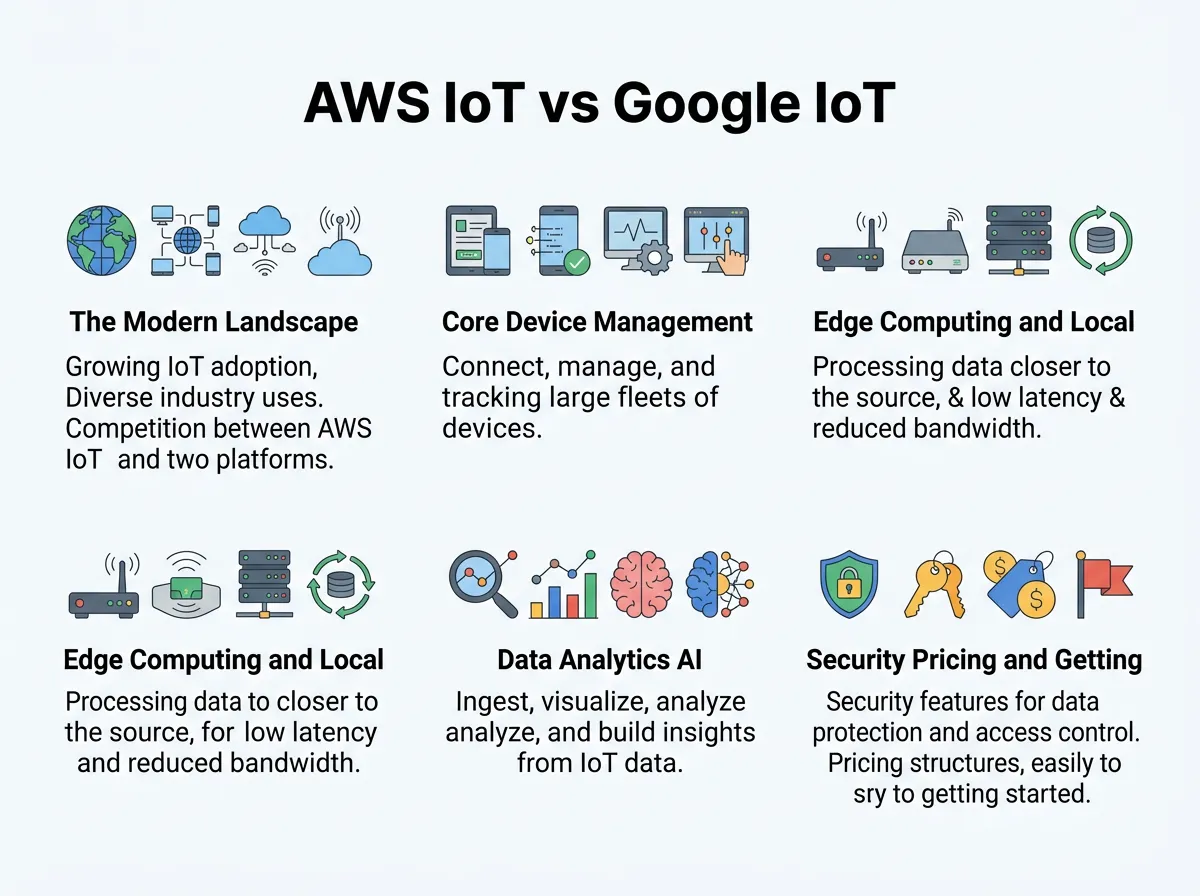
AWS IoT vs Google IoT: Which Is Better? — key points at a glance
Registering and Connecting Devices with AWS
AWS IoT Core makes it easy to connect devices. You can register thousands of sensors at once. AWS supports popular communication protocols like MQTT, HTTPS, and LoRaWAN. The platform includes a native “Device Registry” and “Device Shadow.” The Device Shadow is a neat feature. It saves the last known state of your device. If a device goes offline, you can still read its status or send pending updates.
How Google Handles Devices Today
Since Google retired IoT Core, you cannot register devices directly through a native Google IoT console. Instead, you use partner platforms like ClearBlade, Litmus, or EMQ. These partners connect your devices to Google Cloud Pub/Sub. From there, Google’s powerful data tools take over. While this setup works well, it adds an extra layer of setup. You have to manage relationships and billing with both Google and the chosen partner.
Edge Computing and Local Processing
Sometimes, your devices cannot rely on the cloud for every decision. A smart car cannot wait for a cloud response to hit the brakes. This is where edge computing comes in. It lets your devices process data locally.
AWS IoT Greengrass
AWS IoT Greengrass is a powerful tool for edge computing. It brings cloud capabilities to local devices. With Greengrass, your hardware can run local code, talk to other devices securely, and run machine learning models. Even if the local network loses internet access, Greengrass keeps working. Once the connection returns, it syncs all data back to the AWS cloud.
Example: A smart farm uses Greengrass on its watering systems. The sensors check soil moisture and turn on the water locally. They do not need a constant cloud connection to keep the crops alive.
Google’s Edge Strategy
Google offers Google Distributed Cloud and Anthos for edge setups. However, for smaller IoT devices, Google relies heavily on partner software. Partners run lightweight message brokers at the edge, then stream the data to Google Cloud. It is a highly modular approach, but it requires more manual configuration than AWS Greengrass.
Data Analytics, AI, and Machine Learning
IoT devices generate a mountain of data. That data is useless unless you can understand it. Both platforms shine when it comes to turning raw data into smart business decisions. When comparing these features, it helps to look at leading platforms for IoT development to see how data pipelines are typically built.
Unleashing Data with Google BigQuery
Data analytics is Google’s superpower. Once your partner tool sends IoT data into Google Cloud Pub/Sub, you can route it straight into BigQuery. BigQuery is an incredibly fast, serverless data warehouse. You can run complex searches on petabytes of data in seconds. From there, you can use Google’s advanced AI tools, like Vertex AI, to predict machine failures or analyze user habits.
Native Data Pipelines with AWS
AWS offers AWS IoT Analytics. This service is fully native. It automates the steps required to clean, filter, and store IoT data. You can filter out noisy data from broken sensors before storing it. AWS also integrates with Amazon SageMaker. This tool helps you build and train machine learning models to run on your device data. It is a seamless process, but the learning curve can be steep.
Security, Pricing, and Getting Started
Security is the most critical part of any IoT project. A single weak device can expose your whole network to hackers.
Keeping Your Fleet Safe
AWS uses a security-first model. Every device needs a unique digital certificate to connect. AWS IoT Device Defender constantly checks your fleet. It looks for unusual behavior, like a sensor suddenly sending data to an unknown IP address.
Google Cloud also uses top-tier security. It relies on identity management (IAM) and secure data tunnels. Because Google uses partners for device connection, you must also trust the partner’s security features. This means you have two security models to review and maintain.
Understanding the Costs
Pricing for both platforms depends on use. AWS charges you based on the number of messages sent, the minutes connected, and the actions taken. It is a pay-as-you-go model, which is great for small startups. However, costs can grow quickly if your devices send messages every second.
Google’s cost model is split. You pay the partner company for device management. Then, you pay Google for data ingestion, storage, and analytics. This split billing can make it harder to predict your total costs monthly.
The Verdict: Which Is Better for Your Project?
So, in the matchup of AWS IoT vs Google IoT: Which Is Better? The answer depends on your team’s skills and your project’s goals.
Choose AWS IoT If:
- You want a single, native platform with no third-party dependencies.
- You need strong edge computing tools like AWS IoT Greengrass.
- Your team is already familiar with the AWS ecosystem.
- You want simple, predictable billing from a single provider.
Choose Google Cloud If:
- Your primary focus is advanced data analytics, AI, and machine learning.
- You already use Google BigQuery and Vertex AI for your business.
- You prefer using specialized partner platforms for hardware management.
- You want to build a highly customized, modular cloud system.
Conclusion
Both platforms are incredibly powerful. AWS IoT wins on ease of use, native tool depth, and edge computing. It is a complete package that keeps your hardware and cloud under one roof. Google Cloud remains a strong contender, but only if you are happy using partner tools to manage your devices. Whichever you choose, make sure to plan your security and data paths early to ensure a successful launch!
Frequently Asked Questions
Is Google Cloud IoT Core still active?
No, Google officially retired Google Cloud IoT Core in August 2023. Users must now connect devices through third-party partner services to stream data into Google Cloud.
What is AWS IoT Greengrass used for?
AWS IoT Greengrass is used for edge computing. It lets local devices process data, run machine learning models, and communicate offline before syncing back to the cloud.
Which platform is better for AI and machine learning?
Google Cloud is generally considered superior for AI and machine learning due to tools like BigQuery and Vertex AI. However, AWS also offers excellent tools like Amazon SageMaker.
Can I use both AWS and Google Cloud for IoT?
Yes, you can use a multi-cloud setup. For example, you can collect and manage device data using AWS IoT, then stream that data to Google Cloud for deep analytics.
How does security compare between AWS and Google IoT?
AWS offers native, end-to-end security with unique device certificates and AWS IoT Device Defender. Google Cloud is highly secure but requires you to manage security settings across both Google and your chosen partner platform.
Is AWS IoT cheaper than Google Cloud?
It depends on your setup. AWS charges you directly for messages and connections, while Google requires you to pay both a partner platform fee and Google Cloud usage fees, which can complicate budgeting.
