

The best eUICC SIM for IoT is one that offers seamless multi-carrier coverage, robust remote provisioning, and flat-rate pricing. It must support over-the-air updates to let you switch networks without swapping physical cards. Look for providers that combine global reach with an intuitive platform to manage your smart devices anywhere.
Imagine you just shipped ten thousand smart trackers to customers across the globe. Suddenly, a major network operator in Europe changes its pricing model. Or even worse, their signal drops entirely in your primary market. In the old days, this scenario meant absolute disaster. You would have to recall every single tracker just to swap out a tiny piece of plastic. Thankfully, modern technology has a much better way. This is where smart cellular technology comes to the rescue. Today, we will explore how to pick the perfect connectivity partner. We will dive deep into what features you need to scale your project without the stress.
When you start researching, the sheer number of technical terms can feel overwhelming. You will hear about profiles, platforms, and various carriers. It is easy to get lost in the noise. However, finding the right path is simple once you know what to look for. We will break down the essential features of these smart cards. By the end of this guide, you will know exactly how to choose the right fit for your business.
Key Takeaways
- Remote Provisioning is Key: eUICC allows you to change network profiles over-the-air without touching the hardware.
- Global Coverage Rules: The best SIM offers multi-network fallback so your devices never lose their signal.
- Form Factor Matters: Choose between plastic cards or embedded chips depending on your device design.
- Look for Clear Pricing: Avoid hidden fees by choosing providers with simple, predictable payment plans.
- Security is Paramount: Ensure your provider supports secure data encryption and VPN options.
- Check Platform Usability: A great management platform saves time when scaling your IoT fleet.
📑 Table of Contents
Why Traditional SIMs Fail in the IoT World
Traditional SIM cards are great for your personal smartphone. When you want a new carrier, you just go to a local store. You get a new piece of plastic, slide it into your phone, and you are good to go. But this model falls apart when you manage thousands of machines spread across different states or countries. Imagine trying to locate and open thousands of water meters buried underground just to change a card. It is physically impossible and highly expensive.
Classic SIMs tie your device to one network provider. If that provider has a local outage, your device goes dark. If you move your business to a new country, you face huge roaming fees. This lack of flexibility is a massive roadblock for growing businesses. To solve this, many engineers now ask: What Is the Best eUICC SIM for IoT? They want to find a solution that offers freedom. Thankfully, eUICC SIM cards for IoT are gaining massive popularity because they solve these exact pain points.
What Makes eUICC the Ultimate Solution?
Before we look at the top choices, we must understand what eUICC actually is. The acronym stands for Embedded Universal Integrated Circuit Card. Do not let the complex name scare you. It simply refers to a smart software layer on the SIM card. This layer lets you store multiple operator profiles at the same time.
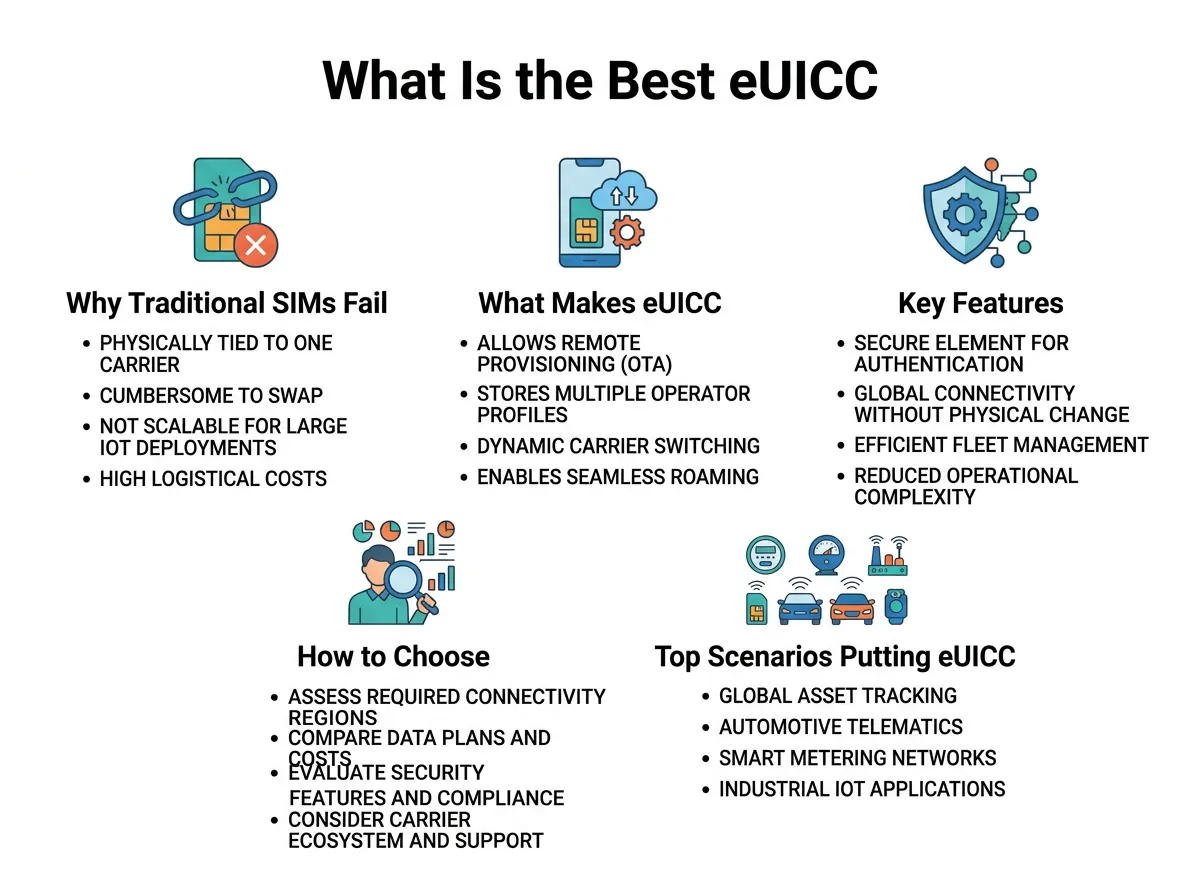
What Is the Best eUICC SIM for IoT? — key points at a glance
Many people confuse eSIM with eUICC. While they sound similar, they are not quite the same. It is highly helpful to understand the differences between eSIM and eUICC before you buy. In short, eSIM is the physical hardware chip soldered onto the board. On the other hand, eUICC is the software that allows remote profile swapping. You can actually have eUICC software on a standard plastic card or on an embedded chip.
Over-the-Air Updates
The magic of eUICC is over-the-air (OTA) provisioning. This means you can send new network credentials to your devices through the cellular network. You do not need to touch the physical device. If a carrier changes its rates, you simply push a new profile to your fleet with a few clicks on your computer.
Form Factor Flexibility
The best eUICC solutions come in all shapes and sizes. You can get them as standard triple-cut plastic cards that fit into classic slots. You can also get them as tiny MFF2 chips that solder directly onto your circuit board. This flexibility helps you design smaller, more durable devices that resist dust, heat, and heavy vibration.
Future-Proofing Your Business
When you deploy devices that must last ten years, you cannot predict the future. Network standards change and carriers go out of business. An eUICC SIM keeps your hardware alive. It ensures you can always adapt to new networks without buying new hardware.
Key Features of the Best eUICC SIMs
So, What Is the Best eUICC SIM for IoT? The answer depends on your specific goals, but the top options always share key features. Here is what you should look for when comparing options.
Multi-Network Coverage
A great SIM should not rely on just one carrier. It should have agreements with multiple local networks in every country. If your primary network drops, the SIM must automatically switch to the next strongest signal. This keeps your devices online, no matter where they travel.
Simple Management Platform
You need a central dashboard to see all your devices. The best platforms let you monitor data use, activate new lines, and switch profiles. If the management tool is too complex, you will waste hours on basic support tasks. Look for a clean, user-friendly interface that makes management simple.
Robust Security
IoT devices are common targets for hackers. The best eUICC cards offer secure virtual private networks (VPNs) and private APNs. They protect your data as it travels from the device to your cloud server. Never compromise on security when choosing a provider.
How to Choose the Best eUICC SIM for Your Needs
Every business has unique needs. A fleet of smart scooters needs different connectivity than a smart farm. To find your ideal match, follow these simple steps.
Assess Your Geographic Footprint
Where will your devices live? If they stay in one country, you might want a local provider with deep coverage. If they cross borders, you need a global provider. Make sure to compare multi-IMSI technology versus eUICC solutions. Sometimes a hybrid approach offers the absolute best global footprint.
Analyze Your Data Needs
Do your devices send small text updates once a day? Or do they stream live video? If you use low-power networks like NB-IoT or LTE-M, ensure your eUICC SIM supports these standards. Choose a billing plan that fits your exact data consumption to avoid paying for unused bandwidth.
Review the Management Tool
Ask for a demo of the provider’s management platform. Is it easy to use? Does it have an API? Good APIs let you link the SIM management tools directly to your own internal software. This makes automation easy as your business grows.
Top Scenarios: Putting eUICC to Work
Let us look at how real businesses use these smart SIM cards to solve big problems.
Smart Logistics and Cold Chain
Imagine tracking sensitive food shipments across Europe. The trucks pass through mountains and cross national borders. A standard SIM would lose connection or run up huge roaming bills. An eUICC SIM automatically switches to the best local carrier. It keeps the temperature sensors online so the food never spoils.
Utility Meters in Rural Areas
Water and gas meters are often placed in deep basements or rural areas. Sending technicians to fix connectivity issues is very expensive. By using eUICC chips, utility companies can update network profiles remotely. This keeps the meters reading accurately for years without human visits.
Conclusion
Finding the perfect cellular solution does not have to be painful. The ideal eUICC card is the one that removes friction from your operations. It gives you deep global coverage, simple pricing, and a powerful platform to manage your devices. By focusing on flexible remote provisioning and high security, you can build an IoT fleet that stands the test of time. Take your time, test a few sample SIMs in the field, and watch your business scale with ease.
Frequently Asked Questions
What is the main difference between eSIM and eUICC?
eSIM refers to the physical chip hardware that is soldered onto a device circuit board. In contrast, eUICC is the software technology that allows you to manage and change carrier profiles over-the-air.
Can I use an eUICC SIM in any standard IoT device?
Yes, eUICC technology is available in standard plastic SIM card form factors like Micro and Nano sizes. This means you can use them in almost any device that has a standard SIM card slot.
How does remote provisioning work?
Remote provisioning sends new network operator profiles to your SIM card over-the-air. This process happens securely through the cellular network, requiring no physical contact with the device.
Does eUICC save money for my business?
Yes, it saves money by eliminating the need to physically replace SIM cards when changing carriers. It also helps you avoid expensive roaming fees by letting you switch to local network profiles when devices cross borders.
Can eUICC SIMs work on low-power networks?
Yes, most modern eUICC SIMs fully support low-power wide-area networks like LTE-M and NB-IoT. These networks are perfect for battery-powered devices that need to send small amounts of data over long distances.
Do I need a special management platform for eUICC?
Yes, you need a connectivity management platform provided by your cellular partner to trigger over-the-air updates. This dashboard lets you view data usage, manage profiles, and troubleshoot devices from one central screen.
