


Push-to-talk two-way radios are instant communication devices that let you send voice messages instantly with the press of a single button. They operate on a half-duplex system, meaning only one person can speak at a time while others listen. These tools are highly valued across many industries for their speed, rugged durability, and reliable safety features.
Imagine you are managing a massive outdoor music festival. Thousands of excited fans are dancing. Suddenly, a light fixture on the main stage starts to flicker. You need your chief technician right away. You do not have time to pull out your smartphone, search for a contact, dial the number, and wait for it to ring. If you do that, the lights might go dark before anyone answers.
Instead, you grab the small device clipped to your belt. You hold down a single button and speak. “Dave, we need you at the main stage right now.” Instantly, Dave hears your voice through his own speaker. He replies in a split second. The problem is solved before the crowd even notices. This is the magic of instant communication.
If you have ever wondered, “What Are Push-to-Talk Two-Way Radios and why are they still so popular?”, you are in the right place. In this guide, we will dive deep into this reliable technology. We will look at how these devices operate, why they are so valuable, and how they have evolved over the years. Whether you are running a business or preparing for an outdoor adventure, understanding how these tools work can change the way you connect.
Key Takeaways
- Instant Connection: You can communicate with your team immediately by pressing a single button.
- Half-Duplex Design: Users take turns speaking on a shared channel, which prevents messy cross-talk.
- Extreme Durability: These devices are built to withstand drops, water, dust, and harsh environments.
- No Monthly Fees: Traditional radio models do not require expensive cellular data plans.
- Broad Coverage Options: Modern Push-to-Talk over Cellular (PoC) systems offer nationwide reach.
- Enhanced Safety: Built-in features like emergency buttons and “Man Down” alerts protect workers in real time.
📑 Table of Contents
How Do Push-to-Talk Two-Way Radios Actually Work?
At their core, these devices are designed for speed. They bypass the complex process of modern phone calls. But how do they send your voice through the air so quickly? Let us break down the basic science behind them.
The Magic of Half-Duplex Communication
To understand these tools, you need to know about “half-duplex” communication. Most cellular phones use full-duplex systems. This means both people can speak and hear each other at the same time. It is just like a normal face-to-face conversation. However, push-to-talk technology relies on a half-duplex system.
On a half-duplex channel, only one person can send a message at a time. While you press the button to speak, your device becomes a transmitter. Everyone else on your channel becomes a receiver. They can only listen. Once you release the button, the channel opens up. Now, someone else can press their button and reply. This setup prevents people from talking over each other. It keeps messages short, clear, and organized.
Channels and Frequencies
To talk to each other, your devices must be set to the exact same frequency or channel. Think of it like tuning your car radio to your favorite station. You can find detailed guides on how walkie-talkies transmit signals over these channels. Traditional push-to-talk two-way radios use radio waves to send sound. These waves travel through the air from one antenna directly to another. Because they do not rely on cell towers, they can work in remote areas where your phone has no service at all.
The Core Benefits of Using Push-to-Talk Technology
Why do so many professional teams choose push-to-talk two-way radios over modern smartphones? The answer lies in their unique benefits. They offer features that standard phones simply cannot match.
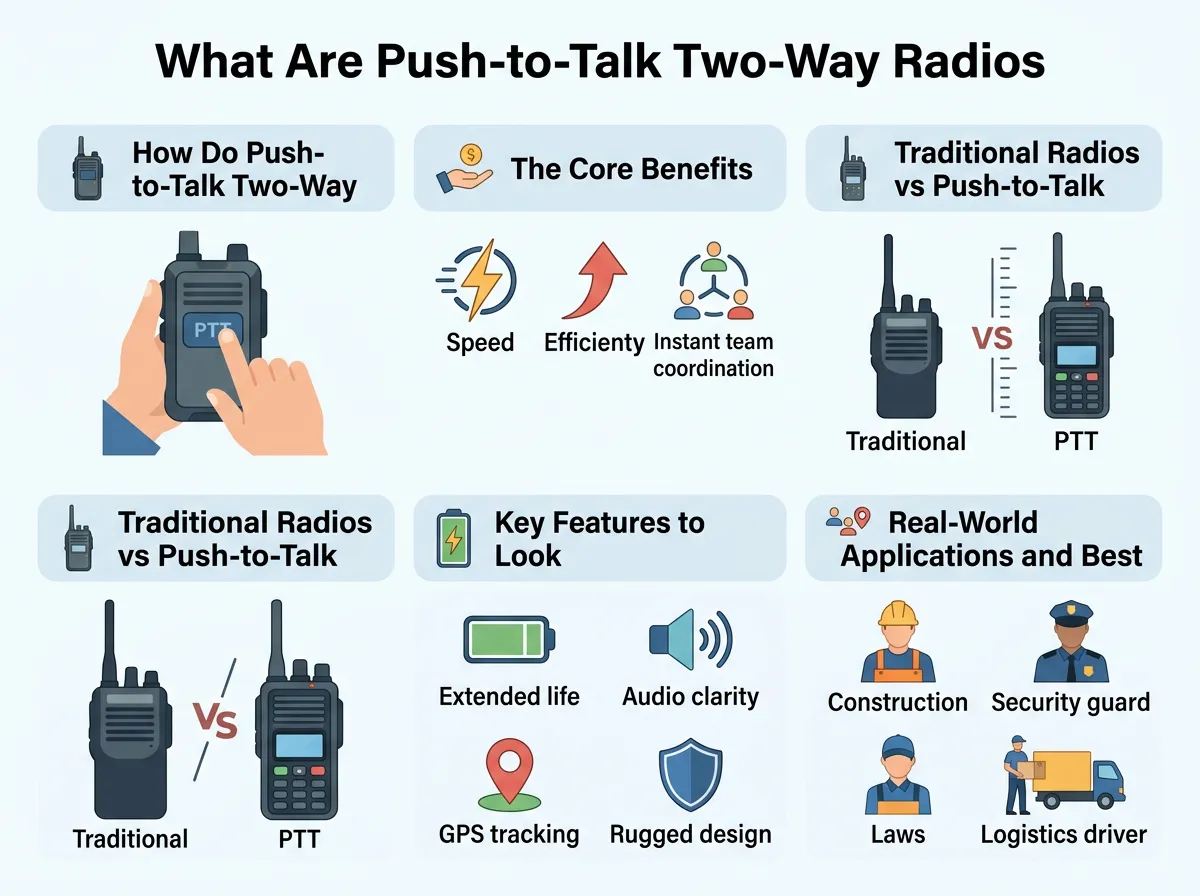
What Are Push-to-Talk Two-Way Radios? — key points at a glance
Speed and Efficiency
The biggest benefit is speed. In emergency situations, every second counts. With these devices, there is no dialing, no waiting for a ring, and no voicemail. You press, you talk, and you are heard. This instant link helps teams work faster. It is perfect for fast-moving environments like hotels, warehouses, and security zones.
Rugged Durability
Smartphones are fragile. One drop on a concrete floor can shatter the glass screen. Push-to-talk two-way radios are built like tanks. Many of them are dustproof and waterproof. They can survive drops, rain, heat, and cold. If you work in a rough environment like a construction site, you need gear that will not break when things get tough.
Cost-Effectiveness
For many businesses, budget is a major concern. Traditional push-to-talk two-way radios do not require monthly service plans. Once you buy the hardware, you own it. There are no surprise bills or data overage charges. This makes them a highly cost-effective choice for long-term operations.
Traditional Radios vs. Push-to-Talk over Cellular (PoC)
As technology has advanced, these devices have evolved. Today, you have more options than ever before. It is important to know the differences between classic models and modern cellular versions.
What is PoC?
Classic radios are great, but they have range limits. If you move too far away, the signal fades. To solve this problem, engineers created Push-to-Talk over Cellular, or PoC. Instead of using direct radio waves, PoC devices use existing mobile phone networks.
With PoC, your range is virtually unlimited. You can press a button in New York and speak to your teammate in California instantly. It combines the speed of a radio with the vast reach of a national cell network. You can explore the differences between traditional radios and cellular options to see which fits your business needs.
Making the Right Choice
How do you choose between the two? It depends on your daily environment. If your team works in one specific building or outdoor area, traditional push-to-talk two-way radios are ideal. They are simple, reliable, and free to run. If your team travels across the state or country, PoC is the better choice. It keeps everyone connected, no matter the distance.
Key Features to Look For in Push-to-Talk Two-Way Radios
If you are ready to invest in push-to-talk two-way radios, you might feel overwhelmed by the choices. Here are the most important features to keep in mind.
Battery Life and Range
A radio is only useful if it stays turned on. Look for devices with long battery lives, ideally lasting 12 hours or more on a single charge. This ensures they will last through a full work shift. Range is also key. Make sure the model you choose can cover your entire work area, whether it is a small school or a vast forest.
Safety and Emergency Features
Many modern push-to-talk two-way radios come with built-in safety tools. For example, some have a “Man Down” feature. This feature detects if a worker has fallen and cannot move. It will automatically send an emergency alert to the rest of the team. Other models have a bright orange panic button that can be pressed to call for help instantly.
Real-World Applications and Best Practices
Who actually uses these devices on a daily basis? You might be surprised by how common they are in our everyday lives.
Who Uses These Radios?
These tools are crucial in many sectors. In schools, teachers use them to monitor playgrounds and keep kids safe. In retail, staff use them to check stock in the back room quickly. Security guards, construction crews, event planners, and medical staff all rely on push-to-talk two-way radios to do their jobs safely and efficiently.
Quick Radio Etiquette Tips
To get the most out of your devices, your team should follow a few simple rules. You can learn more about the step-by-step push-to-talk process to help train your staff. Here are some quick tips:
- Think before you speak: Know what you want to say before you press the button. This keeps the channel clear.
- Wait a second: After pressing the button, wait one second before speaking. This ensures the start of your message does not get cut off.
- Be clear and brief: Use short sentences. Avoid long, winding stories.
- Say “Over” when finished: Let others know you are done speaking so they know they can reply.
Conclusion
In a world filled with complex smartphones, push-to-talk two-way radios remain more important than ever. They offer unmatched speed, tough durability, and simple design. They keep teams safe, connected, and efficient in any environment. Whether you choose a classic radio or a modern cellular system, these tools are a smart investment for anyone who needs instant, reliable communication. Grab your device, press the button, and start talking today!
Frequently Asked Questions
Do push-to-talk radios require cell service?
Traditional push-to-talk radios do not require cell service because they transmit signals directly using radio waves. However, modern Push-to-Talk over Cellular (PoC) models do need a mobile data network to operate over long distances.
What is the difference between half-duplex and full-duplex?
In a half-duplex system, only one person can transmit a message at a time while others listen. In a full-duplex system, like a regular telephone, both parties can speak and hear each other simultaneously.
How far can a standard two-way radio transmit?
The range of a standard radio depends on the model, terrain, and weather conditions. Basic models usually cover one to two miles, while high-end business systems can reach up to thirty miles with the help of repeaters.
Are these radios waterproof?
Many professional-grade models are designed with waterproof and dustproof ratings. You should check the device’s IP rating to see exactly how much exposure to water and dust it can handle.
Do I need a license to use a two-way radio?
Some lower-power radios, like family walkie-talkies, do not require a license. However, high-power business radios often require an FCC license in the United States to prevent interference with other networks.
Can different brands of radios talk to each other?
Yes, different brands can communicate with each other as long as they are set to the exact same frequency and privacy codes. They also need to use the same technology type, such as analog or digital.
