


Finding the right cellular connectivity is crucial for successful international deployments. The top global IoT SIM cards, including options from emnify, Onomondo, floLIVE, and Things Mobile, offer multi-network roaming, centralized management platforms, and flexible pay-as-you-go pricing models. Choosing the best provider depends on your coverage needs, data consumption, and hardware form factor.
Imagine launching your new smart tracking device. You have spent months designing the hardware. You have tested the software. Now, you need to ship your devices to customers in Europe, Asia, and North America. But there is a huge catch. How do you keep these devices online without buying local SIM cards in every single country? Handling multiple carrier bills and contracts can quickly turn into an absolute nightmare.
This is where global IoT SIM cards come to the rescue. They are designed to work across borders on hundreds of different networks. But with so many options on the market, you might wonder: What Are the Top IoT SIM Cards for Global Coverage?
In this guide, we will break down the absolute best choices available today. We will look at what makes them special, how they keep your devices connected, and how to pick the perfect one for your unique business needs.
Key Takeaways
- Multi-Network Roaming is Essential: The best global SIMs automatically switch between local carriers to avoid dead zones.
- eSIM and eUICC Technology: Modern IoT projects rely on eUICC to update carrier profiles over-the-air without swapping physical cards.
- Centralized Management: Top providers offer intuitive cloud platforms to monitor data usage and manage thousands of SIMs in real time.
- Flexible Pricing: Look for pay-as-you-go or pooled data plans to avoid costly overage fees across different countries.
- Form Factors Matter: Choose between standard plastic SIMs and industrial MFF2 embedded chips based on your device design.
📑 Table of Contents
Why Traditional SIM Cards Fail in IoT Deployments
If you have ever traveled abroad, you know the drill. You turn on your phone, and you might get a slow, expensive roaming connection. This is fine for a quick vacation. But for a business running thousands of smart devices, it is a recipe for disaster. Regular consumer SIM cards are just not built for the scale of the Internet of Things. To understand What Are the Top IoT SIM Cards for Global Coverage?, we first have to look at why standard options fall short.
The Nightmare of Carrier Roaming Agreements
Traditional SIMs belong to one primary carrier. When your device leaves that carrier’s home network, it has to roam. This means your data is sent back to the home country first. This process causes high latency. It can also lead to sudden disconnections. Even worse, some carriers will block devices that roam on their network for too long. This is called permanent roaming, and it can brick your devices overnight.
Lack of Centralized Data Management
Think about managing five hundred devices. If each one has a separate consumer account, you cannot track them easily. You would have to log into different portals just to check data usage. If a device goes rogue and consumes gigabytes of data, you will only find out when the massive bill arrives. Global IoT SIMs solve this by putting everything into one single dashboard.
The Standout Features of Top Global IoT SIMs
When searching for What Are the Top IoT SIM Cards for Global Coverage?, you need to look past basic roaming. You should look for specific technologies that make global deployment easy and affordable.
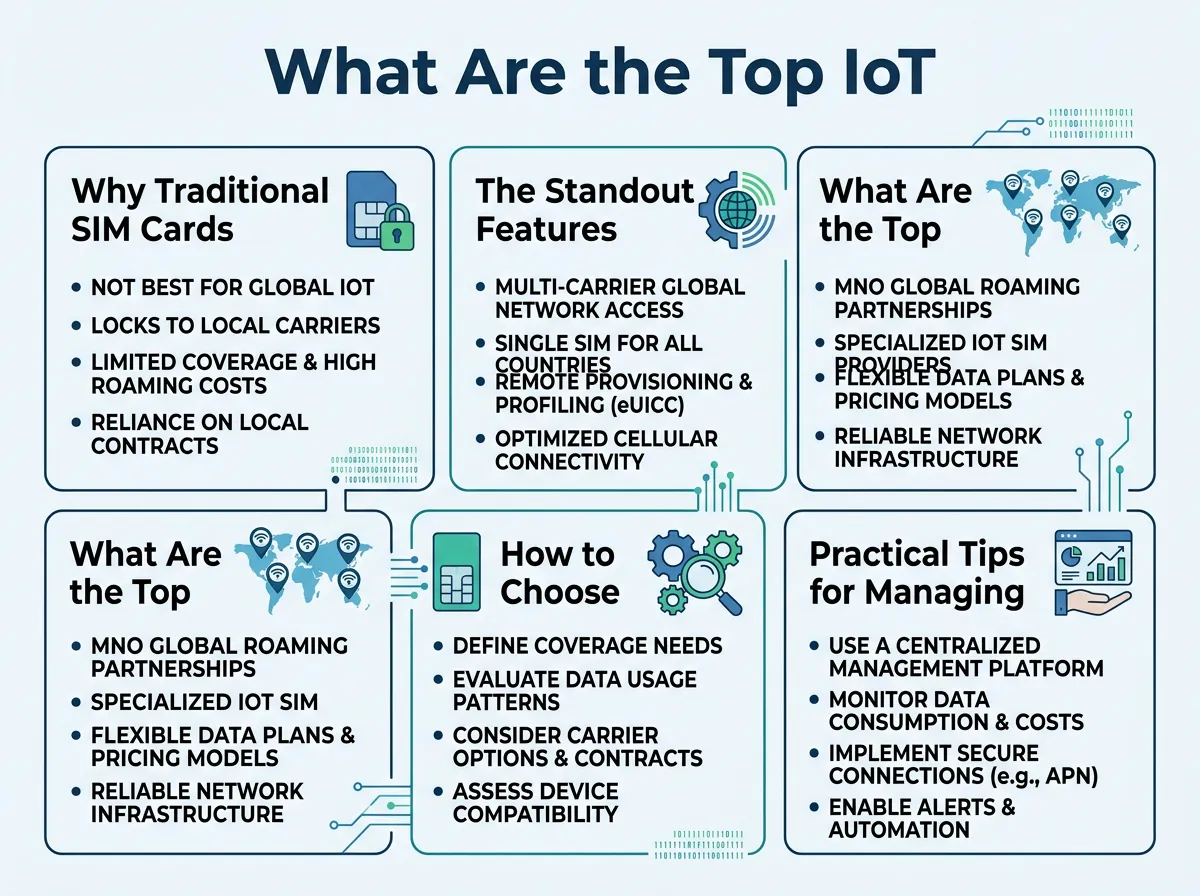
What Are the Top IoT SIM Cards for Global Coverage? — key points at a glance
Multi-Network Auto-Switching
The best multi-network SIM cards for IoT do not rely on just one carrier. Instead, they can connect to multiple local networks in any given country. If Carrier A has a weak signal, the SIM automatically switches to Carrier B. This ensures your devices stay online, whether they are in a deep basement or crossing a remote border.
Over-the-Air (OTA) Updates via eUICC
In the past, changing your network provider meant physically swapping SIM cards. Imagine doing that for thousands of sensors buried under concrete. Thanks to eUICC (embedded Universal Integrated Circuit Card) technology, those days are over. You can now update carrier profiles and download new network access credentials over-the-air. This future-proofs your hardware for years to come.
What Are the Top IoT SIM Cards for Global Coverage? (The Best Providers)
Now, let us answer the big question. What Are the Top IoT SIM Cards for Global Coverage? Here are the leading options that businesses trust to keep their devices connected worldwide.
1. emnify
If you want a modern, developer-friendly solution, the emnify IoT SIM is an outstanding choice. They offer excellent global coverage across more than 180 countries. Their platform is cloud-native, meaning it integrates directly with cloud providers like AWS and Azure. This makes it incredibly easy to secure your data traffic and manage your device fleet. They also offer a very user-friendly management platform where you can pause, activate, or limit data for individual SIMs with a single click.
2. Onomondo
Onomondo is redefining how global IoT connectivity works. Traditional roaming can be slow because data must travel back to the home network. The Onomondo global IoT SIM solves this by building its own core network. They have direct integrations with over 700 operators worldwide. This design reduces latency and improves security. If you need fast, reliable, and highly secure data transfer for assets on the move, Onomondo is a top contender.
3. floLIVE
floLIVE offers a unique local-global approach. They run the world’s largest peer-to-peer global IoT network. Instead of relying purely on standard roaming, floLIVE uses local IMSIs (International Mobile Subscriber Identities). This means your device looks like a local device to the network, no matter where it is in the world. It is a fantastic option for overcoming strict local roaming regulations in countries like Brazil, Turkey, and China.
4. Things Mobile
If you are running a smaller project or just starting out, Things Mobile is a highly accessible option. They offer very competitive pay-as-you-go rates. Their SIM cards work with major networks in over 165 countries. Setup is fast, and you can buy small batches of SIMs directly from their website. It is an ideal entry point for startups and developers who need to test their hardware globally without committing to large contracts.
How to Choose the Right Form Factor for Your Fleet
Choosing the right provider is only half the battle. You also need to select the physical shape of your SIM card. The right choice depends on your device’s environment and size.
Plastic SIM Cards (2FF, 3FF, 4FF)
These are the classic removable SIM cards we all know. They come in three main sizes: Mini (2FF), Micro (3FF), and Nano (4FF). Today, many providers ship trio SIMs that contain all three sizes in one plastic card. These are great for testing and for devices with easily accessible slots. However, they can vibrate loose in moving vehicles and are sensitive to extreme heat and moisture.
Embedded SIMs (MFF2)
For rugged environments, embedded SIMs (MFF2) are the gold standard. These are tiny chips that are soldered directly onto your device’s circuit board during manufacturing. They are highly resistant to shocks, vibrations, and extreme temperatures. Because they cannot be removed, they also offer much better physical security against theft.
Practical Tips for Managing Your Global IoT Data
Once you discover What Are the Top IoT SIM Cards for Global Coverage? and deploy them, the work is not quite done. You must manage them wisely to keep costs low. Here are a few practical tips to help you succeed.
Set Up Real-Time Data Alerts
A single malfunctioning device can try to send data continuously. This can lead to a massive bill. Use your provider’s dashboard to set up automatic alerts. For example, if a device uses more than 50MB of data in a day, have the system send you an email or automatically pause the SIM.
Use Pooled Data Plans
Some of your devices will use more data than others. Instead of buying individual plans for each SIM, look for pooled data plans. In a pooled plan, all your devices share a single bucket of data. If one device uses less data, that extra data can be used by a device that needs more. This helps you balance your monthly costs perfectly.
Conclusion
Finding the right cellular partner is the secret to scaling your IoT project. So, What Are the Top IoT SIM Cards for Global Coverage? The answer depends on your unique needs. If you need deep cloud integration, emnify is fantastic. If you want low latency and direct operator connections, Onomondo is a top pick. For strict regulatory compliance, floLIVE is hard to beat. And for simple, low-cost projects, Things Mobile is a great place to start. Take your time, test a few sample SIMs in the field, and choose the partner that will help your business grow without limits.
Frequently Asked Questions
Can I use a regular phone SIM card for IoT devices?
While a regular SIM card will work in some devices, it is not recommended for commercial projects. Standard SIM cards lack multi-network roaming capabilities, physical durability, and centralized management tools. They can also face permanent roaming bans if left on foreign networks for too long.
What is the difference between eSIM and eUICC?
An eSIM refers to the physical chip soldered onto a device’s circuit board. eUICC is the software technology that allows you to change and manage carrier profiles on that chip over-the-air. Together, they allow you to switch network providers without physically swapping cards.
How much data does an average IoT SIM card use?
Data usage varies wildly depending on your application. Simple temperature sensors might only use 1 to 2 megabytes per month. On the other hand, connected video cameras or industrial gateways can easily consume gigabytes of data each month.
Are global IoT SIM cards secure?
Yes, global IoT SIM cards are highly secure. Top providers offer features like private APNs, VPN integration, and physical write-protection to prevent unauthorized access. You can also lock a SIM card to a specific device so it cannot be used in a phone if stolen.
Do global IoT SIM cards work in every country?
Most top global SIM providers offer coverage in 150 to 180+ countries. However, some countries like Brazil and Turkey have strict regulations regarding permanent roaming. In those regions, you should look for providers like floLIVE that offer localized IMSIs.
What is a pooled data plan for IoT?
A pooled data plan allows all the SIM cards in your fleet to share a single total bucket of data. This means high-usage devices can borrow unused data from low-usage devices. It helps prevent unexpected overage fees and makes your monthly costs highly predictable.
