


The best IoT SIM card in Europe is one that offers multi-network roaming, flexible data pooling, and a secure management platform to keep devices online across borders. Leading providers like EMnify, 1oT, and Olivia IoT stand out as top choices for businesses seeking reliable European coverage.
Imagine you are launching a fleet of smart rental bikes. They need to travel across Germany, France, and Belgium. What happens when a bike crosses a border? If it uses a regular phone SIM card, it might lose its connection. It might stop sending GPS coordinates. This small issue can hurt your business and frustrate your customers.
To keep your smart devices online, you need a specialized network solution. You need cellular connection built for machines, not human phones. This search leads many business owners and developers to ask a critical question: What is the best IoT SIM card in Europe?
In this guide, we will explore the top options for your smart projects. We will cover the key features you must look for in a cellular provider. We will also compare the leading vendors in Europe to help you make the right choice.
Key Takeaways
- Multi-network roaming is essential: The best IoT SIM cards automatically switch between different European networks to prevent signal dead zones.
- Look for eUICC technology: eSIMs with eUICC allow you to change cellular carriers over the air without physically swapping the plastic SIM cards.
- Prioritize a central management platform: A robust portal lets you monitor data usage, activate SIMs, and set limits in real time.
- Ensure strong security features: Protect your devices from cyber threats using private APNs, VPN integrations, and physical IMEI locks.
- Choose pooled data plans: Sharing data limits across all of your deployed devices helps prevent costly overage fees.
📑 Table of Contents
- Why Standard SIM Cards Fail in IoT Devices
- Key Features of the Best IoT SIM Card in Europe
- Top IoT SIM Card Providers in Europe Compared
- Finding What Is the Best IoT SIM Card in Europe for Your Needs
- Practical Implementation: Setting Up Your First Device
- The Future of European IoT Connectivity
- Conclusion
Why Standard SIM Cards Fail in IoT Devices
Regular SIM cards are great for smartphones. However, they are not designed for smart devices. IoT deployments have unique needs that standard mobile plans simply cannot meet.
The Cross-Border Challenge in Europe
Europe has many countries close together. A delivery truck can easily drive through three different countries in a single day. Standard SIM cards charge high roaming fees when crossing these borders. They may also experience lag or lose connection completely during the transition. The best IoT SIM card in Europe must offer seamless, cost-effective roaming across all EU nations.
Network Steering and Downtime Issues
Local mobile carriers want you to use their own network towers. This is called network steering. If the signal gets weak, a standard phone SIM will try to stay on that weak network. It will not switch to a stronger network owned by a competitor. This causes device downtime. True IoT SIMs are unsteered. They always connect to the strongest available signal, no matter which carrier owns the tower.
Key Features of the Best IoT SIM Card in Europe
Before choosing a provider, you must know what features matter most. The right technology will save you time, money, and head-scratching down the road.
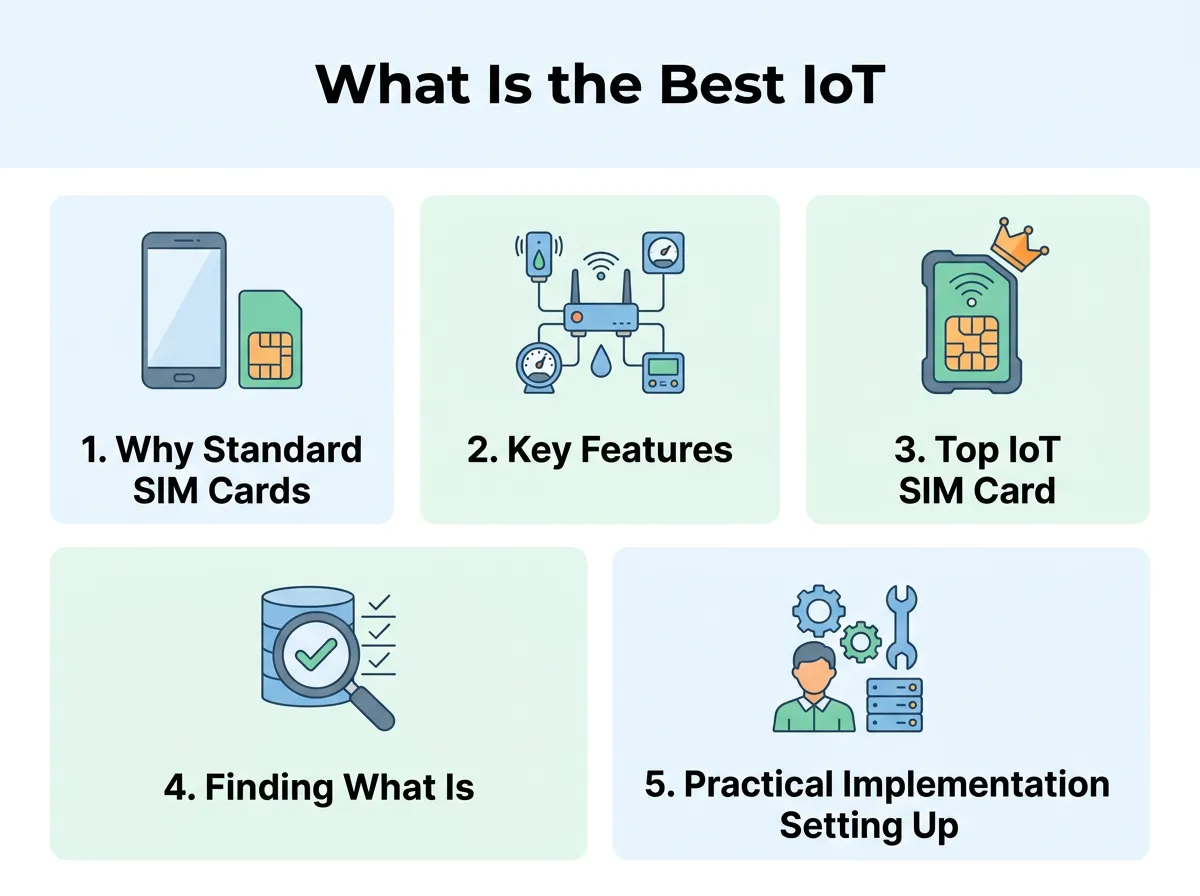
What Is the Best IoT SIM Card in Europe? — key points at a glance
Multi-Network Roaming Capabilities
Europe has dozens of mobile networks. Your devices should be able to connect to all of them. Multi-network roaming allows your SIM to switch between carriers automatically. If Carrier A has a weak signal in a rural area, your device switches to Carrier B. This keeps your uptime close to 100%.
eSIM and eUICC Technology
An eSIM is a chip soldered directly onto your device’s circuit board. eUICC is the software that lets you change network profiles over the air. With this tech, you do not need to swap physical plastic cards when changing carriers. If you want to change providers, you can do it with a click of a button from your office computer. This is a vital feature for growing fleets.
Robust Security with Private APNs and VPNs
Smart devices are frequent targets for hackers. A hacker can access your system through an unsecured cellular connection. Good IoT SIMs use a Private APN (Access Point Name). This creates a secure, private tunnel for your data. You can also use a VPN to encrypt all traffic between your device and your server. Additionally, look for an IMEI lock. This feature binds the SIM card to one physical device. If someone steals the SIM, they cannot use it in another device.
Top IoT SIM Card Providers in Europe Compared
Many companies offer cellular connectivity in Europe. Let us look at three top-rated providers to see how they compare for different business needs.
1oT: The Modern eSIM Pioneer
1oT is based in Estonia, a major European tech hub. They are famous for their modern, user-friendly platform. They offer a single eSIM card that works with multiple networks across Europe. Their platform is very easy to use. You can lock, unlock, and monitor SIMs in seconds. They are perfect for fast-growing startups that need agility.
EMnify: Cloud-Native Global Connectivity
EMnify is a major global player in the IoT space. They offer cloud-native connectivity. This means their system integrates directly with AWS, Azure, and Google Cloud. If your backend infrastructure is in the cloud, EMnify makes secure data routing very simple. They have excellent multi-network coverage across all European countries and offer a pay-as-you-go model.
Olivia IoT: Simple, Transparent Plans
Olivia IoT is great for smaller projects and developers. They offer simple, clear pricing. You do not have to sign long-term contracts. Their web portal is clean and easy to navigate. If you need to test a few devices before scaling up, Olivia IoT is a highly accessible starting point.
Finding What Is the Best IoT SIM Card in Europe for Your Needs
Not all IoT projects are the same. A smart water meter uses very little data. A security camera uses a lot of data. You must choose a plan that fits your specific project profile.
Analyzing Your Data Usage
How much data does your device send? Most IoT devices send small packets of text. They might only need 1 to 5 megabytes (MB) per month. For these devices, look for a low-cost, low-data plan. If you are streaming video or sending photos, you will need a high-data plan. Choosing the wrong tier can lead to wasted money.
Understanding Hidden Fees and Overage Costs
Always read the fine print. Some providers charge low monthly fees but high overage rates. If your device goes over its limit, you could face huge bills. Look for plans that offer pooled data. This lets all your devices share one big bucket of data. If one device uses too much, another device’s unused data covers the difference.
Practical Implementation: Setting Up Your First Device
Once you choose your provider and receive your SIM card, you need to set it up. This process is simple if you follow a few basic steps.
Configuring APN Settings
Every IoT SIM card has a specific APN. You must enter this APN into your device’s network settings. Without it, the device cannot talk to the network. Your provider will give you this name. It is usually a short text string like “iot.sw.apn” or “em”.
Testing Coverage and Latency
Do not deploy hundreds of devices at once. Test a few units in real-world conditions first. Walk around your target area and check how fast the data sends. This speed is called latency. Lower latency means faster communication. Make sure the connection remains stable in basement areas or inside concrete buildings.
The Future of European IoT Connectivity
Technology changes fast. When choosing your provider, you must think about the future of mobile networks.
5G Lightweight (RedCap) and LTE-M
Old 2G and 3G networks are shutting down across Europe. You must choose a SIM that supports newer networks. LTE-M and NB-IoT are perfect for battery-powered devices because they use very little energy. For higher speeds, 5G RedCap is the new standard. Make sure your provider supports these modern technologies so your devices do not go dark in a few years.
Conclusion
Choosing the right connectivity is the foundation of a successful smart project. You need reliable, cross-border coverage and secure data paths. You also need a platform that is easy to manage as your business grows.
So, what is the best IoT SIM card in Europe? The answer depends on your project’s scale and cloud needs. For flexibility and modern software, 1oT and EMnify are outstanding. For simpler, low-risk testing, Olivia IoT is a top choice. Take your time to test different options. Order a few trial SIMs today and see which one keeps your devices connected best.
Frequently Asked Questions
What is the difference between an IoT SIM and a regular SIM card?
IoT SIM cards are built for machines and offer multi-network roaming without steering to a single carrier. They also feature central management portals, pooled data plans, and advanced security like private APNs. Regular SIM cards are made for phones and lack these enterprise-level tools.
Can I use one IoT SIM card across multiple European countries?
Yes, the best IoT SIM cards offer seamless roaming across Europe. They can switch between different national networks automatically without extra roaming charges.
What is an eSIM?
An eSIM is a tiny SIM chip that is soldered directly onto a device’s circuit board during manufacturing. It allows you to download network profiles over the air, eliminating the need to physically swap plastic cards.
What does unsteered roaming mean?
Unsteered roaming means the SIM card will always connect to the strongest available cellular signal. It does not try to force a connection to a specific preferred partner network, which minimizes device downtime.
How much data does an average IoT device use?
Most basic IoT devices, like smart sensors or GPS trackers, use very little data, often between 1 MB and 10 MB per month. High-bandwidth devices like security cameras or media players will require much larger gigabyte plans.
What is a private APN?
A private APN (Access Point Name) is a secure point of entry into a mobile network. It keeps your IoT device traffic completely separated from public internet traffic, protecting your data from hackers.
