


The best SIM card for IoT is a global, multi-network eSIM or eUICC card that offers automatic carrier switching. Unlike standard phone SIMs, top IoT SIM cards provide extreme durability, cloud management platforms, and flexible shared data plans. Selecting the ideal card depends on your device location, power needs, and data usage.
What Is the Best SIM Card for IoT?
Imagine you launch a fleet of smart delivery trucks. Or maybe you set up smart soil sensors across a farm. You expect everything to work well. Suddenly, half of your devices go offline. They cannot connect to the internet. This is a common nightmare for many smart projects. To keep your devices online, you need the right cellular connection. This brings us to a vital question: What Is the Best SIM Card for IoT?
The answer is not as simple as buying a standard phone chip. IoT devices have unique needs. They need to stay connected across long distances. They must work in extreme weather. They also need to run on low power. If you make the wrong choice, your devices will fail, and your costs will skyrocket.
In this guide, we will explore the world of smart connectivity. We will look at different card types, features, and top providers. By the end, you will know exactly how to pick the perfect option for your business.
Key Takeaways
- Global Coverage is Crucial: Look for multi-network IoT SIMs that switch carriers automatically to avoid dead zones.
- Form Factors Matter: Choose between standard plastic cards and soldered eSIMs based on device size and environment.
- Industrial Durability: IoT SIMs offer rugged chips that survive extreme heat, cold, and heavy vibration.
- Central Management: A single platform to track, activate, and pause SIM cards saves time and money.
- Flexible Pricing Plans: Pay-as-you-go and shared data pools prevent high monthly overage fees.
📑 Table of Contents
Understanding IoT SIM Cards vs. Standard SIM Cards
Many people think they can use a normal phone card for their smart devices. This is a big mistake. Phone cards are made for humans. They work well for streaming videos or browsing social media. But they fail when used for machines. Let us look at why they are so different.
Built for Tough Conditions
Standard plastic cards are fragile. They can crack in high heat. They can freeze in cold winter air. If your device is on a bumpy road, vibrations can loosen the card. This breaks the connection. An IoT card is built to survive. These chips use industrial-grade materials. They work in temperatures from minus 40 degrees to over 105 degrees Celsius. They also resist heavy shakes, moisture, and dust.
Multi-Network Capabilities
Your phone usually stays on one carrier network. If that network drops, your phone loses service. This is bad for business. An IoT chip is different. It can connect to multiple networks. If one tower goes down, the chip moves to another tower automatically. This keeps your device online at all times.
IMEI Locking and Security
Carrier networks often block standard SIMs if they detect they are in an IoT device. This is called IMEI locking. IoT SIMs are designed for machines, so they never get blocked. They also offer extra security features like private APNs and fixed IP addresses. This keeps your data safe from hackers.
Key Types and Form Factors of IoT SIMs
Smart devices come in all shapes and sizes. A smart watch needs a tiny chip. A large shipping container can hold a bigger card. That is why there are different shapes, also called form factors. To learn more about these shapes, you can read about the different types and form factors of IoT SIM cards that power modern devices.
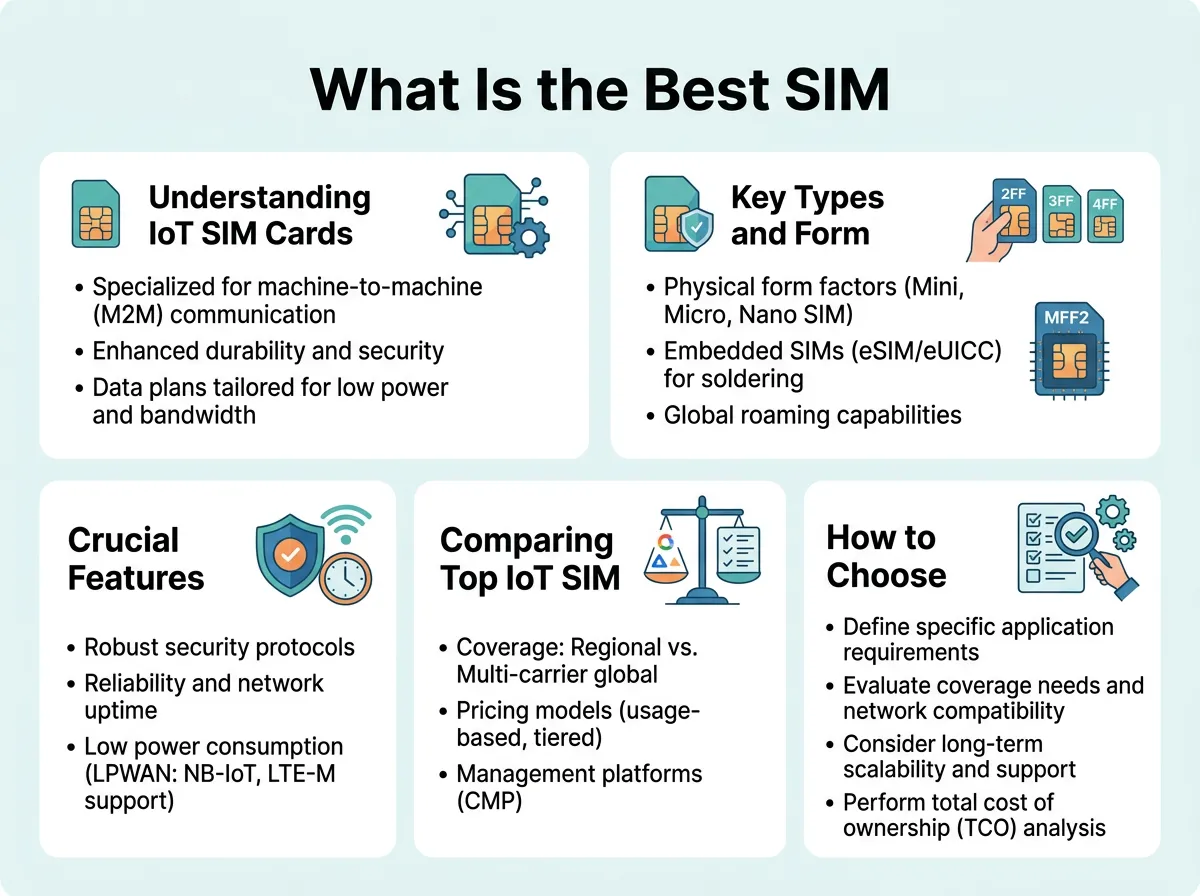
What Is the Best SIM Card for IoT? — key points at a glance
Removable Plastic Cards
These look like the cards in your mobile phone. They come in three sizes. These are Mini (2FF), Micro (3FF), and Nano (4FF). They are easy to slide into a device. However, they can be stolen. They can also wiggle loose over time in moving vehicles.
The Solderable eSIM (MFF2)
The MFF2 is a tiny chip. Engineers solder it directly onto the device circuit board during manufacturing. It is vacuum-sealed. It cannot be stolen, and it cannot shake loose. This is the best choice for rugged environments.
The Power of eUICC
Do not confuse eSIM with eUICC. An eSIM is the physical chip. An eUICC is the software on the chip. It lets you change network profiles over the air. You do not have to swap the physical card if you change carriers. You can change settings with a few clicks on your computer. This makes global scaling very simple.
Crucial Features of the Best SIMs
What makes one chip better than another? When searching for what is the best SIM card for IoT, look for these three key features.
Automated Network Switching
The best cards do not lock you into one carrier. They scan for the strongest signal. If Carrier A has a weak signal, the card switches to Carrier B. This happens in seconds. Your device never loses its link to the cloud. This is vital for moving assets like trucks or trains.
Centralized Management Platform
Imagine managing ten thousand devices by hand. It is impossible. You need a centralized dashboard. This software lets you track data use. You can turn cards on or off. You can also set data limits to avoid high bills. Top options like cloud-native IoT SIM platforms offer these dashboards for free with their plans.
Flexible Billing and Shared Data Pools
Standard phone plans charge you a flat fee per card. This is bad for IoT. Some of your devices might use very little data. Others might use a lot. The best provider lets you pool your data. If you have 100 devices, they all share one big bucket of data. This keeps your monthly costs low and predictable.
Comparing Top IoT SIM Card Providers
There are many providers in the market. Each one claims to be the top choice. Let us break down the best options based on your goals.
Best for Global Scale
If your devices travel across borders, you need global coverage. You do not want to pay high roaming fees. Look for providers that offer a single flat rate for global data. They partner with hundreds of carriers worldwide. This ensures your device works whether it is in New York, London, or Tokyo.
Best for Local and Regional Projects
Sometimes, your project stays in one area. If you only operate in Europe, you do not need global plans. You should look for specialized regional plans. There are excellent best IoT SIM solutions for European markets that offer cheap rates and great local coverage.
Best for Simple, Pay-As-You-Go Pricing
For small projects, avoid complex contracts. You want to pay for what you use. Some companies offer prepaid plans. You buy the card, load it with data, and let it run. To find the right fit, you can compare comprehensive IoT SIM options that cater to small startups and massive corporations alike.
How to Choose the Best SIM for Your Specific Project
There is no single answer to what is the best SIM card for IoT. The right choice depends on your specific project. Here are a few examples to help you decide.
Smart Agriculture and Weather Stations
These devices sit in remote fields. They face rain, wind, heat, and cold. They send small updates once a day. For this, you need an embedded, rugged SIM. It must use low power. It should connect to LPWAN networks like LTE-M or NB-IoT. This keeps the battery alive for years.
Fleet Management and Asset Tracking
These devices travel constantly. They cross state lines or national borders. They need strong global coverage. You should choose an eSIM with multi-network roaming. This ensures the truck is always tracked, even in remote mountain passes.
Medical Devices and Wearables
These devices must work at all times. Lives may depend on them. They are also very small. You need a solderable eSIM. It must have access to multiple tier-one carriers. This guarantees a stable and secure connection.
Conclusion
Finding the right connection is key to your project’s success. It keeps your data flowing and your costs low. So, what is the best SIM card for IoT? The best choice is a card that grows with your business. It should offer multi-network switching, tough physical durability, and an easy management platform.
Do not rush your decision. Test a few cards in the field first. See how they perform in real conditions. With the right cellular partner, your smart devices will stay connected, safe, and efficient for years to come.
Frequently Asked Questions
What is the difference between an IoT SIM and a regular SIM?
An IoT SIM card is built for machines, offering rugged durability to survive extreme temperatures. It also supports multi-network switching and offers central management software, whereas regular SIMs are made for consumer phones and lock to one network.
Can I use a normal SIM card for my IoT device?
While a normal SIM card might work temporarily, carriers will often block it once they detect machine-to-machine traffic. Regular SIMs also lack the durability, multi-network roaming, and data pooling features required for IoT projects.
What does eUICC mean for IoT?
eUICC is a software technology that allows you to change carrier profiles on a SIM card over the air. This means you do not have to physically swap the card when you change network providers, saving significant time and money.
What is the best form factor for outdoor IoT devices?
The MFF2 embedded SIM is the best form factor for outdoor use. Because it is soldered directly onto the circuit board, it is highly resistant to extreme temperatures, water, dust, and heavy vibrations.
Do IoT SIM cards support 5G?
Yes, many modern IoT SIM cards support 5G networks alongside older 4G and LPWAN technologies. This provides the high speeds and low latency required for advanced applications like self-driving cars and video surveillance.
How does billing work for IoT SIM cards?
IoT SIM billing is usually highly flexible, offering pay-as-you-go options or shared data pools. Instead of paying a flat rate per device, you pay for the total data used across your entire fleet of active cards.
