


The best-performing IoT SIM depends on your deployment, but multi-network eSIMs generally offer the highest reliability and performance. By dynamically switching to the strongest local carrier, these SIMs eliminate dead zones and maintain constant uptime. Choosing a global IoT SIM with auto-steering capabilities ensures your devices stay connected across different regions without manual intervention.
Imagine you are running a fleet of delivery trucks. They cross three state lines every single day. Suddenly, half of them stop sending GPS data. You lose track of your cargo. Customers start calling with questions. You feel stressed and frustrated. This nightmare happens when your devices lose their cellular connection. In the world of smart tech, staying online is everything. You need a reliable link. But with so many options, how do you choose? You might ask yourself: Which IoT SIM Offers the Best Performance?
In this guide, we will break down everything you need to know. We will look at network types, SIM formats, and top features. You will learn what makes an IoT SIM reliable and fast. By the end, you will know how to pick the perfect option for your next project.
Key Takeaways
- Multi-Network SIMs Win: They connect to multiple carriers, switching automatically to the strongest signal to prevent downtime.
- eSIM Offers Flexibility: Over-the-air updates let you change carrier profiles without swapping physical cards.
- Latency Matters: Choose providers with localized packet gateways to reduce data travel times and improve response speeds.
- Form Factor Counts: Industrial MFF2 embedded SIMs handle harsh environments, vibration, and extreme heat better than plastic cards.
- Management Platforms: A strong Connectivity Management Platform is vital for tracking data use and real-time performance.
📑 Table of Contents
Key Factors That Drive IoT SIM Performance
Not all SIM cards are made the same way. The card in your phone is different from the one in a smart meter. To find the best option, we must look at what drives real-world success. It comes down to two major things: coverage and speed.
Network Coverage and Carrier Switching
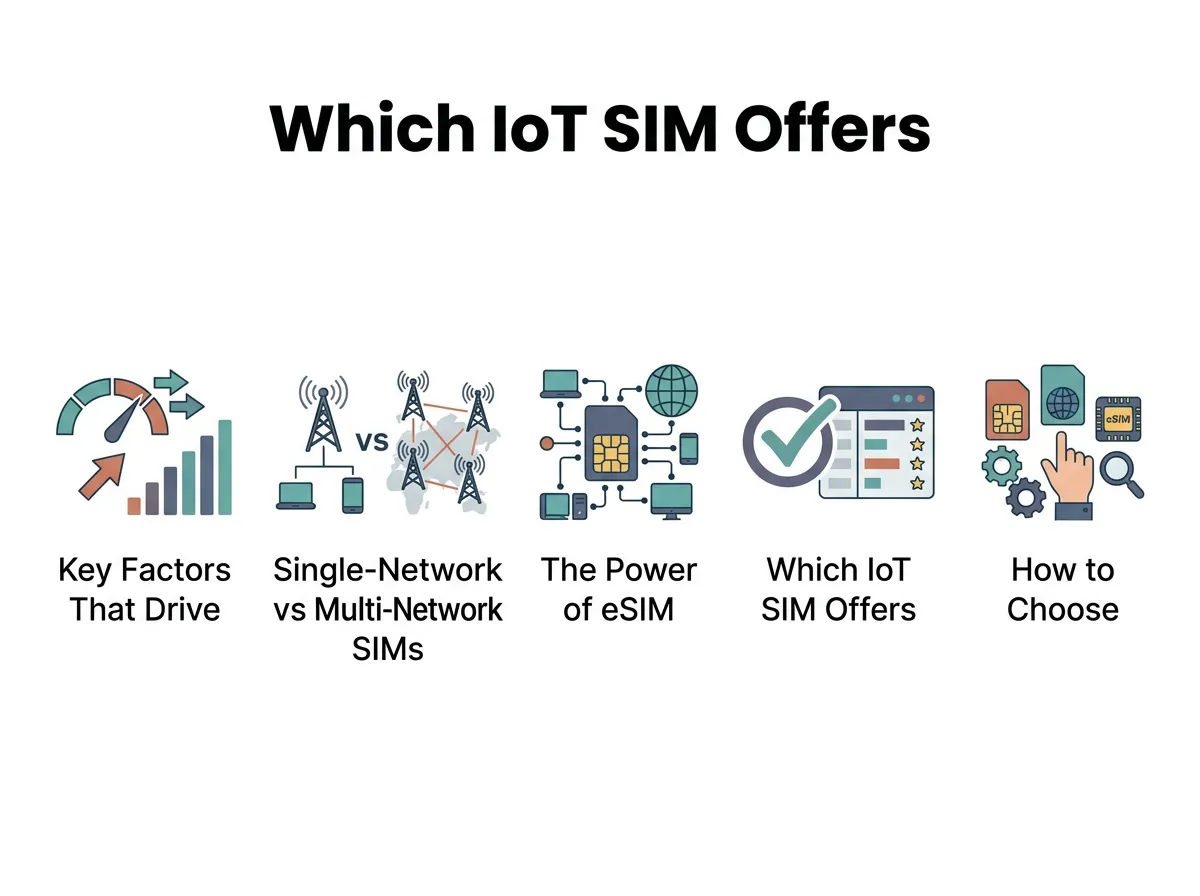
A SIM card is only as good as the network it connects to. If you use a single-carrier SIM, your device relies on one network. What happens if you enter a dead zone? Your device goes offline. High-performance SIMs solve this. They do not lock you into one carrier. Instead, they can connect to many different networks. If one signal drops, the SIM quickly switches to another. This keeps your data flowing without any pause.
Latency and Data Speed
Speed is not just about how fast you can download a file. For IoT, latency is often more important. Latency is the time it takes for data to travel from your device to the cloud and back. For some devices, like smart water meters, a small delay is fine. But for self-driving cars or medical gear, even a tiny delay is dangerous. High-performance SIMs use smart routing to keep latency low. They send data through the closest gateway to save time.
Single-Network vs. Multi-Network SIMs
When you start shopping, you will see two main types of SIMs. Let us compare them so you can see which one fits your needs.
Which IoT SIM Offers the Best Performance? — key points at a glance
Single-network SIMs are simple. They connect to one carrier, like AT&T or Vodafone. They are often cheap. They work well if your devices stay in one city with great coverage. But they have a major flaw. If that one network goes down, your devices go down too. This can cost your business time and money.
If you want to know Which IoT SIM Offers the Best Performance under tough conditions, look at multi-network options. On the other hand, multi-network SIMs connect to many carriers. They switch to the best signal automatically. To find the best options, you can read about top-rated multi-network SIMs to see how they keep devices online. They offer much better uptime. They are perfect for moving assets like trucks, drones, or trains.
The Power of eSIM and eUICC Technology
In the past, changing your network provider meant swapping physical cards. This is a nightmare if you have thousands of devices across the country. eSIM technology changes everything. It uses a special software standard called eUICC.
With eSIM, you can change your carrier profile over the air. You do not need to touch the physical device. If a carrier raises their prices, you can switch to a cheaper one with a few clicks on your computer. When asking Which IoT SIM Offers the Best Performance for large fleets, eSIMs are the clear winner. They save time, reduce truck rolls, and future-proof your business. For a deeper look at the market, you can check out some of the best IoT eSIM providers to compare their features.
Which IoT SIM Offers the Best Performance for Harsh Environments?
IoT devices do not just sit in clean, air-conditioned offices. They live on oil rigs, inside hot engines, and out in freezing weather. Because of this, the physical shape of your SIM card matters just as much as the network software.
Plastic SIM Cards
These are the classic cards you slide into a slot. They come in three sizes: Standard, Micro, and Nano. They are great for indoor devices like smart home hubs. However, they do not do well with vibration. Over time, shake and motion can wiggle the card loose. They can also melt in extreme heat or crack in extreme cold.
Embedded SIMs (MFF2)
These are tiny chips soldered directly onto the device’s circuit board during manufacturing. Because they are soldered down, they cannot wiggle loose. They are highly resistant to vibration, dust, and water. They can also handle extreme temperatures ranging from minus 40 degrees to over 105 degrees Celsius. For industrial use, embedded SIMs offer the best performance and longest lifespan.
How to Choose the Best Provider for Your Needs
Choosing a provider can feel overwhelming. You must look past just the price. You need to think about support, data plans, and platform features. To help you decide, think about these essential considerations for global IoT SIMs before you buy. Ask if they have a clear dashboard. Make sure they offer good customer support when things go wrong.
To find Which IoT SIM Offers the Best Performance for your business, map out your coverage needs first. Do your devices stay in one country, or do they travel across borders? Look for a provider that offers “bootstrap” profiles. This ensures your devices can connect the very first time you turn them on, no matter where they are in the world.
How to Test IoT SIM Performance in the Field
Do not just trust what is written on the box. You should always run a real-world test before you buy thousands of SIM cards. This is called a pilot phase.
Buy a small batch of SIMs from your top choices. Place them in your actual devices. Send them out to the field. This test will show you Which IoT SIM Offers the Best Performance in real-world scenarios. Look at the data. How often did the devices lose connection? How fast did they reconnect? Did they switch carriers smoothly? This data will help you make a smart, confident decision.
Conclusion
Finding the right connection does not have to be a guessing game. While single-network SIMs are cheap, they lack the backup plan that modern businesses need. Multi-network eSIMs offer the best reliability and flexibility for growing fleets. They protect your devices from dead zones and allow you to update carrier profiles over the air. By focusing on these features, you will know Which IoT SIM Offers the Best Performance for your next project and keep your business running smoothly.
Frequently Asked Questions
What is the difference between a standard SIM and an IoT SIM?
Standard SIMs are designed for consumer phones and focus on high-speed data and voice calls. IoT SIMs are built for machines, offering rugged designs, longer lifespans, and flexible multi-network roaming to ensure constant uptime.
Can an IoT SIM card connect to multiple networks?
Yes, many IoT SIMs are designed to connect to multiple networks. They automatically detect and switch to the strongest available cellular carrier in the area to prevent signal drops.
What is an eSIM in IoT?
An eSIM is a SIM card that allows you to update and change carrier profiles over the air without physically swapping the card. This is highly useful for managing large fleets of devices spread across different regions.
Which physical SIM form factor is best for industrial use?
The MFF2 embedded SIM is best for industrial use because it is soldered directly onto the device board. This design protects the SIM from vibration, dust, moisture, and extreme temperatures.
How does latency affect IoT device performance?
Latency is the delay in data transmission; high latency can cause slow response times. For critical applications like health monitoring or self-driving cars, low latency is essential for real-time safety and accuracy.
Why should I avoid using single-network IoT SIMs?
Single-network SIMs rely on one carrier, meaning your device will lose connection if that carrier experience an outage or has poor coverage in the area. Multi-network SIMs avoid this risk by switching to alternative networks automatically.
